
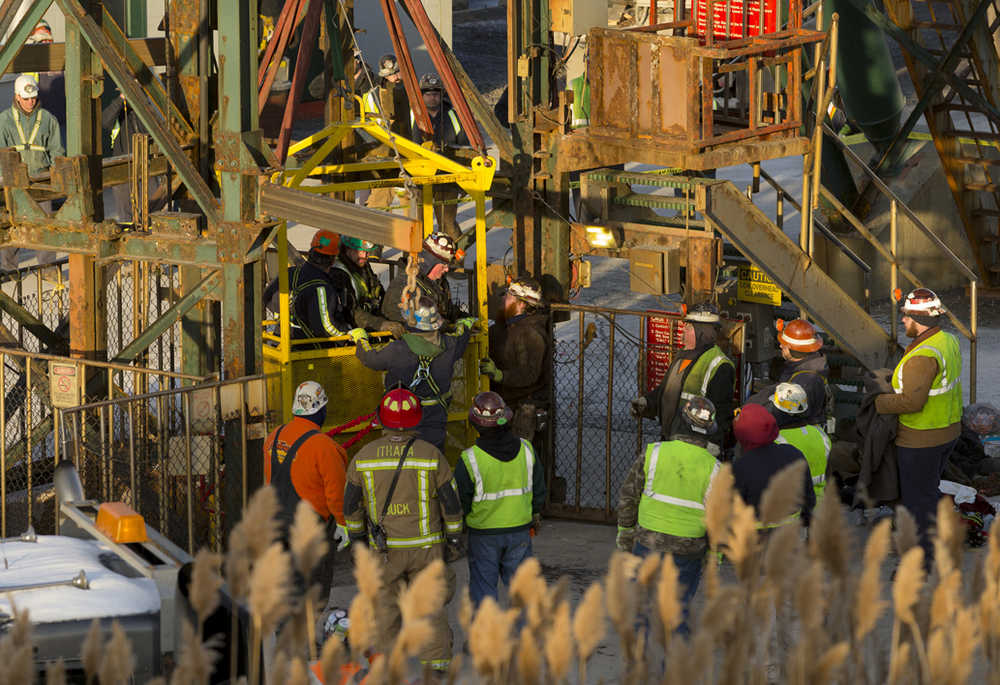
LANSING, N.Y. — Seventeen miners trapped in one of the world’s deepest salt mines were rescued Thursday morning, ending a 10-hour ordeal that began when their elevator broke down 900 feet underground.
The workers were descending to the floor of the 2,300-foot-deep Cayuga Salt Mine — nearly deep enough to fit two Empire State Buildings stacked on top of each other — to start their shift when the elevator malfunctioned at around 10 p.m. Wednesday, said Mark Klein, a spokesman for mine owner Cargill Inc.
With temperatures in the elevator shaft in the teens — the same as the surface — the miners were cold but otherwise unharmed, said Shawn Wilczynski, the mine manager.
“Their spirits are tremendous. I’m inspired by them, to be quite honest with you,” Wilczynski said. “The first four that came out of the mine waited until the last two came out.”
Emergency workers communicated via radio with the miners, who had blankets, heat packs and other supplies lowered to them.
The rescued workers ranged in age from 20 to 60, and their mining experience ranged from a few months to four decades, Wilczynski said.
A crane hoisted the first four to the surface in a basket around 7 a.m. at the mine in Lansing, about 40 miles outside Syracuse. Another four were rescued about 30 minutes later, and seven more were brought to the surface by 8:30 a.m., Klein said. The last two were rescued a few minutes afterward.
Gov. Andrew Cuomo praised the emergency personnel who carried out the rescue, adding that a team of investigators from several state offices will be looking into what caused the miners to become stranded.
The mine, which Klein said is the deepest salt mine in the Western Hemisphere, produces road salt that is shipped throughout the Northeastern United States. The mine is located on the shore of Cayuga Lake and extends beneath its waters.
Minneapolis-based Cargill bought the mine in 1970 and employs 200 workers there, Klein said. The mine processes about 2 million tons of road salt annually, making it one of the biggest producers in the U.S., Cargill said.
Mining operations will be shut down for the rest of the week as company officials and federal mine safety inspectors investigate the malfunctioning, Klein said.
“We want to take a step back, check things out,” he said.
The crane used to rescue the workers had to be brought in by a rigging company in Auburn, 30 miles away.
According to the state Department of Environmental Conservation, a wide swath of upstate New York stretching from the Syracuse area to the western Finger Lakes region is underlain by what’s known as the Salina formation, which contains about 3.9 trillion metric tons of rock salt ranging in depth from 500 feet to 4,000 feet. The Cargill mine is the larger of two salt mines operating in the region. The other is American Rock Salt’s mine, located 35 miles south of Rochester.
New York is the nation’s third-largest producer of rock salt after Louisiana and Texas.
The last serious accident at the mine occurred on the surface in March 2010, when a 150-ton salt bin collapsed, killing a contract truck driver and injuring another man, Klein said. The U.S. Mine Safety and Health Administration later determined a piece of the bin corroded and caused it to give way.
___
Associated Press writer Chris Carola in Albany, New York, contributed to this story.
___
This story has been corrected to show the miners ranged in age from 20 to 60, not 20 to 40.
