
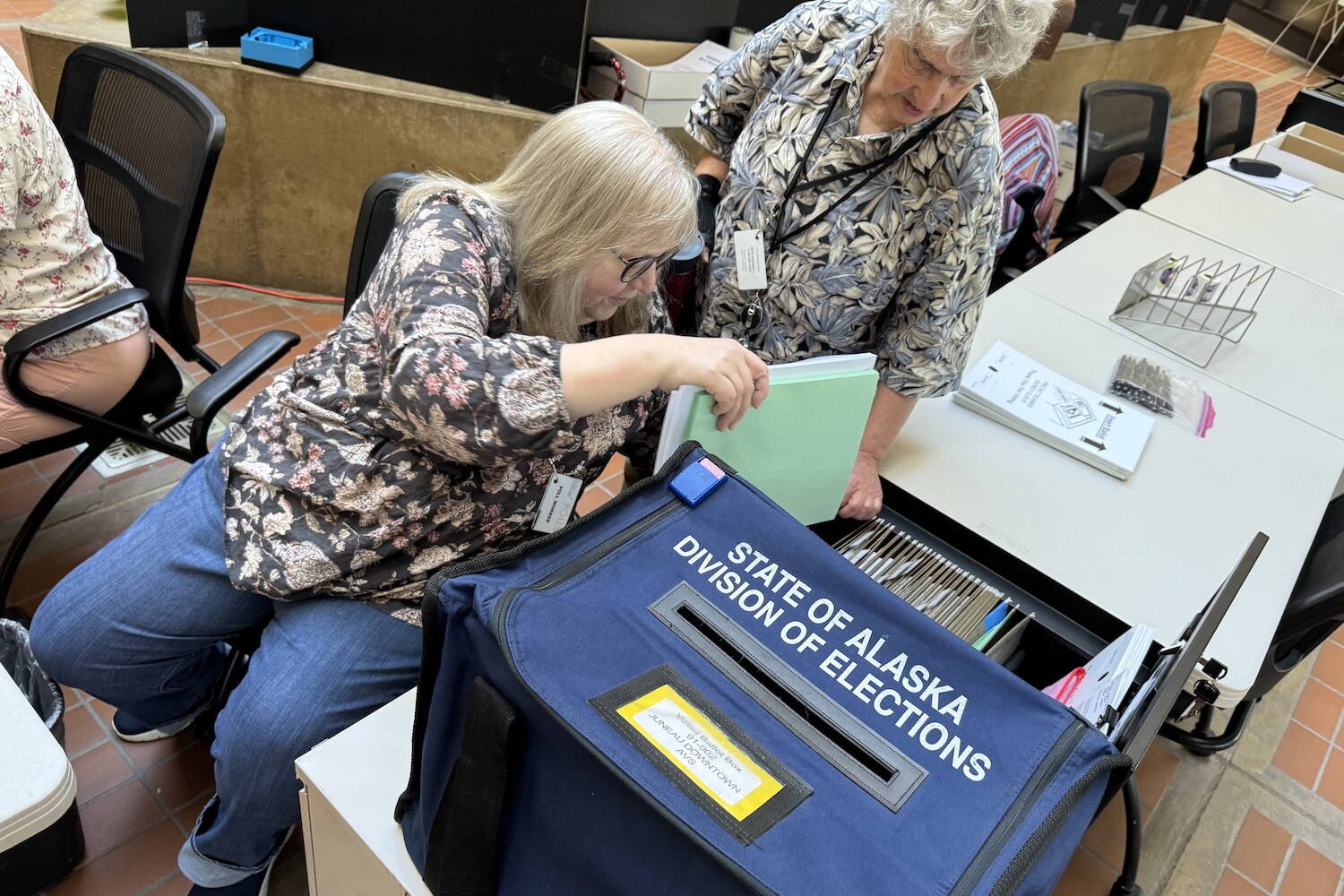
Voter turnout ahead of Alaska’s Aug. 20 primary election is down from the past two elections but is running ahead of what it was in 2018 and 2016, the last two primaries without extraordinary factors in play.
In 2020, the COVID-19 pandemic emergency encouraged Americans to vote by mail, and in 2022, Alaska’s primary election coincided with a special election for the state’s lone U.S. House seat.
Through Thursday, the Alaska Division of Elections had received 12,578 absentee ballot requests through mail, fax or email, according to figures posted on the division’s website. Additional requests are expected in coming days.
Two years ago, Alaskans requested more than 27,000 absentee ballots by mail, fax or email for the primary, and in 2020, the figure was more than 62,000 for the primary.
The Alaska Republican Party, Alaska Democratic Party and the Voter Participation Center have all sent unsolicited absentee ballot request forms to voters, according to the Division of Elections.
Though this year’s requests are lagging behind the past two primary elections, they’re running ahead of the 10,807 that were issued ahead of the 2018 primary or the 10,364 that were issued ahead of the 2016 primary.
Those figures do not include thousands more ballots that were cast at early voting sites or at places with in-person absentee voting.
According to the division, 2,100 Alaskans cast ballots at early voting sites between Aug. 5 and Aug. 7 this year.
In-person absentee voting, used at many rural Alaska voting locations, was disrupted last week by delays that prevented ballots from arriving in time for the Aug. 5 start of early voting.
All polling stations were open by Friday, the Alaska Division of Elections said.
James Boxrud, a spokesperson for the U.S. Postal Service, said on Friday that the agency “is committed to the secure, timely delivery of the nation’s Election Mail.”
“Regarding election materials shipped by the Alaska Division of Elections, we are aware those materials have all been delivered or are available for pickup by local election officials. We continue working closely with state and local election authorities to resolve concerns ahead of the August 20th primary election,” he said by email.
Friday was the deadline for Alaskans to request that an absentee ballot be emailed to them, but voters can request an emailed ballot through Aug. 19.
A ballot must be postmarked on or before Election Day to be counted, and because much of Alaska’s mail is postmarked in either Anchorage or Juneau, voters are encouraged to have their ballot postmarked by hand inside a local post office.
Ballots will be counted if they are appropriately postmarked and arrive no later than 10 days after Election Day.
How Alaska votes
In Alaska’s election system, all candidates for an office, regardless of political party, are placed in the same primary election. Voters pick one candidate, and the four candidates with the most votes advance to the general election.
In the general election, voters are asked to rank the candidates in order of preference, one through four, with a fifth option for a write-in, if wanted.
If a candidate receives more than half of the first-preference votes, they win.
If no one receives more than half of the first-preference votes, the lowest finisher is eliminated, and voters who picked that candidate have their votes go for their second preference.
The elimination process continues until one candidate has more than half of the remaining votes.
Presidential elections do not have a top-four primary. Voters in November may be asked to rank more than four candidates for president.
• James Brooks is a longtime Alaska reporter, having previously worked at the Anchorage Daily News, Juneau Empire, Kodiak Mirror and Fairbanks Daily News-Miner. This article originally appeared online at alaskabeacon.com. Alaska Beacon, an affiliate of States Newsroom, is an independent, nonpartisan news organization focused on connecting Alaskans to their state government.
