
Clarification: This article has been updated to mention that the University of Alaska Southeast coordinated and organized the Tléix’ Yaakw (One Canoe) conference.
Just a few steps into the woods, everything changes.
On the rocky beach at Berners Bay, clumps of seaweed dried in the sun as people chatted and the engine from the catamaran was still audible. But stepping into the quiet, cool shade of the spruce trees was like stepping back in time.
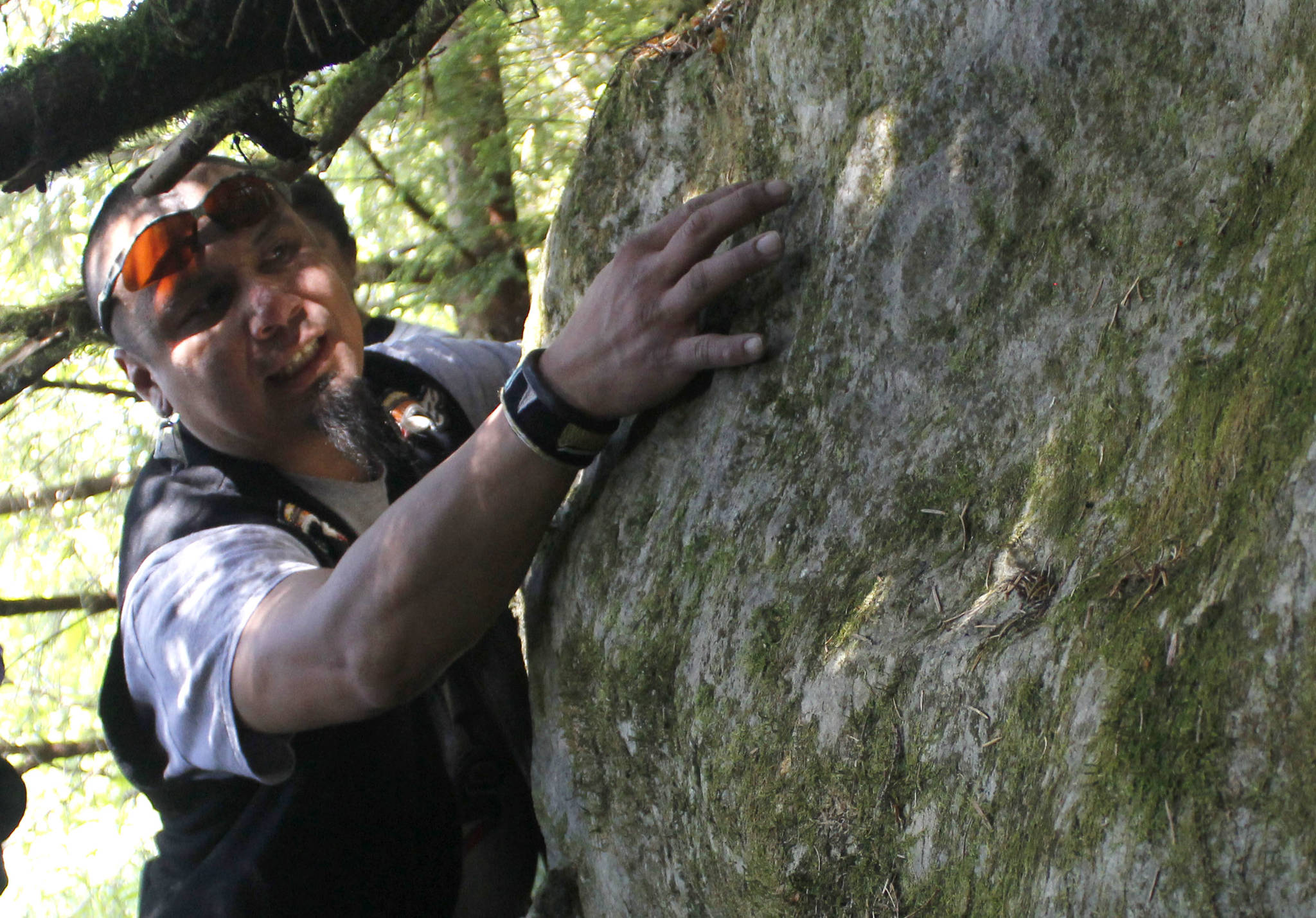
Petroglyphs — carvings in the rocks that were made at least hundreds of years ago — are still visible. They’re a bit faded and lined with moss and lichen, but the shape of a face is distinguishable on one stone as the shape of a swirl is visible on another.
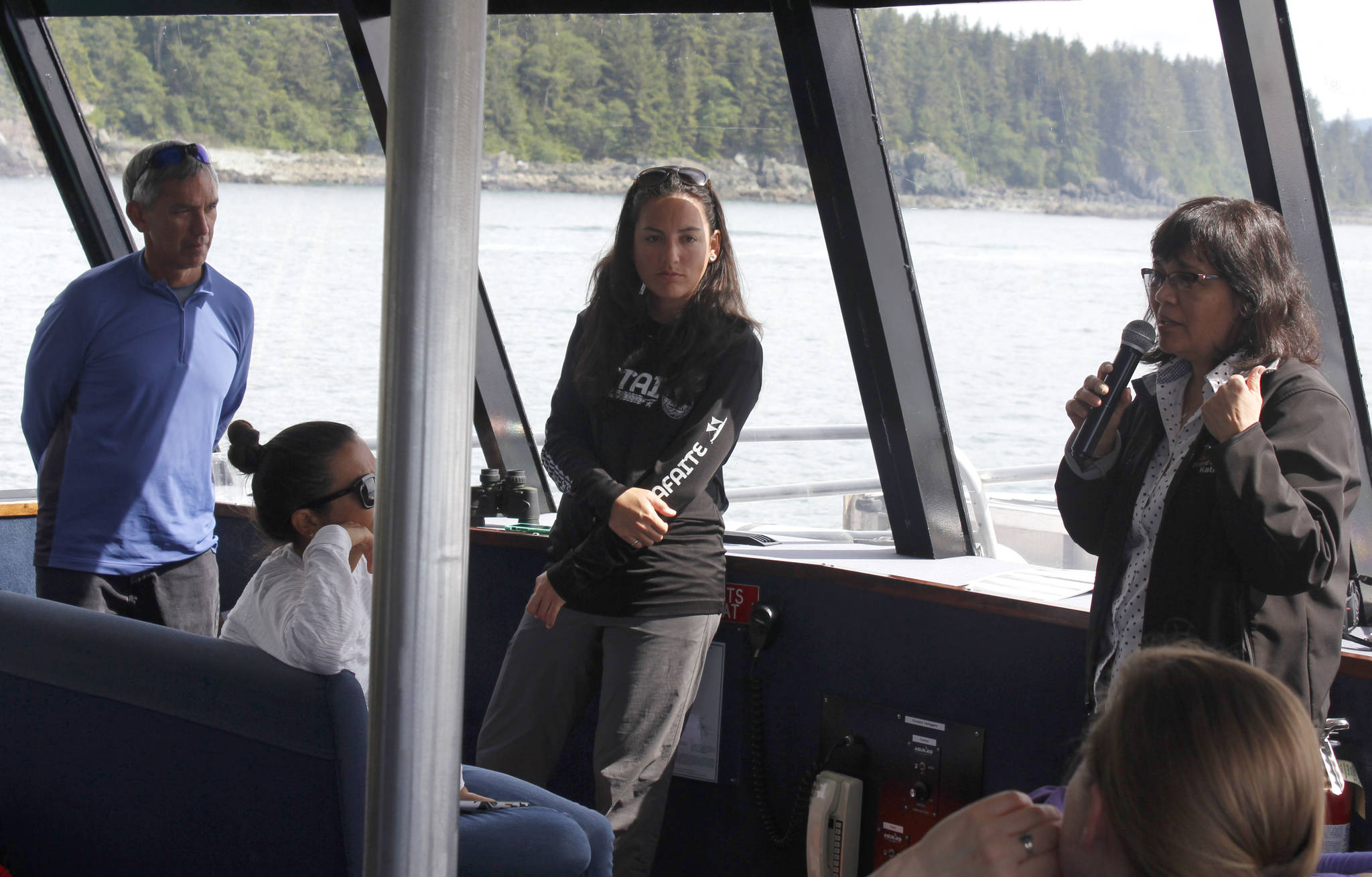
The people who were passing by the stones this Sunday were here as members of a new convention entitled Tléix’ Yaakw (One Canoe), which brings together Alaska Native leaders with Native Hawaiian leaders to explore their common ground and delving into solutions to preserving nature and indigenous languages. The University of Alaska Southeast organized and coordinated the conference.
Those from Hawaii’s Polynesian Voyaging Society, including Lehua Kamalu, saw the generations-old petroglyphs and, as she put it, broke out in “chicken skin,” or goosebumps.
“You can almost feel as if you were walking in the same way that those people who were here first had experienced it,” Kamalu said.
Kamalu said there are similar etchings in places in Hawaii, but towns and buildings have impeded on many sacred areas. She said seeing the way Alaska preserves and honors its historic sites sets an example for them in terms of keeping culture alive.
Nainoa Thompson, the president of the Polynesian Voyaging Society, took it a step further. He spoke about the fact that climate change is affecting people from the Arctic to the Equator, and that the way Alaskans care for their natural resources can set an example not only for Hawaiians but for people around the world.
“We’re all reaching and stretching in a very fearful way about what the future’s going to be like as we grow our population and deplete our natural resources,” Thompson said. “Alaska’s the school, it’s the stronghold of doing things right.”
Sunday’s excursion to Berners Bay to see the petroglyphs was one aspect of the whole conference, which includes speeches, trips to sacred Alaska Native sites and brainstorming sessions. Thompson said he hopes this conference, which runs from this past Saturday to Wednesday, becomes a “moment we’ll remember” when the two groups took action — in preserving the environment, culture and language of their peoples — for the sake of future generations.
Midway through the time when the passengers of the Allen Marine catamaran were exploring the woods, Lt. Gov. Byron Mallott arrived, driving a small motorboat. He spoke with a few guests, finding time to take in the area’s beauty and even skip stones into the water.
More than two decades ago, Mallott was a key figure in uniting Alaska Natives of Southeast together with the Polynesian Voyaging Society. In 1989, Thompson and the organization undertook an ambitious endeavor, looking to reconstruct a double-hulled canoe in traditional native fashion. They named the vessel Hawai’iloa, a voyager of legend who is credited with the discovery of Hawaii.
They were struggling to find logs in Hawaii that were large enough for the hulls, according to the Hawai’iloa website, due to forestry and cattle grazing. Fortunately, Thompson was able to connect with Mallott, who was then the CEO of the Sealaska Corporation, through mutual friends. Mallott helped coordinate the use of Sitka spruce logs for the hull of the vessel.
During Sunday’s excursion, Thompson called the collaboration between the two organizations “a beautiful story.” He reiterated the point that people elsewhere can learn from the way Alaskans have taken care of their natural resources.
This song welcomed visitors to a sacred location at Berners Bay, north of #Juneau. Who were they welcoming and why? Find out more in tomorrow’s @JuneauEmpire. pic.twitter.com/bmGIT7ocip
— Alex McCarthy (@akmccarthy) June 4, 2018
The harmony between the people and the wildlife in the area was a theme of the excursion. As Tlingit elder David Katzeek was telling stories to the group on the way out to Berners Bay, killer whales were spotted near the boat. He stopped his storytelling and began to sing to the whales. One of them leapt out of the water soon after Katzeek stopped singing.
“They’re dancing for us,” Katzeek said. “I should probably sing again.”
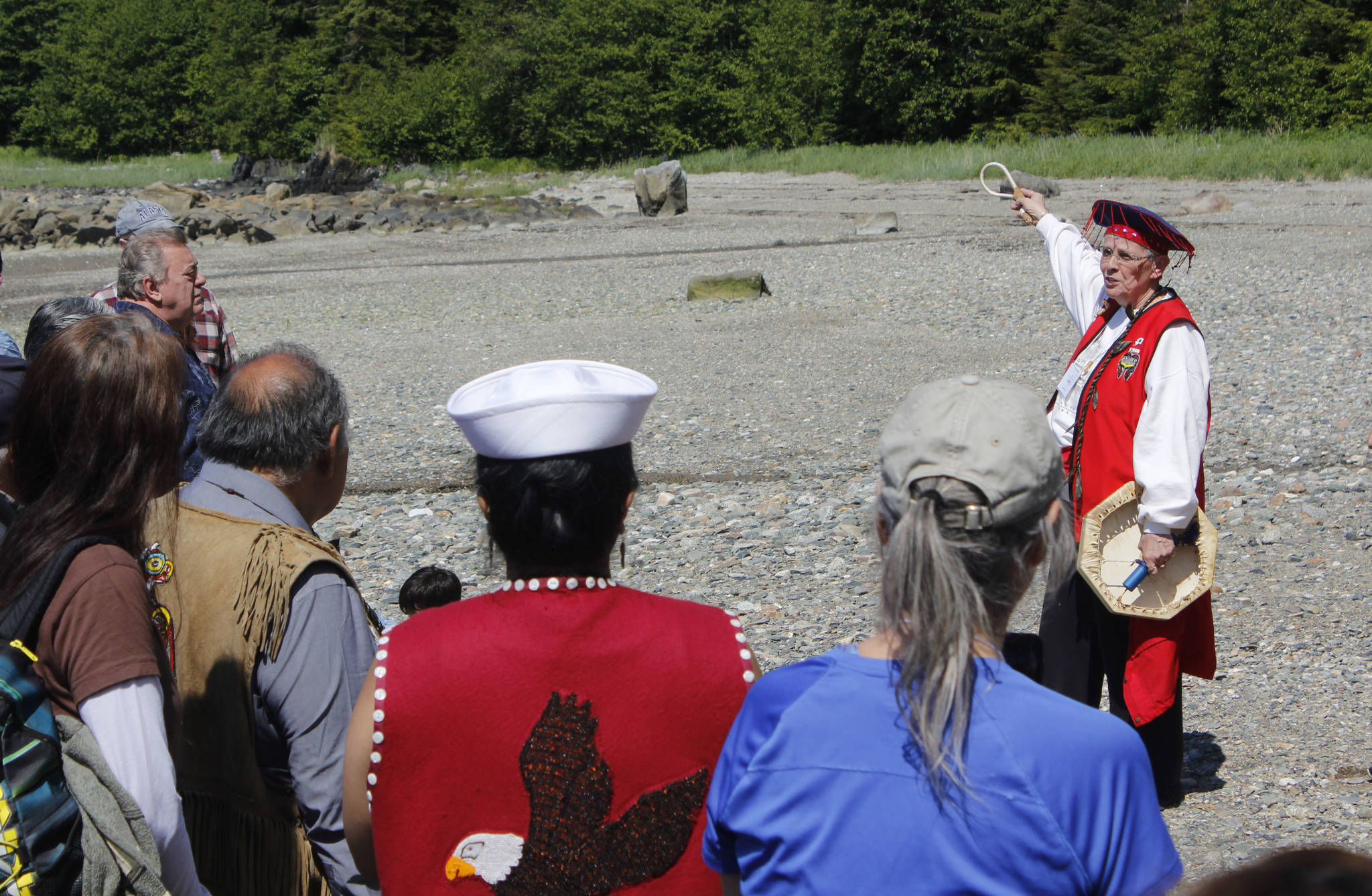
Another such moment happened as people disembarked the catamaran onto the beach. Tlingit leader Fran Houston was among the first to come ashore, and said she immediately asked the ancestors of the area (as the beach used to be the site of a village) for permission to be there.
“I got my answer,” Houston told the group, pointing toward a tall spruce to the north of the beach. “There are two eagles at the top of that tree.”
They were watching over the group, Houston said. The eagles sat there for the next hour or so, flying away just before the group got back onto the catamaran. On the beach, Houston led a song to welcome the visitors to the area — a song entitled Cha Dat Sa, the meaning of which she declined to share. The Hawaiian visitors also sang a song, Thompson said, called Ahu Nua traditionally used to ask permission.
These instances, as well as the maintained petroglyphs and efforts to revitalize the Lingit language, have stuck with Thompson during his visits to Alaska since the 1990s, he said.
“I wish that we can make more and more people around the world see the stories of Alaska, because this is an important school,” Thompson said. “This is more important of a school for the earth than Alaska’s ever been.”
• Contact reporter Alex McCarthy at 523-2271 or amccarthy@juneauempire.com. Follow him on Twitter at @akmccarthy.
233;ix&
700; Yaakw (One Canoe) conference. (Alex McCarthy | Juneau Empire)
