Alaska unions clobbered by Supreme Court decision
Published 4:34 pm Wednesday, June 27, 2018
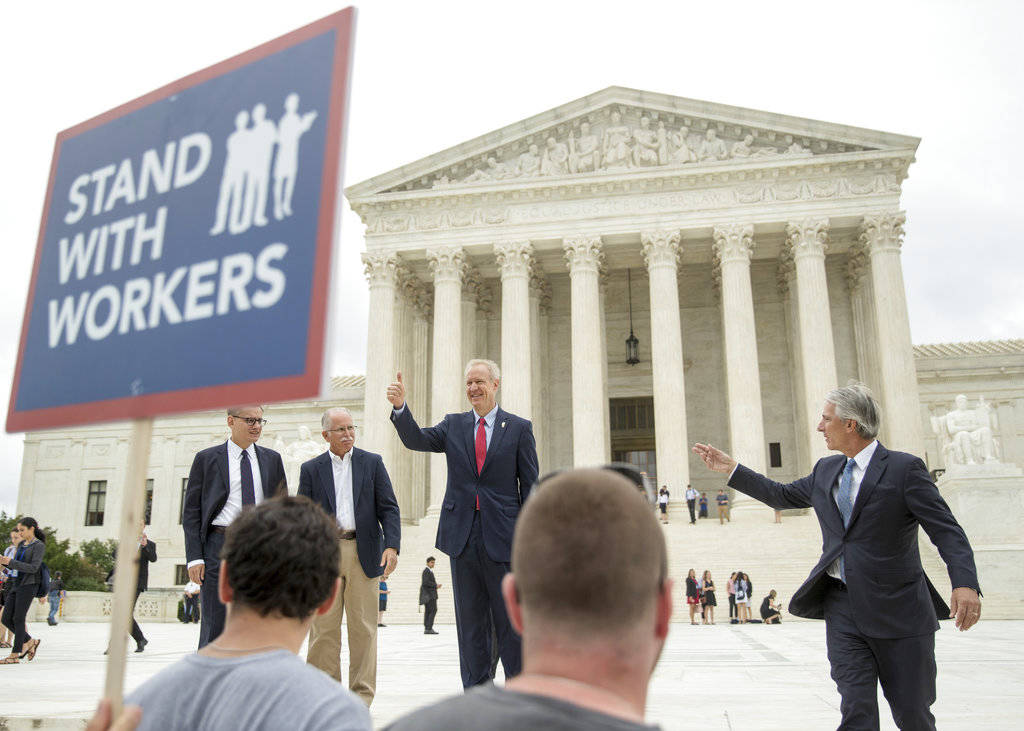
Alaska’s public-sector unions warned Wednesday that a new ruling by the U.S. Supreme Court will have significant effects across the state.
The 5-4 ruling in Janus v. AFSCME means thousands of Alaskans will no longer be required to financially contribute to unions that represent them. The decision is likely to weaken the financial spine of unions that argue on behalf of workers and against corporate interests.
“If they’re not a member, they don’t have to pay. We still have to represent them,” explained Jake Metcalfe, director of the Alaska State Employees Association.
Wednesday’s decision rested on one key question: Should government employees represented by unions and who benefit from union contracts be required to pay a fee?
Most states have laws prohibiting those fees, but they are allowed in Alaska, which has one of the highest unionization rates in the country. According to Bureau of Labor Statistics figures released in January, 19.4 percent of Alaska’s workers, or about 59,000 of the state’s 297,000 workers, are represented by a union.
Of those 59,000, just 55,000 are union members. The difference, about 4,000, represents the people who instead pay mandatory fees instead of union dues and are affected by Wednesday’s Supreme Court ruling.
About half of those 4,000 people are members of unions represented by the National Education Association-Alaska, which represents approximately 13,000 people statewide.
About 10-15 percent of those people are merely represented by unions, not actual members, said Tim Parker, executive director of NEA-Alaska.
In Juneau, the vast majority of union members pay dues; he believes only one or two of the more than 600 Juneau Education Association members pay fees instead.
Parker, who was reached by phone as he boarded a flight to Minnesota, did not have exact figures available.
“Starting today, with that (ruling), you’re either a member or not a member,” he said.
His union, and others, will no longer be allowed to collect a fee to represent non-members. He said his organization is already taking technical steps to implement the ruling, and it has been talking to members for more than two years now as the case has advanced through the federal courts.
“We’ve been definitely talking to people maybe more than we did, knowing this was coming,” he said.
He worries that members might leave the union, knowing they can get union benefits without paying a fee. In the worst-case scenario, membership drops precipitously and teaching becomes “deprofessionalized,” with even higher teacher turnover.
NEA-Alaska has been promoting union membership to avoid that scenario, and is reminding members that they can’t vote on labor agreements if they’re not members.
Metcalfe, of the ASEA, said his organization has been making similar efforts. According to his figures, the ASEA (whose parent organization is the same AFSCME that lost Wednesday’s decision) has between 7,800 and 7,900 members, with “8-10 percent” paying fees instead of membership dues.
“We’re going to do everything we can to get these agency fee payers back,” he said. “We intend to go out and tell them it’s to their benefit to be a member of this organization.”
At the Alaska Public Employees Association, which represents about 2,100 supervisors statewide, business manager Pete Ford said he believes between 7-12 percent of members pay fees instead of dues.
“We’re probably in better shape than we were several years ago, but this is still going to have an impact on us,” he said. “The proportionality of our funding is going to be out of skew, and it’s going to cause us to look harder at what we do.”
The Janus case has two faces, labor organizers said. There’s the legal arguments, and then there are the political ones, which President Donald Trump pointed out on Twitter.
“Big loss for the coffers of the Democrats!” Trump said in a tweet.
Wednesday’s 5-4 decision was made possible after the Republican-controlled U.S. Senate refused to consider a Supreme Court nomination made by President Barack Obama. After Trump’s election, he appointed a justice, Neil Gorsuch, who voted with the majority on the Janus case.
Unions have traditionally backed Democratic candidates both in Alaska and nationwide.
“This court … took advantage of stealing a Supreme Court seat to make a complete political decision,” Metcalfe said. “For 40 years, the law stood, then politically they got the fifth vote and they overturned 40 years of precedent without a reason other than a political reason.”
The conservative nonprofit Freedom Foundation, financially backed by the Koch Brothers, has already deployed organizers to western states, including Alaska, in an attempt to deter former fee payers from joining unions.
Metcalfe, however, said Alaskans should keep fighting for the right to organize.
“They can change the rules, they can be unfair, but that’s the reason unions are around. When people are treated unfairly, they unite,” Metcalfe said.
• Contact reporter James Brooks at jbrooks@juneauempire.com or 523-2258.