

Alaska ranks near the bottom of states in reading and math scores in the “Nation’s Report Card” for this year published Wednesday, provoking a battle between Republican Gov. Mike Dunleavy who says it reflects the state’s failed school system and political foes saying it reflects a huge loss of real-world funding for education the past 15 years.
Alaska ranked 51st of 53 U.S. jurisdictions in reading and math among fourth graders, and in reading among eighth graders, and 47th of 53 in eighth-grade math, according to the National Assessment of Education Progress (NAEP). Nationally the results show most students scoring lower than before the COVID-19 pandemic, and gaps between the highest and lowest performers are widening to historic margins.
The results for Alaska generally show scores dropping compared to the national average since at least 2011 — which education advocates say is when state funding increases largely stopped — but some scores also were dropping leading up to that year.
To a large extent the scores simply add ammunition to battle lines already drawn in the debate about Alaska’s education funding and policy.
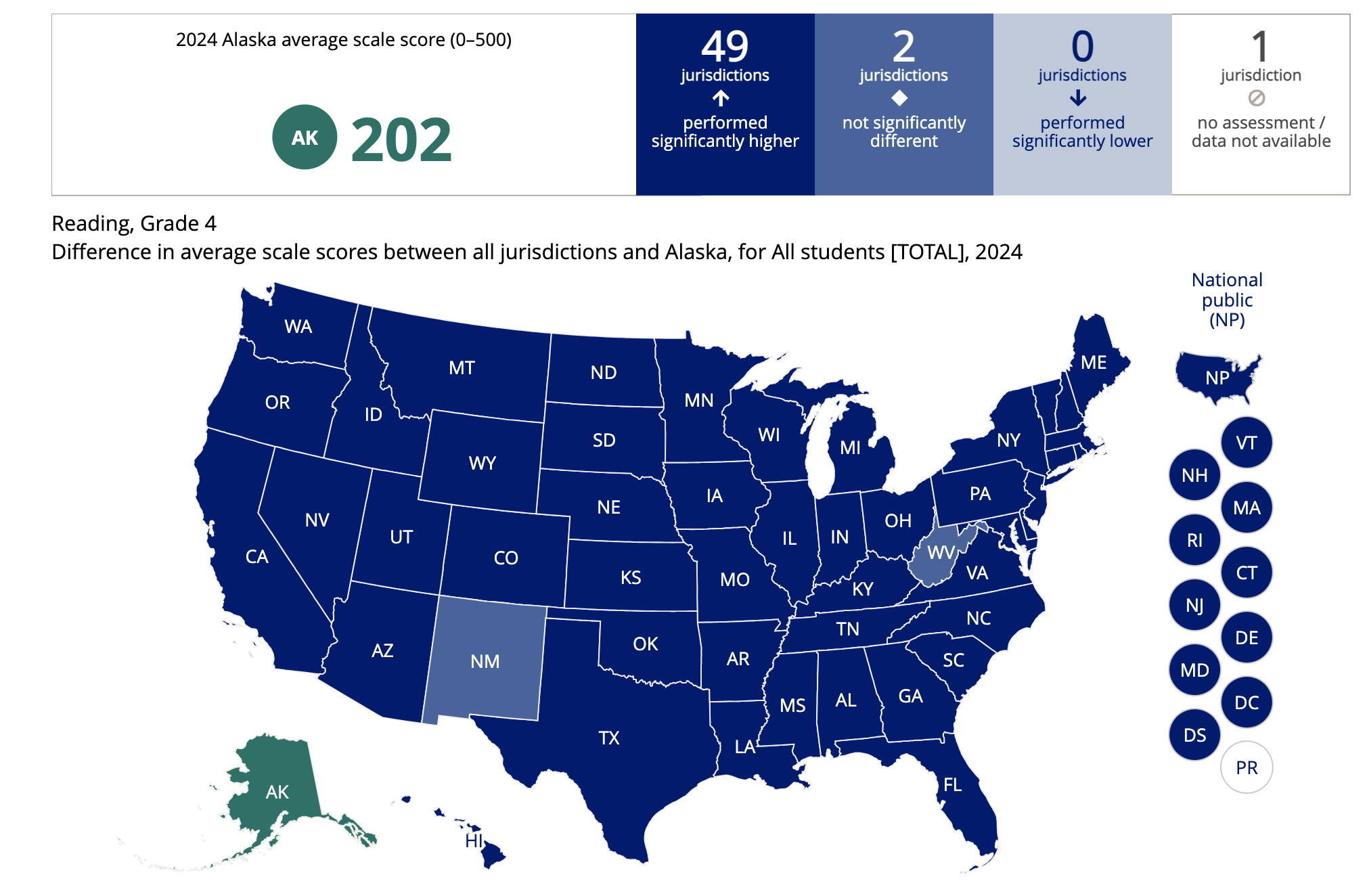
Fourth-grade reading scores in Alaska are shown as near the bottom among states in the U.S. the most recent report by the National Assessment of Education Progress released on Wednesday. (NAEP report chart)
The Dunleavy administration issued a press release Wednesday afternoon stating the latest scores justify the governor’s push for the Alaska Legislature to support policy changes such as more support for charter and homeschools.
“Alaska’s education system isn’t working for many students,” Dunleavy said in a prepared statement. “Just pumping more money into it won’t cause it to fix itself. We must continue to implement education reforms that restore Alaska’s public education system to one that works for Alaskan families.”
The basic counterargument of many lawmakers and educators remains simple: schools can’t perform well if they’re being starved of funds over many years.
“If you look back at 2011 we were one to two percentage points away from that baseline,” Sen. Löki Tobin, an Anchorage Democrat who chairs the Senate Education Committee, said in an interview Wednesday. “Now we’re eight to nine percentage points away from that baseline. So although we have not necessarily always met the baseline we haven’t been so broadly away from it as we are today.”
Similar arguments were made about the nationwide results.
“Public school advocates argue that more support is needed for schools and their students, while conservatives argue there’s too little to show for $190 billion in covid relief money,” the Washington Post reported.
The gap between Alaska and other states isn’t as straightforward during those years as Tobin suggests, since in some instances the difference began increasing prior to 2011 and there are years where the gap narrowed rather than grew. But there are other indicators — notably the test scores themselves on a scale from zero to 500 — that indicate a link to education funding.
Eighth-grade math saw a straight-line decline from 283 in 2011 to 264 in 2024, and eighth-grade reading a straight decline from 261 in 2011 to 246 in 2024. Fourth-grade math scores in Alaska, which hovered between 236 and 237 from 2005 to 2015, dropped to 226 as of 2024. Fourth-grade reading scores saw an unevenly paced drop from 208 in 2011 to 202 in 2024.
The Dunleavy administration in its press release also contains a reference suggesting funding could affect scores, noting the results “do not reflect students who have completed the early-learning reading program required by the 2022 Alaska Reads Act.” The act intended to boost K-3 reading, meaning no fourth-grade students in the test results have participated all of those years, resulted in a small increase in per-student funding as well as grant funding — although Dunleavy vetoed more than $5 million in the budget for the current year to further boost that program.
“This law was passed with the stated goal of improving early literacy, yet the administration provided very limited dedicated funding for its proper implementation,” Lisa Parady, executive director of The Alaska Council of School Administrators, stated in an email Wednesday. “Districts already stretched to the breaking point simply do not have the resources to effectively implement the Act’s requirements. Without the funding needed to support students and educators in early literacy efforts, this mandate becomes yet another burden rather than a tool for progress. Even so, districts are doing everything they can to implement it and students are beginning to see growth across the state. Imagine what could be done if the Reads Act was well funded.”
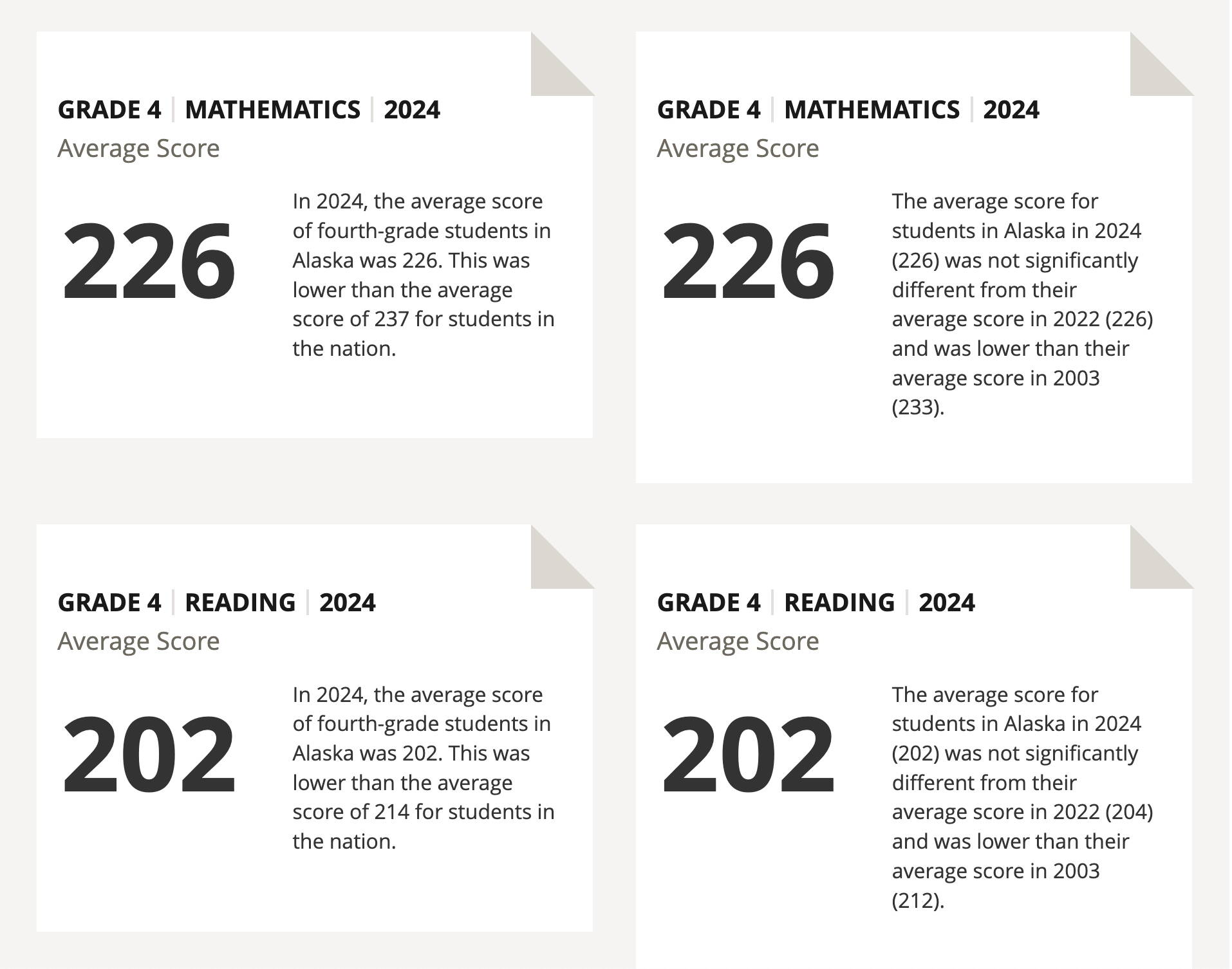
Test score results for fourth- and eighth-grade students in Alaska are summarized in a National Assessment of Education Progress report released on Wednesday. (NAEP report chart)
The administration’s press release also noted “these scores and rank do not reflect 18% of Alaskan students enrolled in correspondence learning.” However, other lawmakers and education officials have emphasized data for such schools is either absent or insufficient for comparison due to the fewer number of students involved, as well as other factors such as socioeconomic statuses that may differ from the general population.
“Correspondence schools — a public school choice — are not subject to the same assessment requirements,” Parady wrote. “This means we have limited statewide data on how these students are performing compared to those in neighborhood schools.”
Dunleavy, in his State of the State address on Tuesday night, continued to cite a 2023 Harvard study that ranks Alaska’s charter schools as the best in the U.S., using it as an argument that the method of education rather than funding is the key to improving results. However, study author Paul Peterson told legislators he is puzzled by the results — which cover a pre-pandemic period from 2009 to 2018 — and two authors of an analysis published earlier this month are arguing the Harvard study isn’t declaring “Alaskan charter schools (are) more effective than neighborhood schools.”
“Peterson did not compare charter and neighborhood schools, but simply compared charter schools across the country,” notes the report by Beth Zirbes, a Fairbanks math and statistics teacher, and Mike Bronson, a member of the NAACP Anchorage Education Committee who authored a study last year related to education funding and test scores. “We find that, after accounting for students’ socioeconomic status, the charter schools and neighborhood schools in Alaska communities which had charter schools at the time of the Peterson study do not statistically differ in the percentage of their students scoring proficient in the English language arts standards. We find instead that proficiency declines as family income declines.”
“Interestingly, when it comes to their high proportions of students with white skin color and higher family income, Alaska charter school student bodies look like private schools in the Lower 48 states more than they resemble charter school students in the Lower 48. Nevertheless, a majority of Alaska charter students assessed in 2024 fell below state standards.”
Peterson, in response to the summary, stated in an email “among states with charter schools, our study shows that low income students who attend charter schools in Alaska score higher in math and reading tests than students attending charter schools in any other state. Nothing in the statement you shared with me contradicts that finding.”
Tobin said Alaska’s traditional public high schools typically have graduation rates of more than 90%, while many of the state’s charter schools are significantly lower — citing specifically recently reported 57% rate for Raven Correspondence School in Fairbanks.
“That, to me, is a very scary accountability measure that we should be spending more time and attention on because students we know who do not graduate high school are more likely to engage in the juvenile justice system,” she said. “They’re more likely to need assistance and support from our social safety net. They’re more likely to not pursue advanced education, and that creates another consequence to the state budget when it comes to how do we support and encourage our citizens to be contributing members of our communities.”
The Dunleavy administration did not respond to inquiries by the Empire about the report challenging the Harvard study.
Tobin said a key consideration when assessing test results is “NAEP doesn’t test the same students each cycle. So if you’ve taken the NAEP in fourth grade, there is no guarantee you will take it in eighth grade, so it doesn’t map progress.” Also, she noted, Alaska is different than other states due to the number of communities where reading and other learning occurs in Indigenous languages, plus “here in Alaska we are experiencing a significant influx of refugees and some other populations, and we don’t know if that’s part of the most recent test scores as well.”
Education funding is again a top priority of the legislative session, with the Democratic-led bipartisan House majority giving quick hearings to a bill that would increase the Base Student Allocation more than 20% next year and a total of 40% over three years. Dunleavy’s proposed budget for next year contains no increase to the statutory BSA of $5,960 — meaning funding to districts would drop since a one-time increase of $680 is in effect this year — but has said he is willing to consider a permanent increase in exchange for some of his policy goals being implemented.
• Contact Mark Sabbatini at mark.sabbatini@juneauempire.com or (907) 957-2306.
