
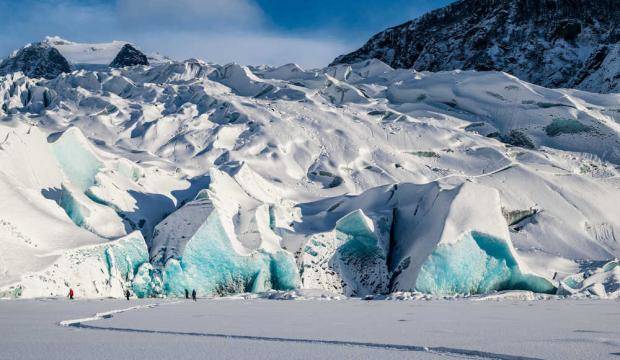
You don’t have to look far to see the effects of climate change in Alaska. Permafrost melts, ocean waters acidify and eroding shorelines threaten coastal Native villages. The state is warming at twice the rate of the rest of the U.S.
The Last Frontier lies on the front lines in the battle against the effects of climate change.
But the state still lacks a comprehensive plan to address climate issues. A draft document released last week could be the first step toward a state-level climate policy. The Climate Action Leadership Team, formed by Gov. Bill Walker, released the seven-page document May 9.
It’s bold. The plan calls for a 30 percent reduction in greenhouse gas emissions and a 15 percent increase in energy efficiency by 2025. It recommends a switch to 50 percent renewable electricity sources by that same year.
It also calls for carbon pricing, a market-based method for reducing greenhouse gas emissions which puts a price on carbon emissions. The provision which could face push back from the state’s large oil and gas industry.
The plan still has much revision to undergo, but it would be the basis upon which future climate legislation could be developed. Former Fairbanks mayor and CALT member Luke Hopkins said by phone Wednesday that the team sought to address a tough issue with tough solutions. The group didn’t concern itself with what was politically salable or not.
“Whether we get there or not, we need to be bold with our plan,” Hopkins said.
The plan is the product of half a year’s work from the 20-person CALT team. The public can weigh in on it before June 4 and the CALT team will make further revisions before it’s sent to the governor, who will use the recommendations to guide policy or recommend the group go back to the drawing board.
The push toward state climate policies has been spurred partly by a lack of climate change action on the federal level. Twenty states and the District of Columbia have adopted clear greenhouse gas emissions goals, according to the Center for Climate and Energy Solutions.
Doug Vine, a senior energy fellow there, said states vary in how they approach climate policy. But there are some similarities. Many states have called for increases in renewable energy use and many have focused their initial efforts in electricity generation, a large greenhouse gas emitter in many states, Vine said. Once renewable electricity sources are in place, states will move on to reducing greenhouse gas emissions tied to transportation and other sources.
“There have been various approaches that have been taken. Some are very targeted and some are sectorially targeted,” Vine said.
Alaska’s proposed 30 percent emissions reduction by 2025 falls roughly in line with states like California and New York, which are calling for a 40 percent reduction by 2030, Vine said. California and New York are considered leaders in state-level climate policy, but transportation emits the most greenhouse gases in those states, according to the U.S. Energy Information Administration. In Alaska, it’s industry, much of it connected to oil and gas production.
That makes the emissions reductions a harder sell politically. The Alaska Oil and Gas Association reviewed the draft plan at a meeting this week, Hopkins said, but wasn’t immediately available for comment for this article. The industry has representation on the CALT team in BP Alaska President Janet Weiss.
Speaking at a talk on climate policy Tuesday in Washington D.C., Lt. Gov. Byron Mallott said Alaska must envision a post-oil future “by way of necessity:” revenue streams from fossil fuels when Mallott assumed office were 80-90 percent dependent on oil.
By the time those revenue sources run out, “We must have in place the end state that we seek,” Mallott said. “In the meantime, we should be investing and invigorating every possible way to increase non-fossil fuel energy capacity.”
In 2007, then-Gov. Sarah Palin established a group similar to CALT in Alaska’s Climate Change Sub-Cabinet. That group went dormant under Gov. Sean Parnell.
• Contact reporter Kevin Gullufsen at 523-2228 and kgullufsen@juneauempire.com. Follow him on Twitter at @KevinGullufsen.
