
The Alaska Supreme Court has upheld Gov. Bill Walker’s veto of a portion of the 2016 Alaska Permanent Fund Dividend.
In a decision issued Friday, the court said, “We conclude that Governor Walker validly exercised his constitutional veto authority when reducing the transfer amount from the earnings reserve to the dividend fund.”
Sen. Bill Wielechowski, D-Anchorage, in conjunction with former legislators Rick Halford and Clem Tillion, had sued the state to overturn Walker’s veto of half the 2016 dividend. Walker’s action, inspired by the inaction of the Alaska Legislature last year, reduced the dividend from more than $2,000 to $1,022.
Friday’s decision is a clear victory for the state, which had argued for the legality of the veto.
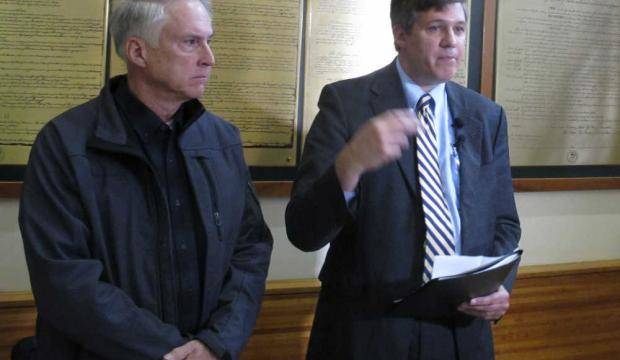
“I’m very disappointed,” Wielechowski said by phone on Friday morning. “With this decision, the governor can ignore mandatory, statutory language that requires dividend payments. … The Legislature can do the same thing.”
Wielechowski, Halford and Tillion contended that when the Alaska Permanent Fund (and subsequently, the dividend program) were created, they bypassed the Alaska Constitution’s prohibition against dedicated funds.
Wielechowski delivered the oral arguments in superior court and at the Supreme Court.
“The answer is no — the 1976 amendment did not exempt the Legislature’s use of Permanent Fund income from the Constitution’s anti-dedication clause,” the court stated in its decision. “The Legislature’s use of Permanent Fund income is subject to normal appropriation and veto budgetary processes.”
The Supreme Court also rejected an argument that Walker exercised his veto technically incorrect.
Assistant Attorney General Kathryn Vogel delivered the state’s argument to the Supreme Court.
“I think that there’s a recognition here that this was a really important legal issue which needed to be clearly understood, and that’s what this court did,” she said by phone.
The Alaska Legislature is currently considering multiple options for using a portion of the earnings of the Permanent Fund to balance a multibillion-dollar budget deficit. While Friday’s decision was ostensibly about the 2016 veto, it has huge implications for that ongoing debate.
The Supreme Court ruling means that legislators have a free hand to adjust the annual amount of the dividend if they divert a portion of the Permanent Fund’s earnings to cover government expenses.
“In that sense, it affirms the state’s position on what was legally allowed,” Vogel said.
Friday’s decision formally upholds a November superior court ruling from Judge William Morse, who said at the time that he expected the issue to ultimately be decided by the Supreme Court.
“I think this will send shockwaves all across the state. I think people are very angry about the cuts to the dividend, and this has the potential to really galvanize them,” Wielechowski said.
He said the reprecussions may be felt in the Legislature and in next year’s general elections.
Wielechowski has been rumored as a Democratic candidate for governor, but on Friday when asked whether he will run, he said, “I haven’t made any decision at this point.”
For the past several years, Wielechowski has offered a constitutional amendment in the Legislature to enshrine dividend payments in the Alaska Constitution.
This year’s attempt, Senate Joint Resolution 1, has passed the Senate State Affairs Committee but is stuck in the Senate Judiciary committee, which is chaired by Sen. John Coghill, R-North Pole and an opponent of the idea.
Coghill was the sole “do not pass” vote on the resolution in the state affairs committee.
By phone from the Interior, he said he’s “no great fan of putting a constitutional right to a dividend in our constitution.”
“The way he wrote that,” Coghill said of Wielechowski’s amendment, “it would look like a constitutional right equal to free speech.”
In effect, SJR 1 would grant Alaskans a constitutional right to money from the government.
Wielechowski, for his part, said Friday’s ruling may kick-start the discussion on the constitutionality of the dividend.
“I think this is really going to start that discussion a little more earnestly,” Wielechowski said.
DV.load(“https://www.documentcloud.org/documents/3961508-Wielechowski-PFD-Opinion.js”, {
responsive: true,
height: 600,
container: “#DV-viewer-3961508-Wielechowski-PFD-Opinion”
});
Wielechowski PFD Opinion (PDF)
Wielechowski PFD Opinion (Text)
• Contact reporter James Brooks at james.k.brooks@juneauempire.com or call 523-2258.
