
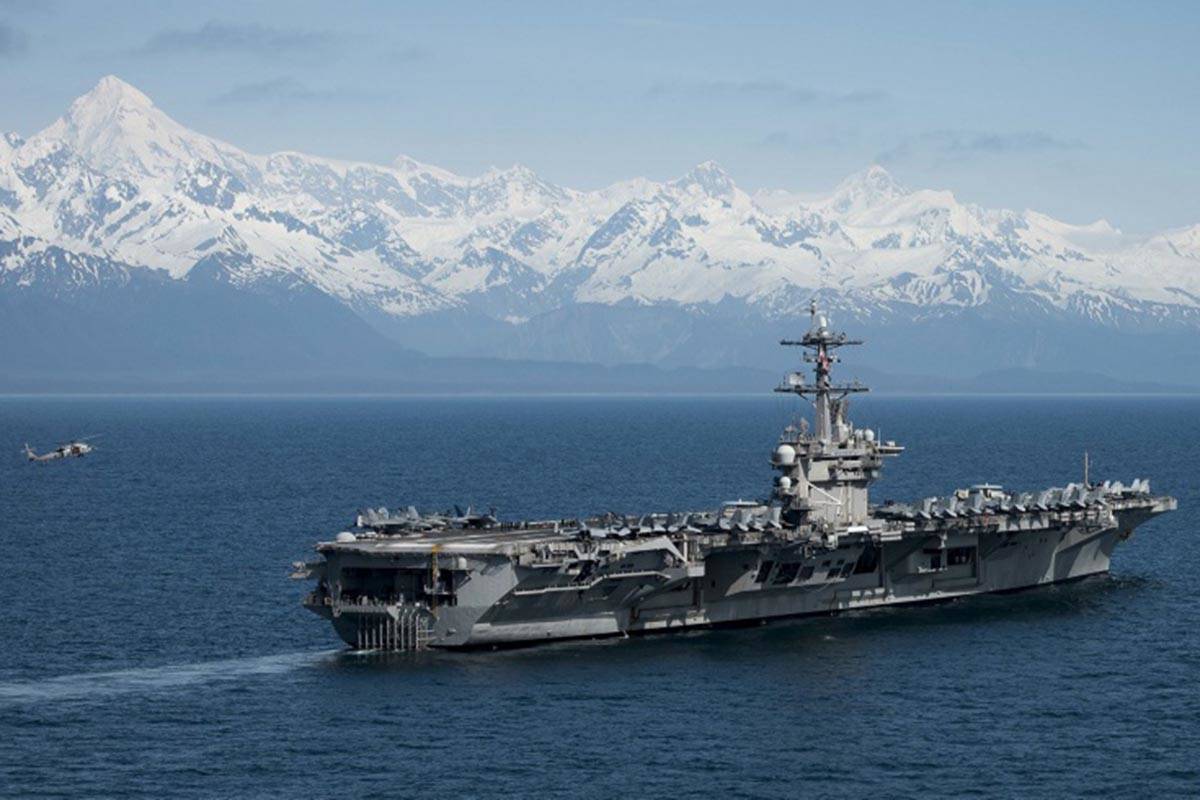
An MH-60S Sea Hawk, assigned to the “Eightballers” of Helicopter Sea Combat Squadron (HSC) 8, approaches the flight deck of the aircraft carrier USS Theodore Roosevelt (CVN 71) as the carrier transits the Gulf of Alaska on May 25, 2019. (MC2 Anthony J. Rivera | United States Navy)

An MH-60S Sea Hawk, assigned to the “Eightballers” of Helicopter Sea Combat Squadron (HSC) 8, approaches the flight deck of the aircraft carrier USS Theodore Roosevelt (CVN 71) as the carrier transits the Gulf of Alaska on May 25, 2019. (MC2 Anthony J. Rivera | United States Navy)

Alaska senators introduce Arctic naval ops bill

Activity in the region is soaring as more ice melts.

Several lawmakers have sponsored a new bill in the Senate Armed Services Committee intended to galvanize planning by the Department of Defense for naval operations in the Arctic.

The Arctic Naval Focus Act of 2019, introduced by Sens. Lisa Murkowski and Dan Sullivan, R-Alaska, in concert with Sen. Angus King, I-Maine, is intended to jumpstart planning for operations in the rapidly changing Arctic environment, which is lagging behind those of Russia and China, according to a press release from Murkowski’s office.

U.S. naval forces have not kept abreast with the level of activity in the Arctic as new sea lanes and traffic ramps up, Sullivan said in a statement.

“Worse still, the military interest and investments being committed here by our adversaries, Russia and China, have been met for many years with tepid statements and inaction by the Pentagon,” Sullivan wrote. “Our new legislation will change this dynamic, directing the Defense Department to make serious assessments of our interests and capabilities in the Arctic, and to put forward detailed plans to preserve the safe flow of commerce, protect the pristine natural environment, and secure America’s sovereignty.”

[Gov says warming Arctic could be good for Alaska]

The act doesn’t commit any forces to the region, but instead requires that the DOD collate its findings on the strategic importance of the region, declare that it’s the United State’s policy to deploy naval forces to meet new challenges in the Arctic, and develop a plan within a year for long term, logistically and strategically supported Arctic naval operations.

This comes not long after a visit to Alaska this autumn by Coast Guard Commandant Adm. Karl Schultz and the largest Navy-Marine exercise in the region in years, the Arctic Expeditionary Capabilities Exercise, involving more than 3,000 Marines and sailors.

The operation occurred mainly around Adak and Kodiak, which are ice-free year-round. During the exercise, Navy Rear Adm. Cedric Pringle, commander of Expeditionary Strike Group 3 said that for the Navy to operate any further north, they’ll need organic icebreaker support. The Navy does not have that capability right now, though the hulls for the Coast Guard’s new Polar Security Cutters, designed to operate in the high Arctic are scheduled to begin construction in 2021.

If the Senate votes the bill in, it will have to be voted on in the House of Representatives before going to the president, who would sign it into law.


• Contact reporter Michael S. Lockett at 757-621-1197 or mlockett@juneauempire.com.


More in News

The northern lights are seen from the North Douglas launch ramp late Monday, Jan. 19. A magnetic storm caused unusually bright northern lights Monday evening and into Tuesday morning. (Chloe Anderson/Juneau Empire)
Rare geomagnetic storm causes powerful aurora display in Juneau

The northern lights were on full display Monday evening.

teaser
Juneau activists ask Murkowski to take action against ICE

A small group of protesters attended a rally and discussion on Wednesday.

A female brown bear and her cub are pictured near Pack Creek on Admiralty Island on July 19, 2024. (Chloe Anderson for the Juneau Empire)
Pack Creek permits for bear viewing area available now

Visitors are welcome from April 1 to Sept. 30.

Cars pass down Egan Drive near the Fred Meyer intersection Thursday morning. (Clarise Larson / Juneau Empire file photo)
Safety changes planned for Fred Meyer intersection

DOTPF meeting set for Feb. 18 changes to Egan Drive and Yandukin intersection.

Herbert River and Herbert Glacier are pictured on Nov. 16, 2025. (Mari Kanagy / Juneau Empire)
Forest Service drops Herbert Glacier cabin plans, proposes trail reroute and scenic overlook instead

The Tongass National Forest has proposed shelving long-discussed plans to build a… Continue reading

A tsunami is not expected after a 4.4-magnitude earthquake northwest of Anchorage Wednesday, Feb. 4, 2026. (U.S. Geological Survey)
No tsunami expected after 4.4-magnitude earthquake in Alaska

U.S. Geological Survey says 179 people reported feeling the earthquake.

ORCA Adaptive Snowsports Program staff member Izzy Barnwell shows a man how to use the bi-ski. (SAIL courtesy photo)
Adaptive snow sports demo slides to Eaglecrest

Southeast Alaska Independent Living will be hosting Learn to Adapt Day on Feb. 21.

Cars drive aboard the Alaska Marine Highway System ferry Hubbard on June 25, 2023, in Haines. (Photo by James Brooks)
Alaska’s ferry system could run out of funding this summer due to ‘federal chaos problem’

A shift in state funding could help, but a big gap likely remains unless a key federal grant is issued.

Photo by James Brooks/Alaska Beacon
U.S. Sen. Dan Sullivan stands with acting Coast Guard Commandant Adm. Kevin Lunday during the after the commissioning ceremony for the Coast Guard icebreaker Storis on Sunday, Aug. 10, 2025, in Juneau, Alaska.
Coast Guard’s new Juneau base may not be complete until 2029, commandant says

Top Coast Guard officer says he is considering whether to base four new icebreakers in Alaska.

Most Read