
Standing in the 29-degree air outside a building on the University of Alaska Fairbanks campus, Josephine Galipon held a pinkie-size vial that may have contained tiny organisms locked in a coma for thousands of years.
Galipon, a researcher with Keio University in Japan, needed to work outside a heated room so as not to disturb molecules that have been motionless in frozen ground for as long as 25,000 years. That was a time when giant sheets of ice pressed down on most of North America.
In October 2022, Galipon visited Alaska to see if she could tease out genetic information from gray cylinders of permafrost — silty soil that has been frozen for at least two years, but in this case thousands.
Using a large drill with a hollow bit, Galipon’s colleague Go Iwahana of UAF’s International Arctic Research Center pulled the samples from the U.S. Army’s Permafrost Tunnel Research Facility in Fox, Alaska, a few hours before.
Galipon planned to examine ancient RNA, molecules living things use to express traits that help them survive, such as producing more heat to withstand the cold.
And what might still be living within plugs of frigid soil?
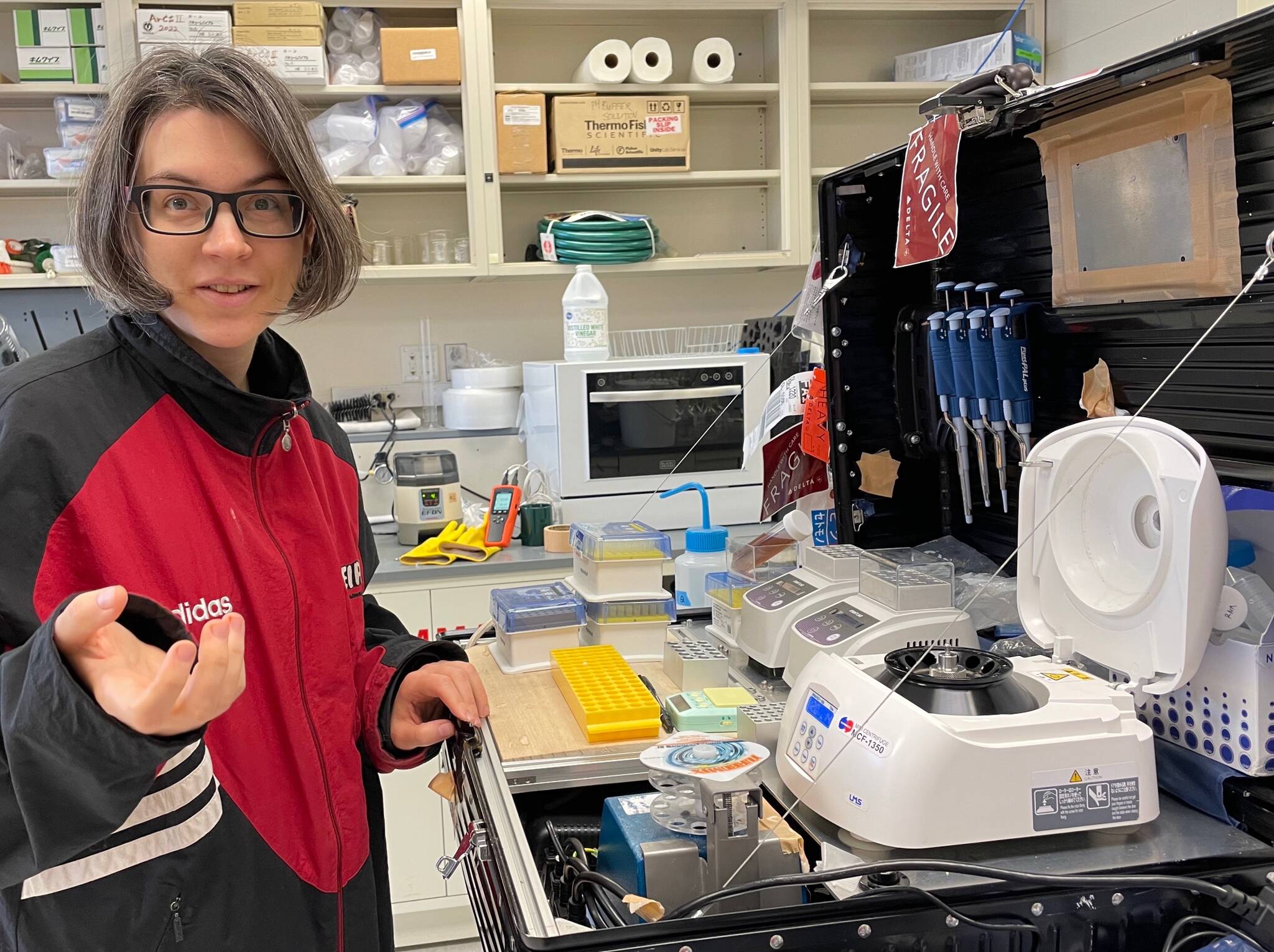
Josephine Galipon of Keio University in Japan holds a cylinder of frozen soil extracted by her colleague Go Iwahana from the U.S. Army’s Permafrost Tunnel Research Facility in Fox, Alaska. She is looking for microorganisms that might still be alive in the ancient soil. (Courtesy Photo / Ned Rozell)
Scientists have found 1,500-year-old moss in Antarctica permafrost that came back to life when warmed. From permafrost extracted in Siberia, researchers have coaxed back to life bacteria and small worms known as nematodes that wriggled 41,000 years after they were suspended in ice.
Galipon is not expecting such a bounty of creatures in her few samples, but she was excited to look for viable molecules of RNA — ribonucleic acid — that would tell her what creatures were in the soil at the time cold penetrated down from the grasses above.
“RNA tells us how the thing is dealing with the environment,” she said. “How do these microbes adapt to cold and warmth? What’s the range of temperatures they can withstand and survive, and how do they do it?”
She described a DNA molecule as sort of a dictionary of everything a living thing can do, and an RNA molecule as the few words that express what that creature does to survive.
“Plants and insects express different genes at different times. The RNA can change up to 100-fold in a few minutes.”
That is why, for example, some COVID-19 vaccines need to be held at extreme cold temperatures, to keep the messenger RNA true and useful.
And there is a niche Galipon is trying to fill: She is developing a field kit to let researchers examine RNA outside the lab, before conditions change so much that the molecules lose whatever information they have to share.
Galipon — who grew up in rural France and moved to Japan 13 years ago — carried a large suitcase to Fairbanks filled with instruments for looking at soils in the field — in this case the permafrost tunnel dug into a hillside north of Fairbanks.
Inside the black-plastic case were the tools of her trade, including a small centrifuge.
She is tweaking her kit in hopes of taking it to places like the Atacama Desert in Chile and the Gobi Desert in China, as well as Alaska and Siberia and Antarctica and other places where ground frozen long ago persists.
“I would like to merge biology with engineering,” she said. “I would like to invent something that makes several scientific discoveries possible.”
• Since the late 1970s, the University of Alaska Fairbanks’ Geophysical Institute has provided this column free in cooperation with the UAF research community. Ned Rozell ned.rozell@alaska.edu is a science writer for the Geophysical Institute.
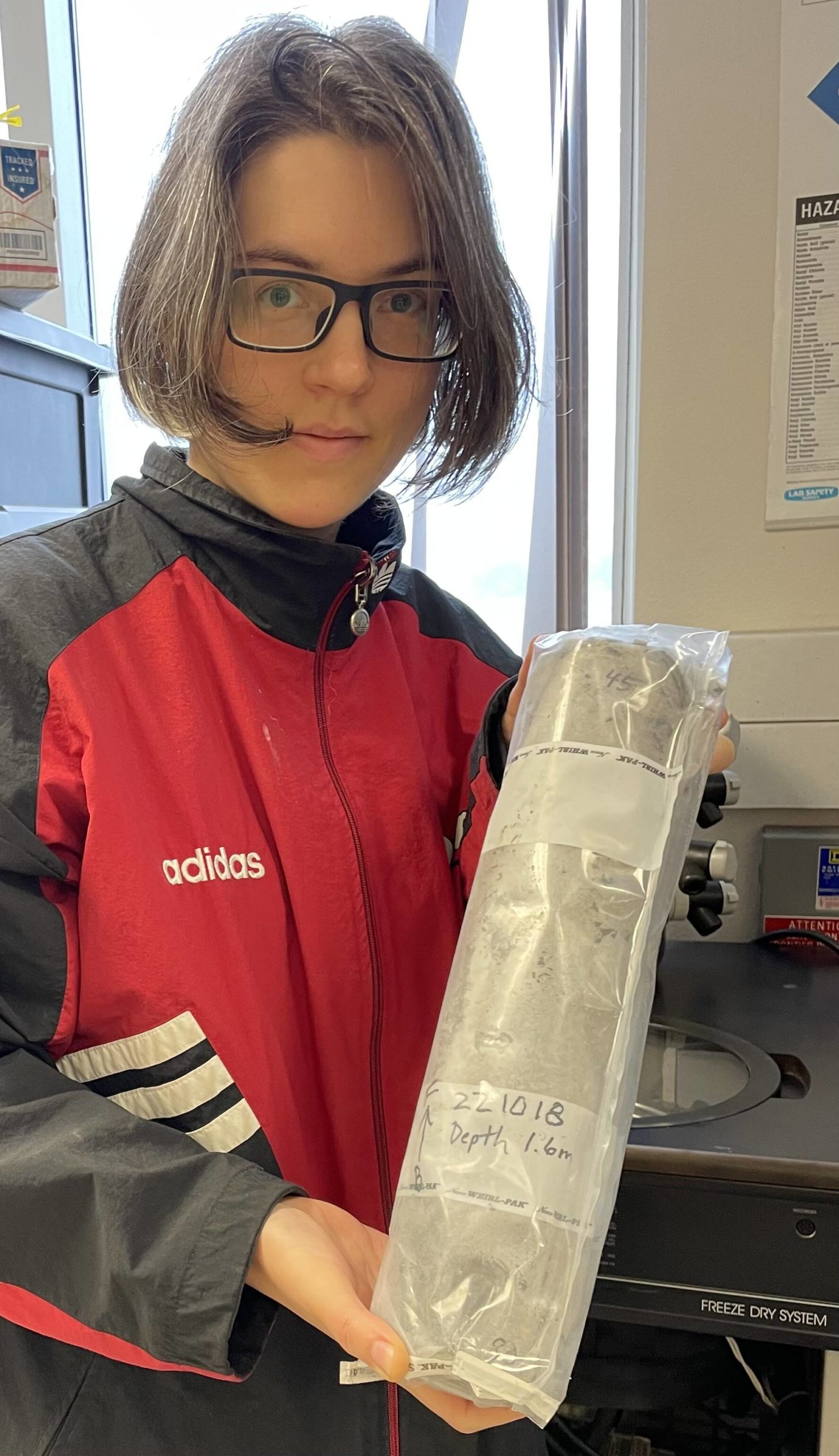
Josephine Galipon of Keio University in Japan shows a field kit she has invented for studying microorganisms in the field. She used it to study microorganisms collected by her colleague Go Iwahana from the U.S. Army’s Permafrost Tunnel Research Facility in Fox, Alaska, recently. Photo by Ned Rozell. (Courtesy Photo / Ned Rozell)
