
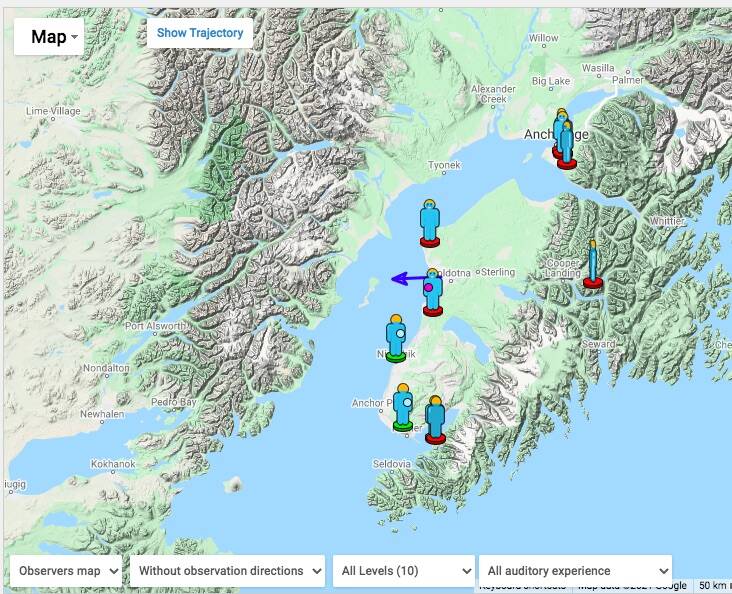
A screenshot of a website created for the American Meteor Society showing reports from Alaska residents about a fireball that exploded above Alaska on Sept. 30, 2021. The blue arrow is the estimated direction of the fireball. (Screenshot)

A screenshot of a website created for the American Meteor Society showing reports from Alaska residents about a fireball that exploded above Alaska on Sept. 30, 2021. The blue arrow is the estimated direction of the fireball. (Screenshot)

Alaska Science Forum: Space rocks streak through the Alaska sky

  • By Ned Rozell
  • Friday, October 8, 2021 5:47pm
  • News

By Ned Rozell

About once every other week for as long as you have been alive, zooming space rocks have penetrated the shell of gases surrounding our blue planet.

If you happened to be in the right spot and were looking up, you might have seen a fireball in the sky, caused by a supersonic space rock encountering the sudden friction of gas molecules in our atmosphere.

Such was the case in late September, when people on the Kenai Peninsula and Anchorage noticed a white streak slashing the black night sky. Some even heard a boom.

“I’ve seen shooting stars but this was giant in comparison. It was once-in-a-lifetime.” Holly S. of Anchorage posted on a fireball-and-meteor webpage on Sept. 30, 2021.

“Sounded like rolling thunder and lasted about 15 seconds,” wrote Jason S. of Kasilof.

“Two other people with me saw it,” said Kim S. of Halibut Cove. “It was the most incredible thing any of us have ever seen.”

They saw and heard a bolide — a large meteor that explodes in the atmosphere. Scientists farther away in Alaska noticed it too. Placed on the ground not far from where the meteor blew up are networks of sensitive microphones.
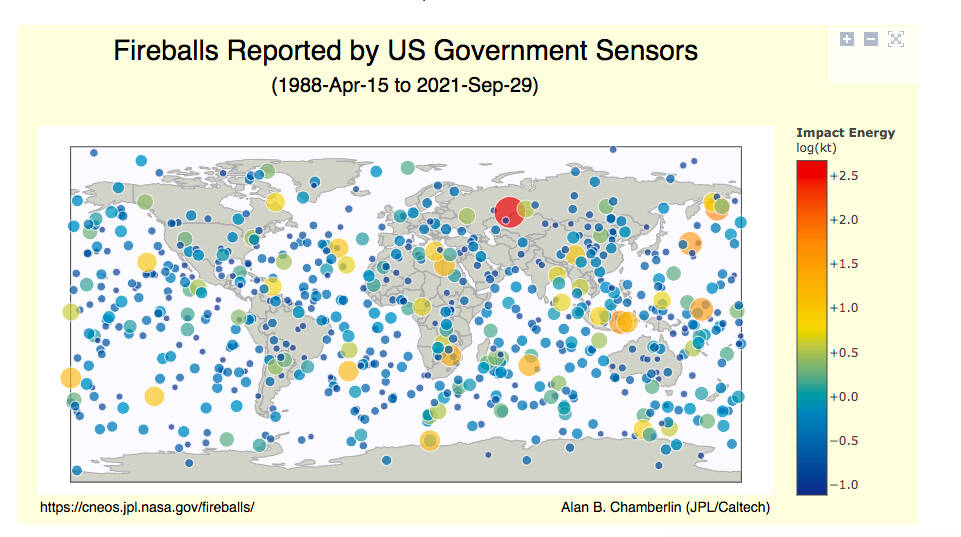
This screenshot from a NASA webpage on confirmed fireballs entering Earth’s atmosphere from 1988 to the present.(Screenshot)

This screenshot from a NASA webpage on confirmed fireballs entering Earth’s atmosphere from 1988 to the present.(Screenshot)

These infrasound networks are tools scientists use to hear sound waves, including some so low in frequency our ears can’t pick them up.

A cluster of six infrasound microphones installed near Kenai in 2020 by researchers from the Alaska Volcano Observatory and the U.S. Geological Survey captured the end of the space rock’s recent journey to our planet.

Max Kaufman of the Geophysical Institute looked at spikes in the infrasound data and matched air-pressure changes to the behavior of the heavenly visitor.

“The bolide might only be visible for three-to-five seconds, but it left a trail of sound in the atmosphere that took 100 seconds to pass by,” said Kaufman, who often travels to the slopes of volcanoes to maintain seismic and infrasound stations.

Since people like Kaufman installed more than 100 infrasound stations all over Alaska, in Antarctica, and on humid islands in large expanses of ocean, scientists have detected nuclear explosions beneath North Korea from as far away as Fairbanks. Nuclear treaty compliance is the main reason for the networks’ existence, but scientists have over the years found them useful in ways they didn’t expect.

With the infrasound microphones, which are on all the time, scientists have also heard the roar of volcanoes, the dance of the aurora, and — once in a while — the sonic pathway left behind by a fiery object that plunges toward Earth in a few blinks.

No one knows the fate of the blackened space pebbles that survived the recent journey from the infinite cosmos to Alaska, but scientists think it’s a decent bet a few are nestled in the ocean floor in Cook Inlet.

• Since the late 1970s, the University of Alaska Fairbanks’ Geophysical Institute has provided this column free in cooperation with the UAF research community. This year is the institute’s 75th anniversary. Ned Rozell ned.rozell@alaska.edu is a science writer for the Geophysical Institute.

More in News

A house on Telephone Hill stands on Dec. 22, 2025. (Mari Kanagy / Juneau Empire)
Court sets eviction date for Telephone Hill residents as demolition plans move forward

A lawsuit against the city seeks to reverse evictions and halt demolition is still pending.

Juneauites warm their hands and toast marshmallows around the fire at the “Light the Night" event on winter solstice, on Dec. 21, 2025. (Mari Kanagy / Juneau Empire)
A mile of lights marked Juneau’s darkest day

Two ski teams hosted a luminous winter solstice celebration at Mendenhall Loop.

A Capital City Fire/Rescue truck drives in the Mendenhall Valley in 2023. (Clarise Larson / Juneau Empire file photo)
Juneau man found dead following residential fire

The cause of the fire is still under investigation.

CBJ sign reads “Woodstove burn ban in effect.” (City and Borough of Juneau photo)
Update: CBJ cancels air quality emergency in Mendenhall Valley Sunday morning

The poor air quality was caused by an air inversion, trapping pollutants at lower elevations.

A dusting of snow covers the Ptarmigan chairlift at Eaglecrest Ski Area in December 2024. (Eaglecrest Ski Area photo)
Update: Waterline break forces closure at Eaglecrest Friday, Saturday

The break is the latest hurdle in a challenging opening for Juneau’s city-run ski area this season.

Patrick Sullivan stands by an acid seep on July 15,2023. Sullivan is part of a team of scientists who tested water quality in Kobuk Valley National Park’s Salmon River and its tributaries, where permafrost thaw has caused acid rock drainage. The process is releasing metals that have turned the waters a rusty color. A chapter in the 2025 Arctic Report Card described “rusting rivers” phenomenon. (Photo by Roman Dial/Alaska Pacific University)
Ecosystem shifts, glacial flooding and ‘rusting rivers’ among Alaska impacts in Arctic report

NOAA’s 2025 report comes despite Trump administration cuts to climate science research and projects

The U.S. Capitol in Washington, D.C., on Oct. 1, 2025. (Photo by Jennifer Shutt/States Newsroom)
Moderate US House Republicans join Dems to force vote on extension of health care subsidies

WASHINGTON — Republican leaders in the U.S. House will face a floor… Continue reading

The National Weather Service Juneau issues a high wind warning forDowntown Juneau, Southern Douglas Island and Thane due to increased confidence for Taku Winds this afternoon. (National Weather Service screenshot)
Taku winds and dangerous chills forecast for Juneau

Gusts up to 60 mph and wind chills near minus 15 expected through the weekend.

Chloe Anderson for the Juneau Empire
Fallen trees are pictured by the Mendenhall river on Aug. 15, 2025. Water levels rose by a record-breaking 16.65 feet on the morning of Aug. 13 during a glacial outburst flood.
Lake tap chosen as long-term fix for glacial outburst floods

The U.S. Army Corps of Engineers and Juneau leaders agreed on the plan.

Most Read