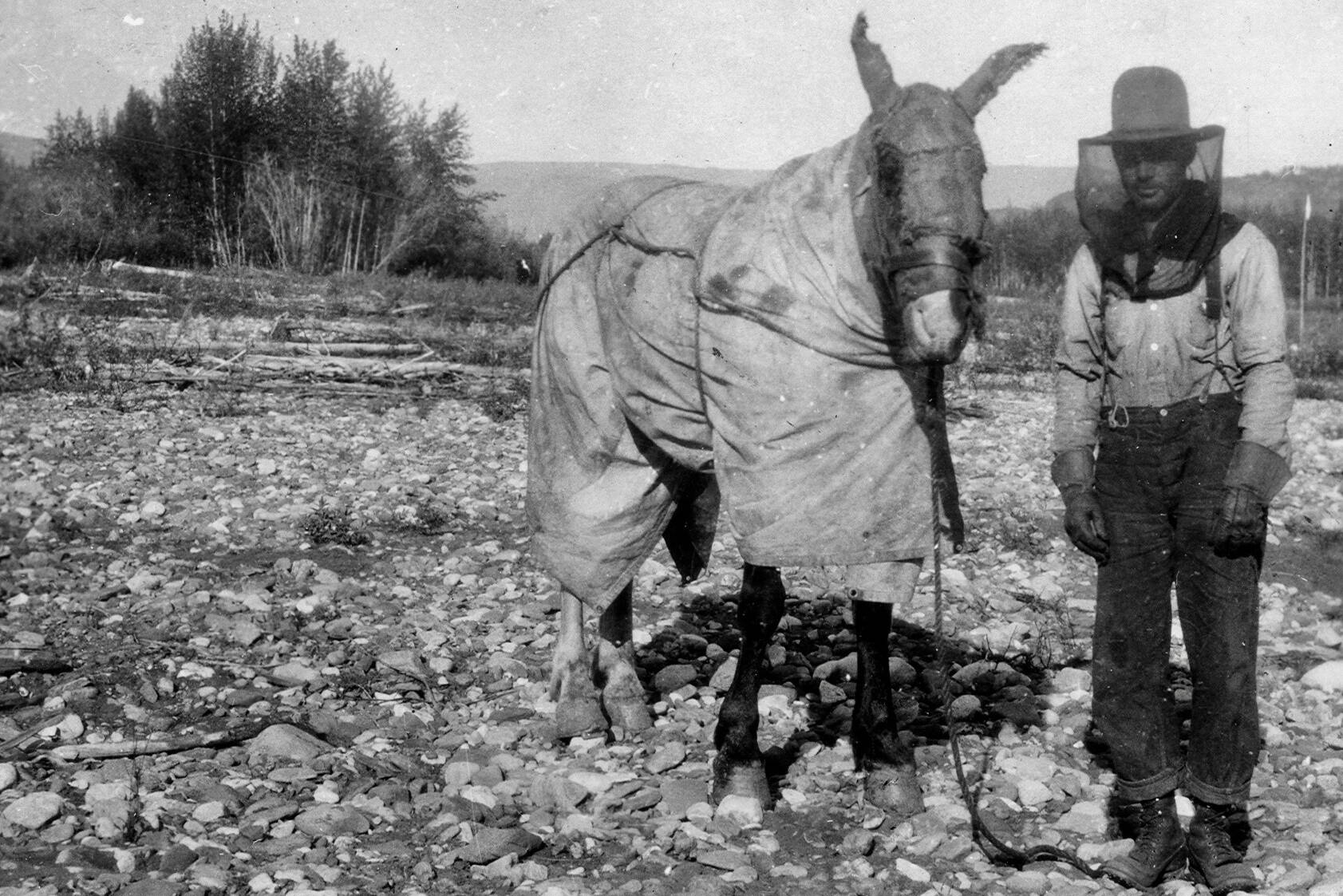
R.L. Phillips pauses with his “mosquito-proofed” horse Sparkplug on a gravel bar of the Tatonduk River, a tributary of the Yukon River, on June 17, 1930. (From the J.B. Mertie Collection of photos, U.S. Geological Survey Denver Library Photographic Collection, public domain)

R.L. Phillips pauses with his “mosquito-proofed” horse Sparkplug on a gravel bar of the Tatonduk River, a tributary of the Yukon River, on June 17, 1930. (From the J.B. Mertie Collection of photos, U.S. Geological Survey Denver Library Photographic Collection, public domain)

Alaska Science Forum: Pound for pound, Alaska mosquitoes pack punch

Researcher calculates combined weight of Alaska’s yearly mosquito “crop” is 96 million pounds.

  • By Ned Rozell
  • Thursday, June 15, 2023 5:14pm
  • News

In mid-June, while standing deep within the northern boreal forest, it’s possible to feel a sensation similar to one felt in mid-December at the same spot. It’s a sting to exposed skin, delivered in December by bitter air and in June by the stab of the mosquito.

The mosquito has buzzed its way into most historic journals of Alaska summer visitors. Like that of Ivan Petrof, who counted 33,426 Alaskans while traveling the territory for the 1880 census. He wrote of what he encountered in the Kuskokwim River valley:

“There is another feature in this country which, though insignificant on paper, is to the traveler the most terrible and poignant infliction he can be called upon to bear in a new land. I refer to the clouds of bloodthirsty mosquitoes … under the stress of whose persecution the strongest man with the firmest will must either feel depressed or succumb to low fever.”

About 20 years later, during a military exploration of the Copper River Valley, Army Lt. J.J. Rafferty described the days of June 9-13, 1898:

“The men were compelled to wear veils day and night, with gloves to protect the hands. The ferocity of these mosquitoes I regard as something remarkable. The species found here is not the large, singing sort seen in the States, but a small, silent, business-like insect, sharp of bill, who touches the tender spot in a surprisingly short time after alighting.”
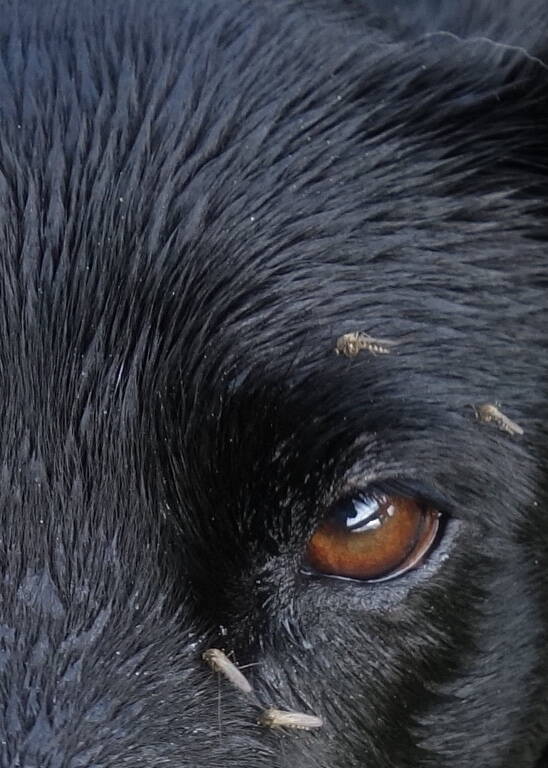
Female mosquitoes draw a blood meal from Cora the dog near Fairbanks. (Photo by Ned Rozell)

Female mosquitoes draw a blood meal from Cora the dog near Fairbanks. (Photo by Ned Rozell)

Alaska hosts at least 27 species of mosquito. The “snow mosquito” Culiseta alaskaeensis is a thumbnail-size insect that in autumn wafts down to the forest floor. There, it hibernates until its bunker warms in spring, when it ascends.

By mid-June, the larger snow mosquitoes have lived out their few weeks of life. But the artful dodgers that Lt. Rafferty wrote about are plentiful. Many of those smaller mosquitoes emerged from eggs that females laid last fall. Mother mosquitoes either dabbed the eggs upon a water surface or placed them on the ground in areas that might be flooded by spring snowmelt.

Mosquitoes live in water during their wriggling larval and pupal stages. That’s one of the reasons most of the vastness of Alaska, with its magnificent swamplands, is excellent mosquito habitat.

“(Water enough for mosquito rearing) may be in a small tin can or a vast tidal marsh,” wrote an unnamed scribe in the 1961 U.S. Department of Agriculture publication “The Mosquitoes of Alaska.”
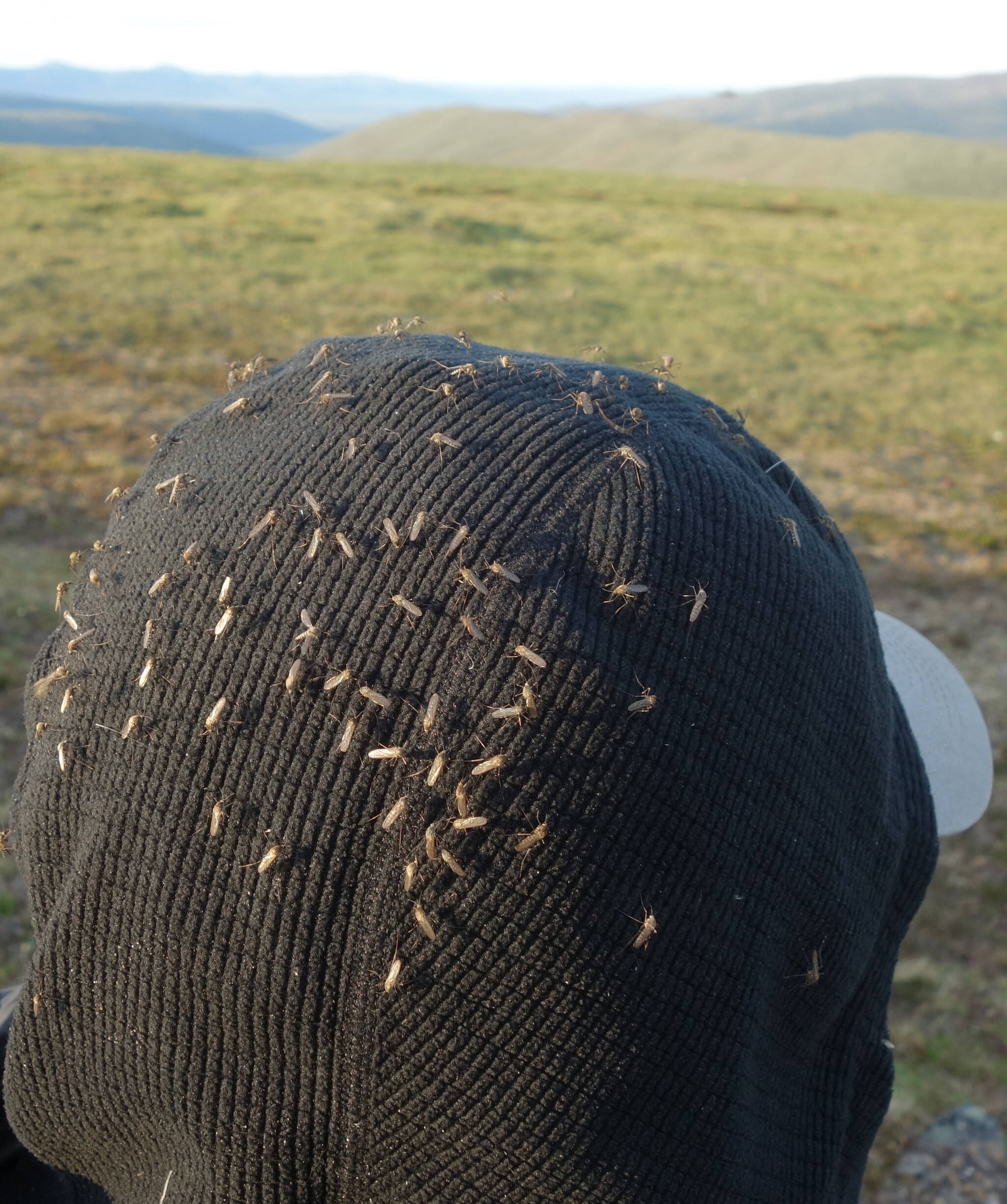
Female mosquitoes perch on Ned Rozell’s hood north of Fairbanks. (Photo by Anna Rozell)

Female mosquitoes perch on Ned Rozell’s hood north of Fairbanks. (Photo by Anna Rozell)

Upon emergence from the water as adults, clouds of male mosquitoes seek out females. Mating takes place in mid-air. Male mosquitoes lack the surprisingly complex needle-like proboscis of the females. Instead they sport a pair of garish feathery antennae.

While both males and females eat plant nectar, mated female mosquitoes follow invisible trails of carbon dioxide exhaled by animals like us, as well as molecules of body odor. Blood protein, one of the richest foods in existence, helps make their eggs viable.

Once those blood-nourished eggs hatch, the numbers get a bit goofy. Derek Sikes, curator of insects at the University of Alaska Museum of the North, once calculated that about 17,489,393,939,393 mosquitoes hover over Alaska each summer. Yes, that’s 17 trillion. Sikes did not weigh each one individually, but he calculated that the combined weight of Alaska’s yearly mosquito crop is 96 million pounds.

• Since the late 1970s, the University of Alaska Fairbanks’ Geophysical Institute has provided this column free in cooperation with the UAF research community. Ned Rozell is a science writer for the Geophysical Institute.

More in News

A commercial bowpicker is seen headed out of the Cordova harbor for a salmon fishing opener in June 2024 (Photo by Corinne Smith)
Planned fiber-optic cable will add backup for Alaska’s phone and high-speed internet network

The project is expected to bring more reliable connection to some isolated coastal communities.

Gustavus author Kim Heacox talked about the role of storytelling in communicating climate change to a group of about 100 people at <strong>Ḵ</strong>unéix<strong>̱</strong> Hídi Northern Light United Church on Wednesday, Dec. 3, 2025. (Mari Kanagy / Juneau Empire)
Author calls for climate storytelling in Juneau talk

Kim Heacox reflects on what we’ve long known and how we speak of it.

The Juneau road system ends at Cascade Point in Berners Bay, as shown in a May 2006 photo. (Michael Penn / Juneau Empire file)
State starts engineering for power at proposed Cascade Point ferry terminal

DOT says the contract for electrical planning is not a commitment to construct the terminal.

Members of the Alaska Air and Army National Guard, Alaska Naval Militia, and Alaska State Defense Force work together to load plywood onto a CH-47 Chinook helicopter, in Bethel, Alaska, Nov. 2, 2025, bound for the villages of Napaskiak, Tuntutuliak, and Napakiak. The materials will help residents rebuild homes and restore community spaces damaged by past storms. (U.S. Army National Guard photo by Spc. Ericka Gillespie)
Gov. Dunleavy approves Alaska National Guard assisting ICE in Anchorage

The National Guard said five service members will assist with administrative support; lawmakers and civil rights advocates worry that the move signals a ramping up of immigration enforcement operations in Alaska

A cruise ship, with several orange lifeboats visible, is docked in downtown Juneau. (Laurie Craig / Juneau Empire file photo)
CBJ seeks input on uses for marine passenger fees

Public comment period is open for the month of December.

Browsers crowd into Annie Kaill’s gallery and gift shop during the 2024 Gallery Walk. (Juneau Empire file photo)
Gallery Walk guide for Friday, Dec. 5

The Juneau Arts & Humanities Council announced community events taking place during… Continue reading

The Alaska State Capitol is seen on Tuesday, Nov. 25, 2025. (Photo by James Brooks/Alaska Beacon)
Alaska Senate Republicans confirm Rauscher, Tilton and open two vacancies in state House

The Alaska Republican Party is moving quickly after Republicans in the Alaska… Continue reading

Downtown Skagway, with snow dusting its streets, is seen in this undated photo. (Photo by C. Anderson/National Park Service)
Skagway’s lone paramedic is suing the city, alleging retaliation by fire department officials

This article was reported and published in collaboration between the Chilkat Valley… Continue reading

A spruce tree grows along Rainforest Trail on Douglas Island. (Mari Kanagy / Juneau Empire)
Where to cut your Christmas tree in Juneau

CBJ and Tongass National Forest outline where and how residents can harvest.

Most Read