
By Ned Rozell
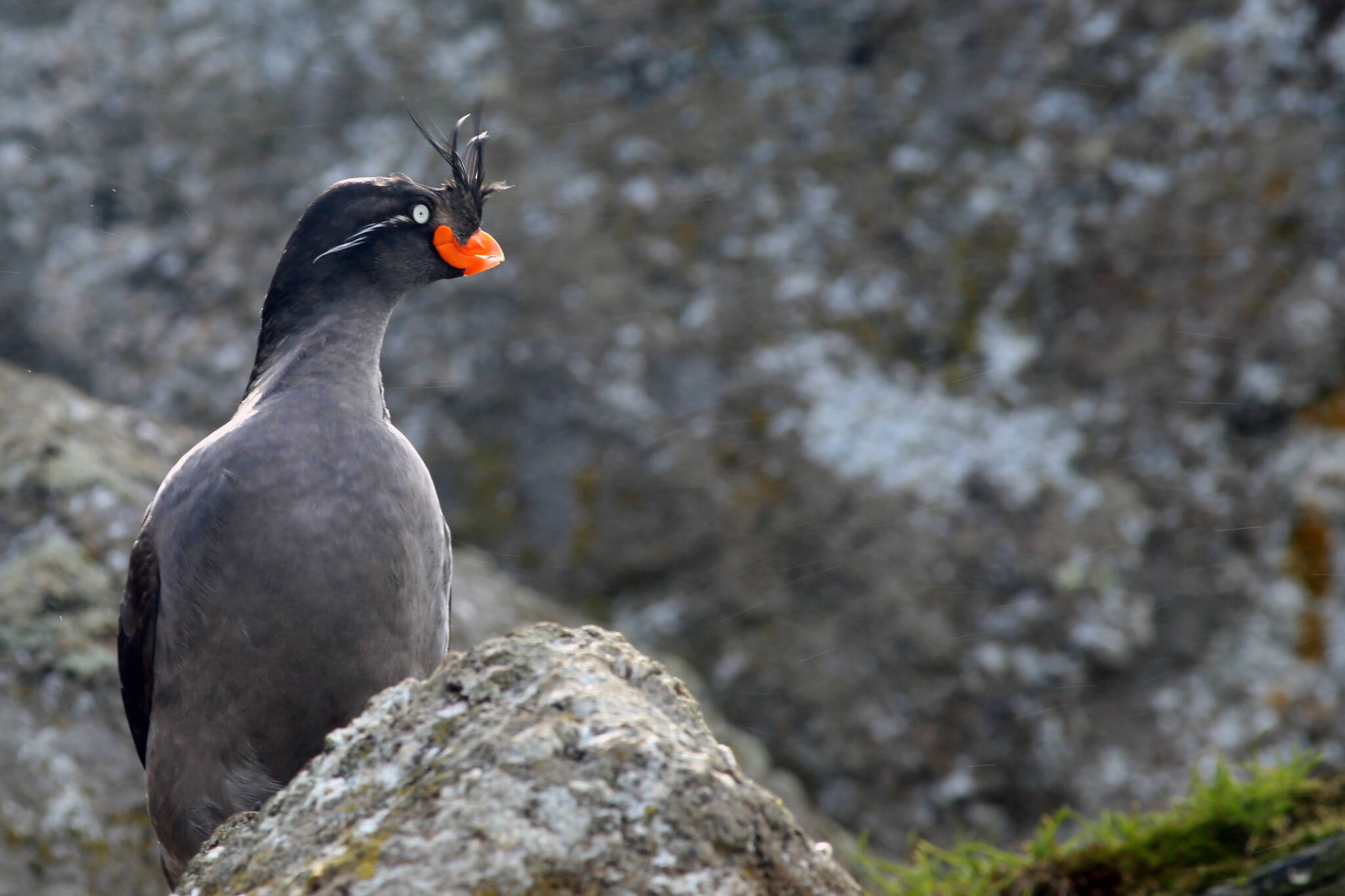
The crested auklet looks like a smiling clown that never blinks. It is probably the only seabird that smells like a tangerine. Its beak — the color of a tangerine — is so bright a scientist thinks it may be fluorescent.
Hector Douglas is that scientist. He teaches at Grambling State University in the pine forest of Louisiana, but has spent many hours hunched between volcanic rocks off the west coast of Alaska.
Since the late 1980s, Douglas has said yes to any chance to visit the windy islands of the Aleutian Chain or farther north in the Bering Sea. There, he has focused his binoculars on the crested auklet, a hand-size seabird. Crested auklets nest by the thousands in the salt-scented air off Alaska and Siberia.
Douglas has thought a lot about crested auklets. He has in the past tried to tease out the chemical secrets of the birds’ citrus odor, the strength of which — when combined with jaunty feathers curling from its forehead — may determine how attractive a crested auklet is to a mate.
Douglas has isolated the chemicals responsible for that scent, compounds that are also found in citrus fruits and stink bugs. He thinks the crested auklet’s scent is not only sexy; it may repel ticks, lice, and mosquitoes.
During many hours of watching crested auklets, Douglas has also admired the exceptional brightness of their beaks. He decided to study the chemistry of the bill pigment, why it might be important, and what tiny sea creature in the auklets’ diet might be the source of the color.
Though he had no specific funding to chase this question, in 2016 Douglas headed back to Little Diomede Island, which is right on the U.S. side of the international date line, with a nice view of Russia’s Big Diomede Island.
His main mission on Little Diomede was to check crested auklets for the presence of both bird flu and coronaviruses in birds. He would find no evidence of either, but on that trip he carried in his rucksack six little crested auklets made of plastic.
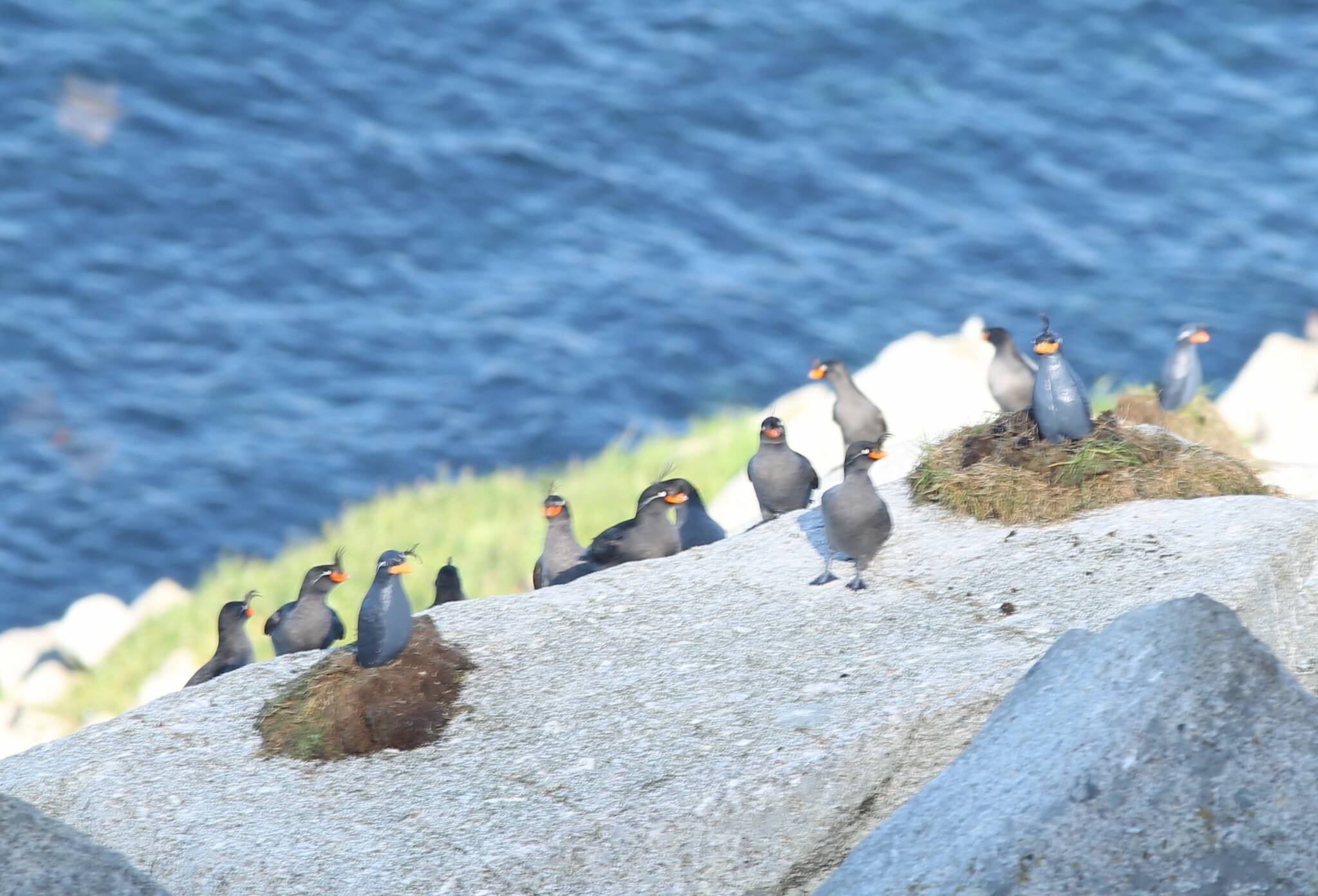
Several plastic crested auklet decoys stand amid wild crested auklets on Little Diomede Island. (Courtesy Photo / Hector Douglas)
These models were the fourth dummy version of crested auklets he had created over the years. The latest (and most successful) he based on a crested auklet his friend Don Wedl of Bethel had carved for him from a chunk of wood.
Douglas made a mold using the carving and filled it with resin.
He painted the resulting bodies with the proper colors. He glued on “round wiggle eyes” he ordered from a company called Creativity Street. For the ornamental crest feathers sprouting from the head, he inserted the real thing, which subsistence hunters on Little Diomede gave to him from birds they had harvested.
On the three control models of his decoys, he painted the beaks orange with regular acrylic paint. On his three experimental decoys, he used fluorescent orange paint. Fluorescent molecules within something make it appear brighter than it would be otherwise, as long as a light source is striking it.
On Little Diomede, Douglas set out his decoys on rocks frequented by hundreds of breeding crested auklets. He then turned and hiked away to a hiding spot in similar rocks less than 100 yards away.
When the auklets returned to where he had stood the decoys, Douglas was pleased to see the real birds shuffle up to his.
“They would bill with them,” he said. “They would sniff their napes as though they were trying to detect an identifying odor.”
In a paper just published in Behavioral Ecology and Sociobiology, Douglas documented how more crested auklets approached the fluorescent-billed models than the control decoys, and how more of the fluorescent-beak decoys got sniffed and touched by the real birds.
What might be the advantage of having extra-bright body parts?
Douglas thinks that auklets with fluorescent bills are more visible on foggy and misty slopes, and within the rock crevices where they nest. A brighter bill makes an individual quickly recognizable among hundreds of others standing close together.
A fluorescent bill may also signal to a mate that he or she is great at catching euphausiids, super-nutritious shrimp-like creatures that are probably the source of that neon orange.
• Since the late 1970s, the University of Alaska Fairbanks’ Geophysical Institute has provided this column free in cooperation with the UAF research community. This year is the institute’s 75th anniversary. Ned Rozell ned.rozell@alaska.edu is a science writer for the Geophysical Institute.
