
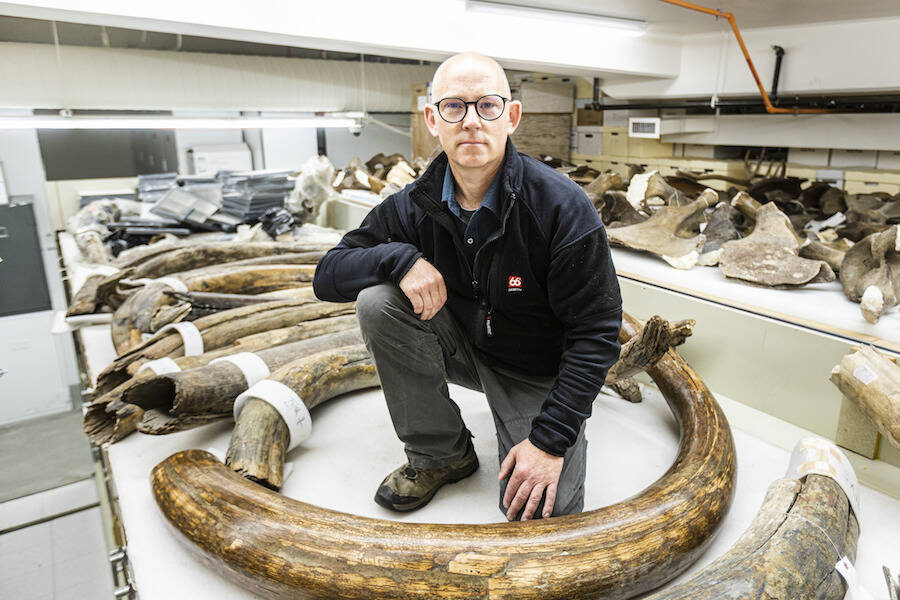
A University of Alaska Fairbanks scientist wants to find out when the last woolly mammoth fell to the grass in Alaska. He is asking for help from an unusual source: people like you.
Matthew Wooller was walking a beach in Florida last winter with his wife and two kids when the adopt-a-mammoth idea struck him.
His plan involves 1,500 mammoth bones, teeth and tusks housed in Fairbanks at the UA Museum of the North. Donated by explorer Otto Geist and many gold miners over the last 100 years, the mammoth remains are a treasure that would become much more useful to scientists if they knew when the animals were alive.
Why not — Wooller said to his wife Diane O’Brien as they strolled on the beach — ask people if they would pay for radiocarbon dating of one (or more) of those bones? In doing so, they could help scientists determine when the woolly mammoth vanished from mainland Alaska. The person with the youngest fossil wins!
O’Brien, the director of UAF’s Institute of Arctic Biology, loved the idea. Crowdsourcing is an unconventional way to do science, but think of all the funding-agency pressure you would avoid. Plus, mammoths are fun, and so are competitions.
Before the details, a little more on what the contest might do for our knowledge of an iconic creature.
Of all the animals that once walked the planet but no longer do, the woolly mammoth is one we can almost smell.
Their bones have turned up in frozen ground all over the North; a baby mammoth extracted by a Yukon gold miner in summer 2022 looks like it is about to wake from its resting spot on a blue tarp.
The giant relatives of African and Asian elephants — but shaggy, with longer, curvier tusks and smaller ears — woolly mammoths are a symbol of the far North that went extinct not very long ago.
The youngest mammoth fossils, found on Wrangel Island north of Siberia, are from animals that were alive 3,700 years ago. That’s when Queen Hatshepsut ruled as a pharaoh in Egypt.
The mammoths of Wrangel Island were isolated from Egyptians and other people by sheer distance and icy wilderness. They are — so far as we know — the most recent woolly mammoths, which ranged as far south as at least Mexico.
About a decade ago, researchers including Wooller found that mammoths on Alaska’s St. Paul Island lived until about 5,600 years ago. Those island mammoths seem to have persisted more than 5,000 years longer than other Alaska mammoths.
“How young is the youngest mammoth fossil from mainland Alaska?” Wooller wonders.
There are 1,500 undated bones, teeth and tusks in museum drawers and on shelves that might help answer that question.
The youngest dated mammoth fossil from middle Alaska is one unearthed near Chicken, Alaska, that is about 11,600 years old. That animal might have eyeballed humans whose shadows appeared on the horizon from the direction of Asia.
But were mammoths alive in Alaska after that one died? If they were, it would extend the overlap period between mammoths and humans, and counter the idea that we were responsible for mammoths’ demise by hunting them all out.
“A bigger (time) gap would help downplay that hypothesis,” Wooller said.
Adopt-a-mammoth will allow anyone who donates the radio-carbon dating fee of $350 to receive a digital photo of their tusk, femur or whatever mammoth part it happens to be. Scientists will then remove a collagen sample and send it to a carbon-dating lab in California. Mammoth adopters will get results on the age of their animal shortly after the scientists do.
That date will enter the sponsor in the youngest-mammoth contest. The winner will get a trophy, as well as having his or her photo displayed on a plaque in the Museum of the North during the announcement period. The winner may also get the satisfaction of helping discover when the last woolly mammoth rumbled through the northern grasslands.
• Since the late 1970s, the University of Alaska Fairbanks’ Geophysical Institute has provided this column free in cooperation with the UAF research community. Ned Rozell is a science writer for the Geophysical Institute.
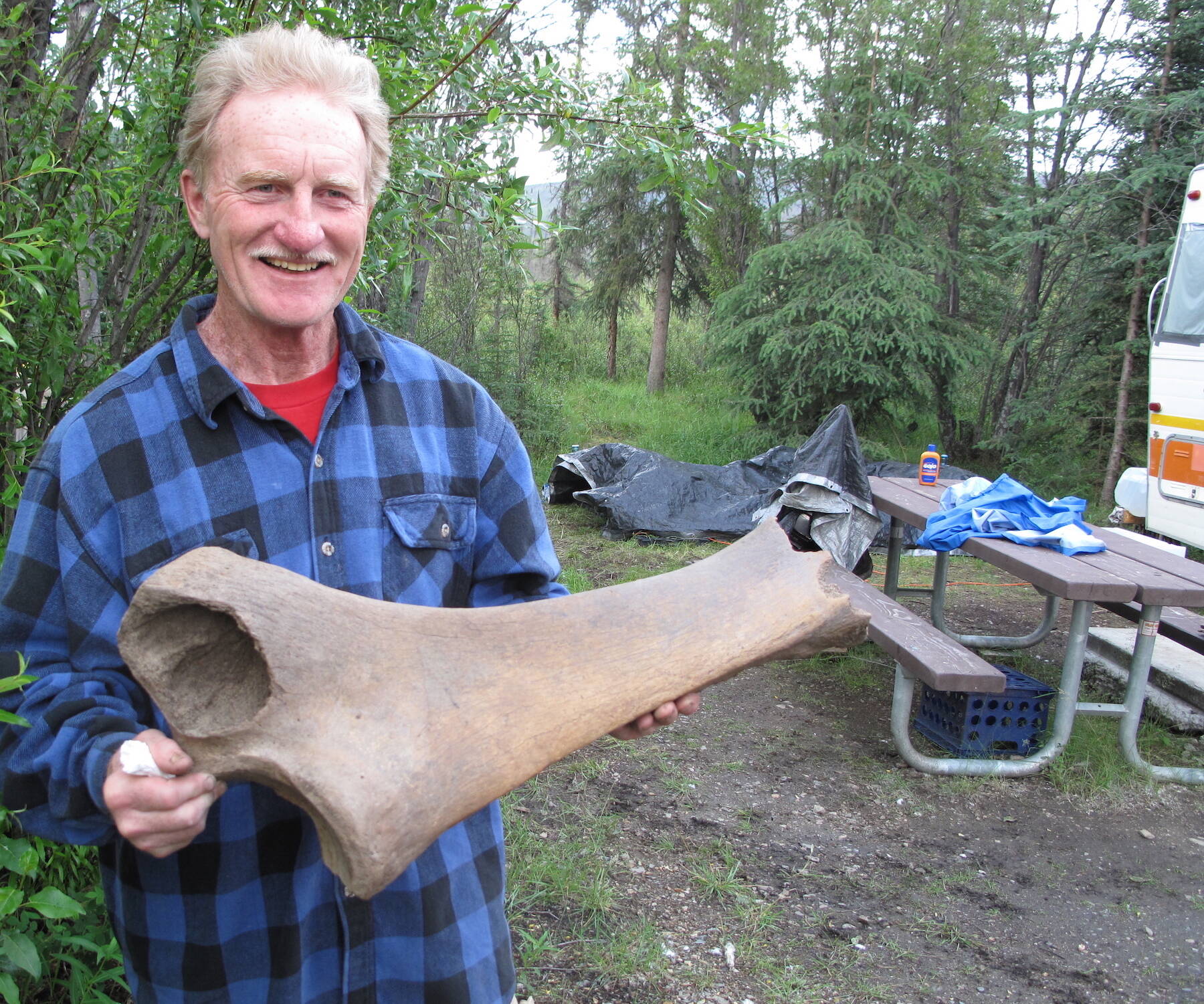
A gold miner holds a woolly mammoth femur he found as he worked frozen ground in the Fortymile River mining district. (Courtesy Photo / Ned Rozell)
