
Alaska schools are hiring teachers from the Philippines amid a massive national shortage. It’s the latest wave of immigrants from Southeast Asia to come to the state. This is part one of a five part audio series, Mabuhay sa Alaska, by KMXT and breaks down how and why those teachers are here, as well as what it means for both Alaska, and the island nation.
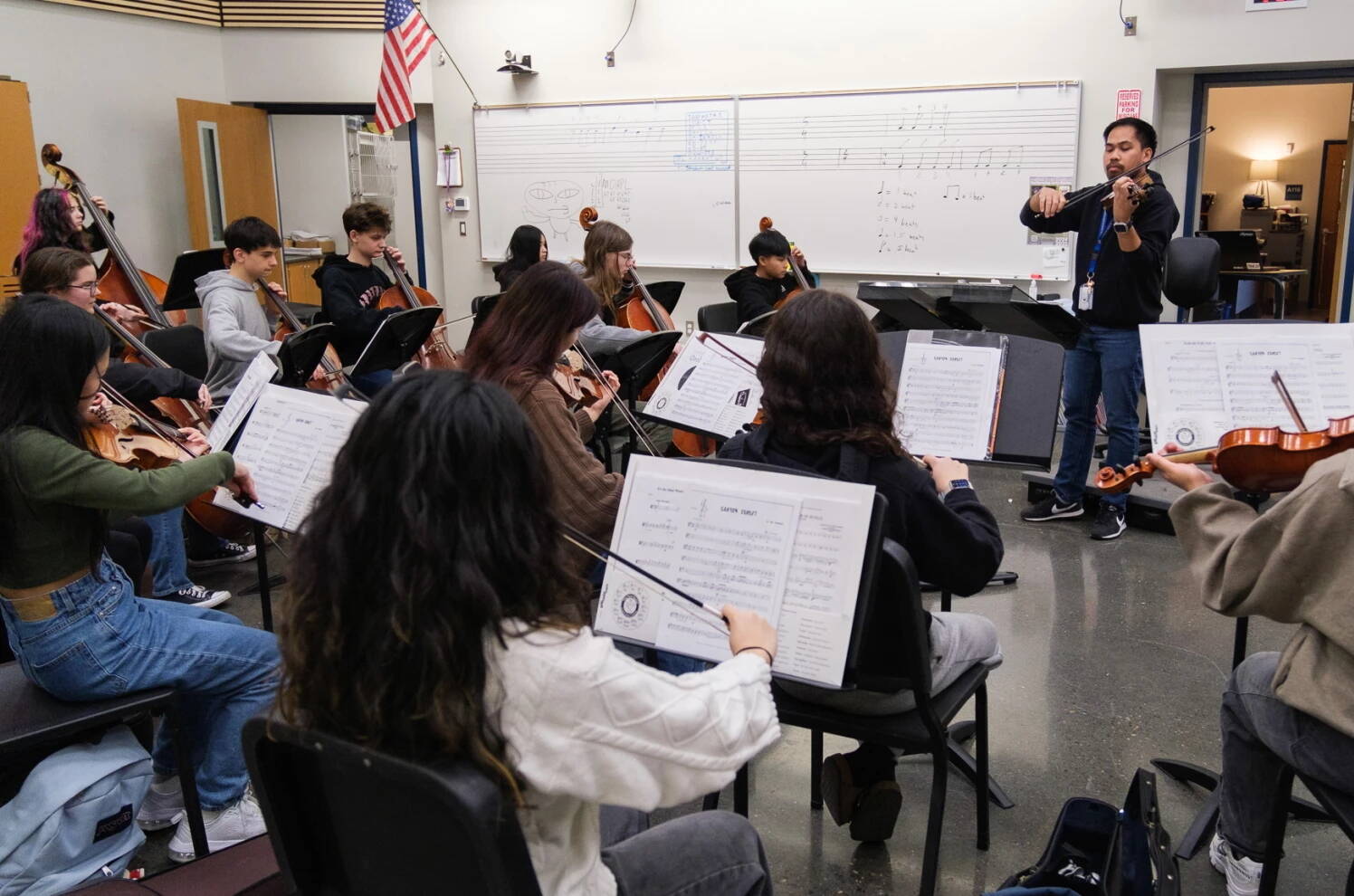
Serjoe Gutierrez stood above the Kodiak High School Orchestra, violin in hand, as students rifled through their sheet music for pieces like “The Barber of Seville” and “Canyon Sunset.”Gutierrez often plays with his students instead of conducting them.
Gutierrez, who was born and raised in the Philippines, was in his fifth year of teaching there when he decided he wanted to try to work in another country.
“I think it’s time for me to come out of my comfort zone, explore a lot of opportunities, since I’m still young,” he said.
Alaska wasn’t high on his list. Kodiak barely made it on his radar.
“Kodiak was the last school district I applied to because it was the last school district that pop(ped) out of my Google browser,” Gutierrez said. “And I told myself, ‘Well if not in Kodiak, maybe the United States is not for me.’”
He’s now in his third year of teaching here.
Gutierrez’s immigration story is one of hundreds already playing out in schools all over Alaska, from the Aleutians to the North Slope to Southeast, as dozens of school districts have hired from the Philippines amid a national shortage of certified teachers.
School districts are cutting out the middleman
Gutierrez has become well known in Kodiak. Parents chat with him at student concerts, and he hosts a Filipino music show on KMXT. He plays piano at a local church, as well as violin for charity auctions and in the community’s theater.
He has even joined the Kodiak Island Borough School district’s efforts to recruit more teachers from his home country. In January, Gutierrez helped lead a group of Alaska school administrators on a recruiting trip to the Philippines.

One teaching candidate on a call back wore a filipiniana while interviewing with Kodiak High School Assistant Principal Matt Bieber. (Brian Venua/KMXT)
Until recently, school districts have relied on third-party agencies to recruit teachers. But with demand up and opportunities to cut out middlemen, Kodiak’s district has led the way to recruit directly from the Philippines.
Some parents and Kodiak community members have criticized the practice for being too expensive. Kodiak Island Borough School District spent about $28,000 to send a team of 4 people this year, including Gutierrez. Teams like that screen hundreds of candidates in a single trip.
Working with lawyers and visa fees cost an additional $7,000 per teacher hired. Districts also can pay another $2,400 if they want to work with immigration lawyers to extend visas.
Hiring through an agency can cost a district about $27,000 per teacher.
And districts aren’t the only ones that pay when going through agencies. When Gutierrez started looking for work abroad three years ago, he had to pay $50 just to learn how to apply for jobs in other countries. Many teachers in the Philippines make only about $400 per month. He’s heard of some agencies charging teachers thousands of dollars once they’ve been placed in the U.S.
“The best of the best”
It took the group of administrators about two days to travel from Anchorage to the Philippines for the most recent recruitment trip. On the first day of recruiting, in a hotel conference space near Manila, candidates wore Western dresses and suits – even tuxedos. Others wore traditional Filipino formal wear, like embroidered shirts called barong tagalogs and distinctly shouldered filipinianas.
The room was full of candidates with graduate and postgraduate degrees. Some of the administrators said that on recruiting trips within the U.S., candidates were often fresh from their undergraduate colleges.
The Bering Strait School District has hired up to 60 teachers in a single year – about a third of its total teaching staff. The district has hired international teachers through an agency before, but this was its first time sending someone to recruit directly.
Tera Cunningham leads the district’s human resources. She’d never seen so many people vying for teaching jobs in Alaska.
“It’s exciting to see so many well-trained, well-prepared people who genuinely just want to help kids,” she said.
The candidates had only a few minutes to introduce themselves and impress the administrators. Out of the first group of 120 candidates, less than a third had callbacks that day.
“It is intense to do it this way, and we know we’ll get the best of the best here,” Cunningham said.
She said meeting candidates in person helps her visualize them in action.
“And so I’m excited to see who that looks like, what that looks like when they make it through and they’re finally at our sites,” she said.

Recruiters like Tera Cunningham work in teams of two to screen eight people at a time. (Brian Venua/KMXT)
But not every school district can afford to visit the Philippines. That’s part of why Jennifer Schmidt with the Alaska Council of School Administrators joined the group. She said that the trip makes sense for districts with many openings, but some have only one or two.
The council, which handles the Alaska teacher and personnel system, received grant money from the U.S. Department of Education to improve the state’s retention and recruitment.
Kodiak’s school district has led the recruiting trips so far, but Schmidt said the eventual goal is for her to take the lead. She said ideally, schools wouldn’t need to recruit from abroad, but there just aren’t enough American and Alaska-grown candidates.
“It’s going to take a lot of turnaround and a lot of change in the state of Alaska for us to have enough teachers in Alaska and in the U.S. that are going to want to come and teach there,” she said.
This story was originally published by KMXT, as part one of a five part audio series, Mabuhay sa Alaska. Alaska Beacon, an affiliate of States Newsroom, is an independent, nonpartisan news organization focused on connecting Alaskans to their state government.
