
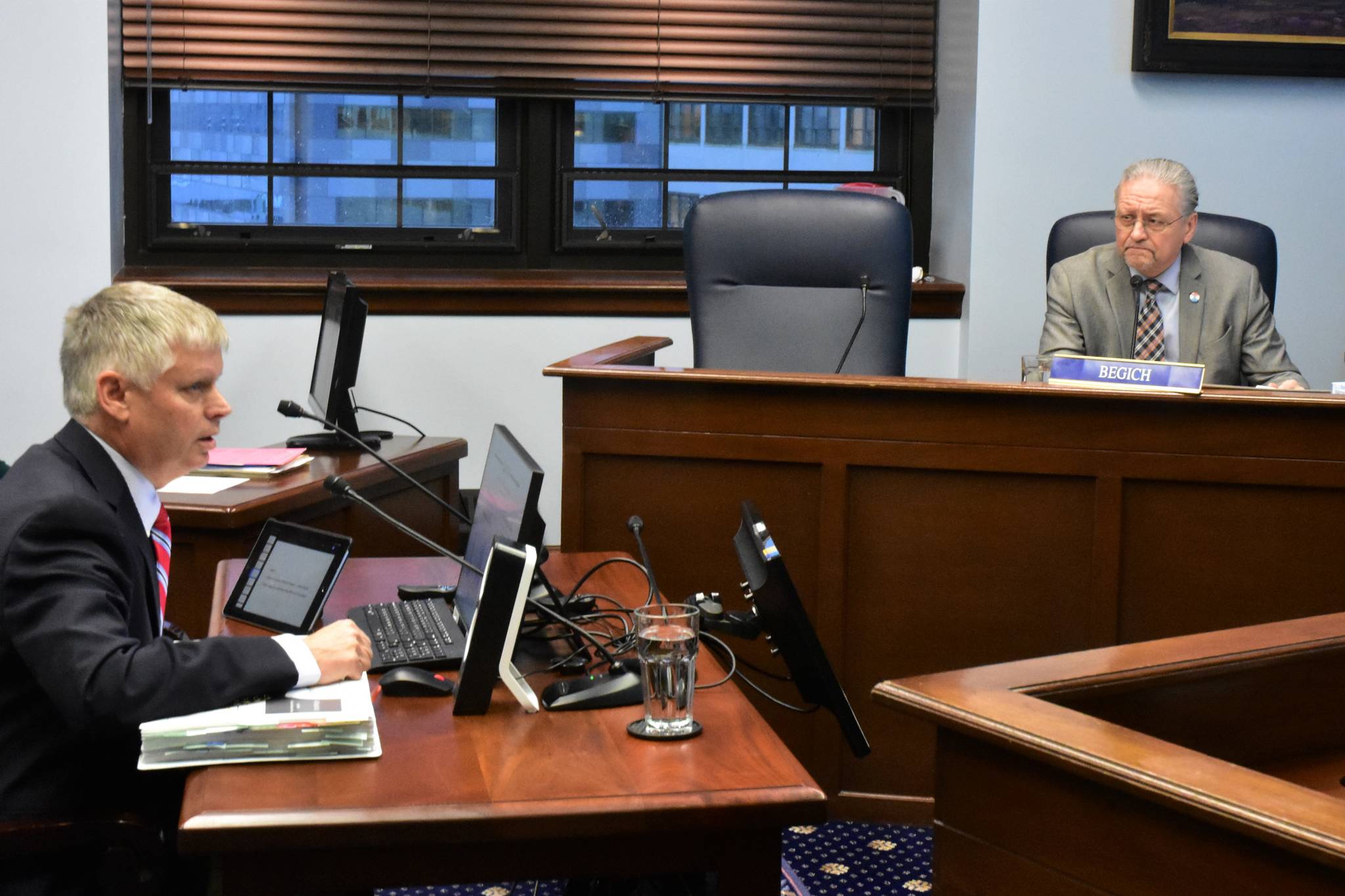
Bob Griffin, senior education research fellow from the Alaska Policy Forum, left, and Sen. Tom Begich, D-Anchorage, at a Senate Education Committee meeting on Tuesday. (Peter Segall | Juneau Empire)

Bob Griffin, senior education research fellow from the Alaska Policy Forum, left, and Sen. Tom Begich, D-Anchorage, at a Senate Education Committee meeting on Tuesday. (Peter Segall | Juneau Empire)

Alaska Reads Act gets a closer look

Students could be retained under the bill, but retention only works with strong support, experts say

Lawmakers on the Senate Education Committee got a crash course on the effects of student retention and promoting students to the next grade based on testing at a committee meeting Tuesday.

Despite being much celebrated for its bipartisanship and comprehensive approach, the Alaska Reads Act has a long way to go before it finally becomes law, and many of its finer details are still being hammered out.

One of the critical components of Senate Bill 6, better known as the Alaska Reads Act, are intervention programs that can be implemented if a student is found to be unproficient in reading. One of those provisions is the possibility of holding students back if they’re not able to read at grade level. Students will have multiple pathways to show reading proficiency, according to the text of the bill, so students who may not perform well on standardized tests might still be promoted to the next grade.

But if third grade students are found to not read at grade level by the end of the school year, parents and educators could make the decision to hold the child back a grade. Florida has a similar “test-based promotion policy” for third graders and so the committee heard from several experts on what the effects of that policy was on the state’s educational outcomes.

[Bipartisan reading bill receives broad support]

One of the presenters to the committee was Boston University professor Marcus Winters, an economist who had studied the effects of retention under Florida’s policy. Students retained in third grade showed substantial increases in GPA and decreases in remedial high school courses, Winters said.

But while retention programs might yield benefits down the line, retention programs are only meaningful when there are effective reading intervention programs in place which address student needs, according to Anji Gallanos, director of literacy, school readiness and pre-school for pre-K through third grade for the state of Colorado.

Colorado’s policy focuses on screening kids for reading deficiencies so that interventions can be made before students fall too far behind, Gallanos said. One of the critical components of interventions was teacher training that gives educators the tools they need to effectively help students with reading troubles. Quality screening for reading deficiencies are essential, she said, because there are a number of areas where students may have trouble reading. If educators are not able to identify which areas of reading a student is struggling in, it can make creating an intervention plan for that student difficult, Gallanos said.

At the end of the meeting, Department of Education and Early Development Commissioner Michael Johnson said while retention got a lot of attention during the meeting, the Alaska Reads Act is not a retention bill. Retention is an element of the bill but not its goal.

Helping students learn to read, and providing educators with the tools they need to help students succeed is the goal, Johnson said. Training teachers to be able to identify when students show reading deficiencies is critical component of the bill.

• Contact reporter Peter Segall at 523-2228 or psegall@juneauempire.com.

More in News

Downtown Juneau experiences its first significant city-level snow fall of the season as pictured on Saturday, Dec. 6, 2025. (Mari Kanagy / Juneau Empire)
Sub-zero temperatures to follow record snowfall in Juneau

The National Weather Service warns of dangerous wind chills as low as -15 degrees early this week.

A truck rumbles down a road at the Greens Creek mine. The mining industry offers some of Juneau’s highest paying jobs, according to Juneau Economic Development’s 2025 Economic Indicator’s Report. (Hecla Greens Creek Mine photo)
Juneau’s economic picture: Strong industries, shrinking population

JEDC’s 2025 Economic Indicators Report is out.

Map showing approximate location of a 7.0-magnitude earthquake on Saturday, Dec. 6, 2025. (Courtesy/Earthquakes Canada)
7.0-magnitude earthquake hits Yukon/Alaska border

Earthquake occurred about 55 miles from Yakutat

A commercial bowpicker is seen headed out of the Cordova harbor for a salmon fishing opener in June 2024 (Photo by Corinne Smith)
Planned fiber-optic cable will add backup for Alaska’s phone and high-speed internet network

The project is expected to bring more reliable connection to some isolated coastal communities.

Gustavus author Kim Heacox talked about the role of storytelling in communicating climate change to a group of about 100 people at <strong>Ḵ</strong>unéix<strong>̱</strong> Hídi Northern Light United Church on Wednesday, Dec. 3, 2025. (Mari Kanagy / Juneau Empire)
Author calls for climate storytelling in Juneau talk

Kim Heacox reflects on what we’ve long known and how we speak of it.

The Juneau road system ends at Cascade Point in Berners Bay, as shown in a May 2006 photo. (Michael Penn / Juneau Empire file)
State starts engineering for power at proposed Cascade Point ferry terminal

DOT says the contract for electrical planning is not a commitment to construct the terminal.

Members of the Alaska Air and Army National Guard, Alaska Naval Militia, and Alaska State Defense Force work together to load plywood onto a CH-47 Chinook helicopter, in Bethel, Alaska, Nov. 2, 2025, bound for the villages of Napaskiak, Tuntutuliak, and Napakiak. The materials will help residents rebuild homes and restore community spaces damaged by past storms. (U.S. Army National Guard photo by Spc. Ericka Gillespie)
Gov. Dunleavy approves Alaska National Guard assisting ICE in Anchorage

The National Guard said five service members will assist with administrative support; lawmakers and civil rights advocates worry that the move signals a ramping up of immigration enforcement operations in Alaska

A cruise ship, with several orange lifeboats visible, is docked in downtown Juneau. (Laurie Craig / Juneau Empire file photo)
CBJ seeks input on uses for marine passenger fees

Public comment period is open for the month of December.

Most Read