
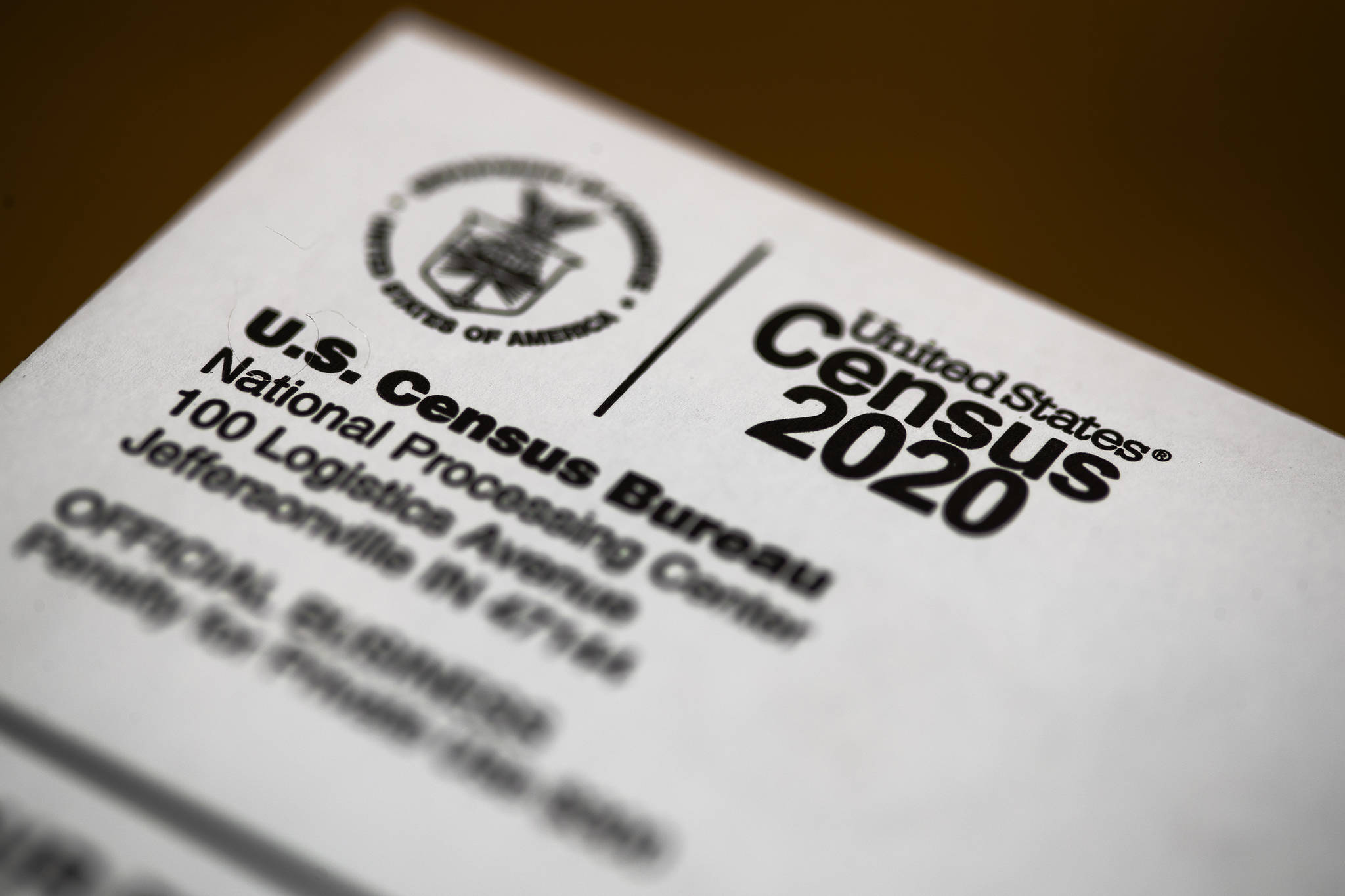
This photo shows an envelope containing a 2020 census letter mailed to a U.S. resident. On Wednesday, March 24, 2021, a federal judge dismissed a lawsuit filed by the state of Ohio that tried to get the U.S. Census Bureau to provide data used for drawing congressional and legislative districts ahead of its planned release. (AP Photo / Matt Rourke)

This photo shows an envelope containing a 2020 census letter mailed to a U.S. resident. On Wednesday, March 24, 2021, a federal judge dismissed a lawsuit filed by the state of Ohio that tried to get the U.S. Census Bureau to provide data used for drawing congressional and legislative districts ahead of its planned release. (AP Photo / Matt Rourke)

Alaska joins 15 other states in backing Alabama’s challenge to Census privacy tool

The case could go directly to the Supreme Court if appealed.

By Mike Schneider

Associated Press

ORLANDO, Fla. — Sixteen other states are backing Alabama’s challenge to a statistical method the U.S. Census Bureau is using for the first time to protect the privacy of people who participated in the 2020 census, the nation’s once-a-decade head count that determines political power and funding.

A federal judge on Monday allowed the 16 states to file a brief in a support of a lawsuit brought by Alabama last month. The suit seeks to stop the Census Bureau from applying the method known as “differential privacy” to the numbers that will be used for redrawing congressional and legislative seats later this year.

The states supporting Alabama’s challenge are Alaska, Arkansas, Florida, Kentucky, Louisiana, Maine, Mississippi, Montana, Nebraska, New Mexico, Ohio, Oklahoma, South Carolina, Texas, Utah and West Virginia. Maine and New Mexico have Democratic attorney generals, while all the other states have Republican ones.

A three-judge panel in federal court in Alabama is hearing the case, which could go directly to the Supreme Court if appealed.

Differential privacy adds mathematical “noise,” or intentional errors, to the data to obscure any given individual’s identity while still providing statistically valid information.

Bureau officials say the change is needed to prevent data miners from matching individuals to confidential details that have been rendered anonymous in the massive data release, which is expected as early as August. It will be applied to race, age and other demographic information in geographic areas within each state.

“It’s a statistical technique that is intended to protect people’s privacy … There can be privacy hacks today that technologically weren’t possible 10 years ago,” said Department of Commerce Secretary Gina Raimondo last week during a White House briefing. “So in order for us to keep up with that and protect people’s privacy, we have to implement new techniques, and this is one of those new techniques.”

The Commerce Department oversees the Census Bureau.

The 16 states supporting Alabama said that differential privacy’s use in the redistricting numbers will make the figures inaccurate for all states, especially at small geographic levels, and the Census Bureau could use other methods to protect people’s privacy.

Differential privacy “would make accurate redistricting at the local level impossible,” violating the constitutional obligation that districts have equal populations, and it also could harm long-running research on health and safety, their brief said.

“Because differential privacy creates false information—by design—it prevents the states from accessing municipal-level information crucial to performing this essential government functions,” the 16 states said. “And the distorting impact of differential privacy will likely fall hardest on some of the most vulnerable populations—rural areas and minority racial groups.”

A pair of civil rights groups also raised concerns, saying an examination of test Census data showed differential privacy produced numbers that were less accurate for determining if a racial or ethnic minority group formed a majority in a particular community, potentially diluting their local political power. Democratic-led lawmakers in California, the nation’s largest state, also raised concerns about differential privacy in a recent letter to President Joe Biden’s chief of staff, Ronald Klain.

More in News

Map showing approximate location of a 7.0-magnitude earthquake on Saturday, Dec. 6, 2025. (Courtesy/Earthquakes Canada)
7.0-magnitude earthquake hits Yukon/Alaska border

Earthquake occurred about 55 miles from Yakutat

A commercial bowpicker is seen headed out of the Cordova harbor for a salmon fishing opener in June 2024 (Photo by Corinne Smith)
Planned fiber-optic cable will add backup for Alaska’s phone and high-speed internet network

The project is expected to bring more reliable connection to some isolated coastal communities.

Gustavus author Kim Heacox talked about the role of storytelling in communicating climate change to a group of about 100 people at <strong>Ḵ</strong>unéix<strong>̱</strong> Hídi Northern Light United Church on Wednesday, Dec. 3, 2025. (Mari Kanagy / Juneau Empire)
Author calls for climate storytelling in Juneau talk

Kim Heacox reflects on what we’ve long known and how we speak of it.

The Juneau road system ends at Cascade Point in Berners Bay, as shown in a May 2006 photo. (Michael Penn / Juneau Empire file)
State starts engineering for power at proposed Cascade Point ferry terminal

DOT says the contract for electrical planning is not a commitment to construct the terminal.

Members of the Alaska Air and Army National Guard, Alaska Naval Militia, and Alaska State Defense Force work together to load plywood onto a CH-47 Chinook helicopter, in Bethel, Alaska, Nov. 2, 2025, bound for the villages of Napaskiak, Tuntutuliak, and Napakiak. The materials will help residents rebuild homes and restore community spaces damaged by past storms. (U.S. Army National Guard photo by Spc. Ericka Gillespie)
Gov. Dunleavy approves Alaska National Guard assisting ICE in Anchorage

The National Guard said five service members will assist with administrative support; lawmakers and civil rights advocates worry that the move signals a ramping up of immigration enforcement operations in Alaska

A cruise ship, with several orange lifeboats visible, is docked in downtown Juneau. (Laurie Craig / Juneau Empire file photo)
CBJ seeks input on uses for marine passenger fees

Public comment period is open for the month of December.

Browsers crowd into Annie Kaill’s gallery and gift shop during the 2024 Gallery Walk. (Juneau Empire file photo)
Gallery Walk guide for Friday, Dec. 5

The Juneau Arts & Humanities Council announced community events taking place during… Continue reading

The Alaska State Capitol is seen on Tuesday, Nov. 25, 2025. (Photo by James Brooks/Alaska Beacon)
Alaska Senate Republicans confirm Rauscher, Tilton and open two vacancies in state House

The Alaska Republican Party is moving quickly after Republicans in the Alaska… Continue reading

Downtown Skagway, with snow dusting its streets, is seen in this undated photo. (Photo by C. Anderson/National Park Service)
Skagway’s lone paramedic is suing the city, alleging retaliation by fire department officials

This article was reported and published in collaboration between the Chilkat Valley… Continue reading

Most Read