
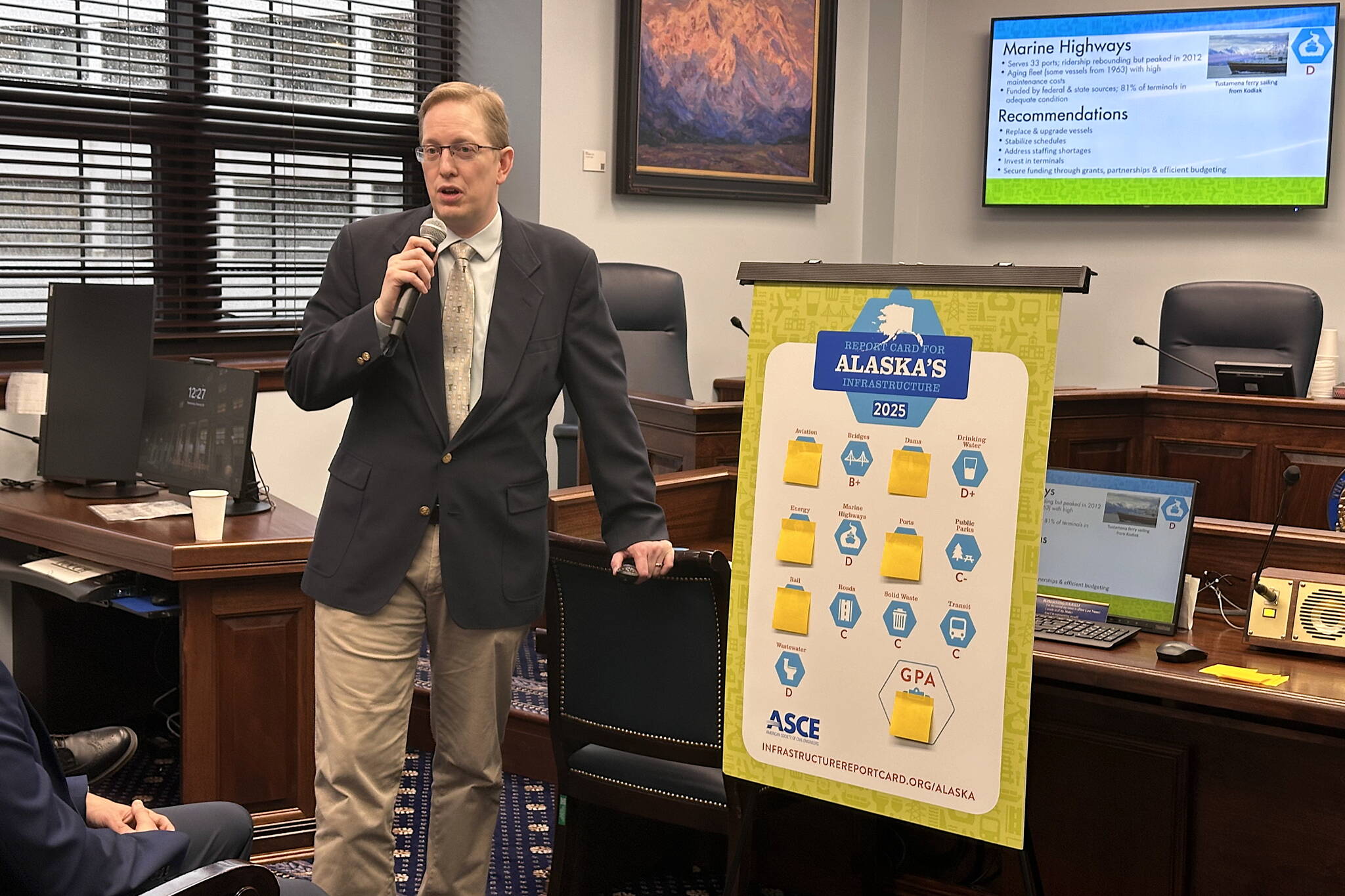
Alaska improved from a C- four years ago to a C on an Infrastructure Report Card presented Wednesday by the American Society of Civil Engineers, with funding from the Infrastructure Investment and Jobs Act cited as a key factor.
But the Alaska Marine Highway System again ranked at the bottom with a “D” grade, sharing that dishonor with wastewater among the 13 categories assessed. Concern was also expressed by an official presenting the report about funding for future statewide infrastructure improvements due to large-scale cutbacks sought by the Trump administration.
A key takeaway from the grades is the importance of “asset management” by wisely using available resources to assess and maintain existing infrastructure so that more costly repairs or replacements can be minimized, said Greg Kinney, one of three members of the engineers’ society presenting the study during a noontime seminar at the Alaska State Capitol.
“We have to know the condition of the facilities that we’re managing and we have to be able to maintain them,” he said. “So with that information we can do condition-based maintenance. We can also look ahead and begin to plan proactively for replacements, or, you know, repairs.”
The infrastructure report cards have been issued every four years since 2017 for states as well as a nationwide assessment, with the latter scheduled for release on March 25.
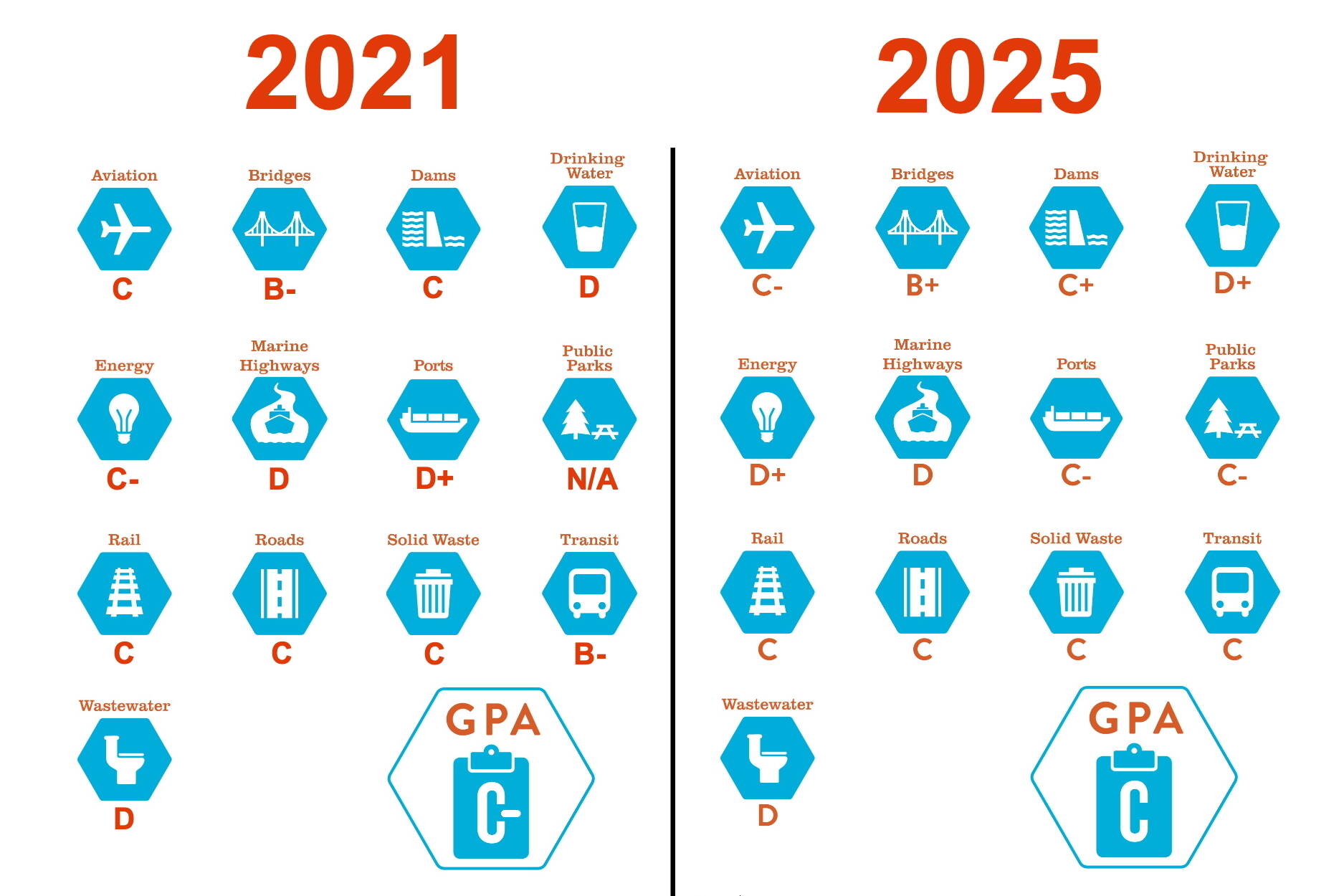
Comparisons of Alaska’s Infrastructure Report Card as graded by the American Society of Civil Engineers for 2021 and 2025. (American Society of Civil Engineers)
Alaska’s overall grade of C is comparable to many other states, said Ryan Anderson, commissioner of the Alaska Department of Transportation and Public Facilities, in an interview after the presentation. The highest overall grade in this year’s report is a C+ earned by three states, while Texas and Maine are among the states sharing a C grade with Alaska.
“I’m always impressed in Alaska because I could take off from Juneau right now and I could be in Barrow today if I so chose,” he said. “That’s a that’s a good transportation system from my perspective and I feel safe on it, and so the safety aspect is really important.”
The biggest improvement in this year’s Alaska report card was bridges, receiving a B+ in this year’s report card compared to B- in 2021, which are cited as “a shining” example of the state making the most efficient use of its resources to upgrade bridges in poor condition. The biggest drop was public transit with a 2025 grade of C, down from B- in 2021, due to ongoing effects of a shutdown and subsequent large loss of service resulting from the COVID-19 pandemic.
Authors of the study also emphasized Alaska’s vast size and difference in communities means the grades aren’t a simple statewide snapshot. An example cited was drinking water, with a 2025 grade of D+ up from D in 2021, where urban supplies were called among the best in the U.S. while many of Alaska’s 280 rural communities have failing grades — and 32 have no source of clean drinking water at all.
“They’re using mainly river water, snow melts, rain collection, sort of thing,” said Daniel Nichols, another presenter of the study, noting similar problems exist for wastewater issues in those communities.
The Alaska Marine Highway’s basement grade is due to “aging ships that need constant repair,” a workforce shortage because “for every person that they hire with the Marine Highway System, 1.5 quit,” and ridership being half of its 2012 peak, Nichols said.
“That’s not sustainable and they actually have to take one of the ships offline at different times to because they didn’t have the staff to manage the vessels safely,” he said. Upgrade and replacement plans are in place, but “they just haven’t happened yet (and) we need to make sure we get that to the end, and then stabilize the schedules (and) address the staffing shortages. And we’re going to have to find a long-term solution for the funding and operation budgets.”
However, funding is a major dilemma for policymakers who are facing both a sizeable state deficit as well as the Trump administration’s efforts to drastically slash federal spending, which funded 37.3% of Alaska’s $16.3 billion state government budget during the past fiscal year.
A total of $9.3 billion for 3,825 projects in Alaska is being provided by the 2021 bipartisan infrastructure bill as well as the 2022 Inflation Reduction Act, Kinney said.
“Some of that, as I’m sure most of you are aware, is in jeopardy,” he said. “There’s been a change in priority with the change in administration.”
Some funding has already been revoked, such as the National Electric Vehicle Infrastructure (NEVI) Formula Program, which in Alaska was going to provide more than $50 million over five years for charging stations and related facilities. Other funding officials have said is at risk includes federal grants to upgrade the state ferry system and hundreds of millions for energy projects primarily in rural parts of the state.
“We’ve had a change in administration, but we are hopeful that infrastructure funding has bipartisan support on the national level and that will continue to have funding to make those necessary infrastructure repairs,” said David Gamez, another of the society members making the presentation.
• Contact Mark Sabbatini at mark.sabbatini@juneauempire.com or (907) 957-2306.
