
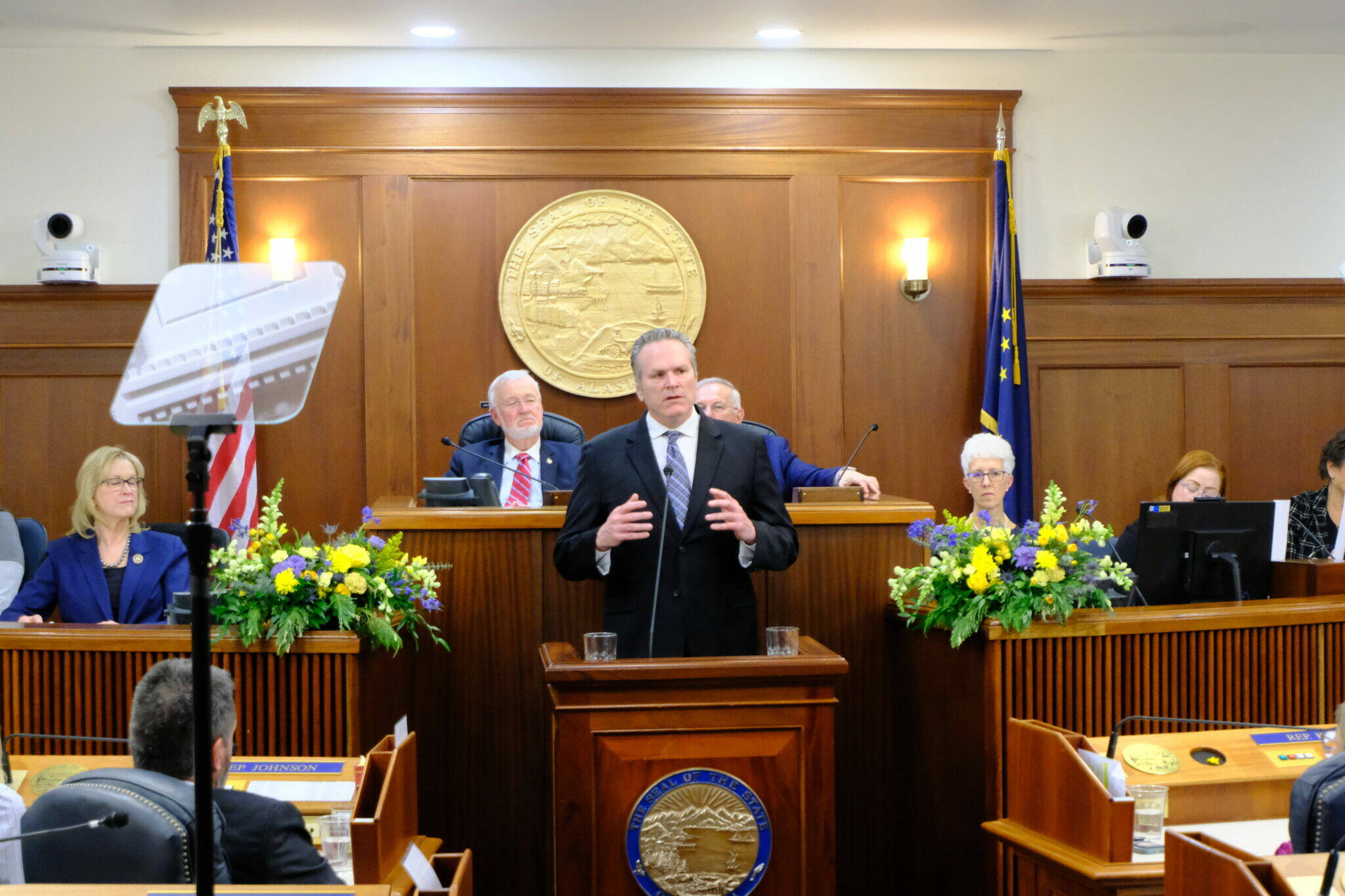
Gov. Mike Dunleavy has proposed a 4% statewide summer sales tax, effective through 2034, as part of his plan to bring Alaska’s state revenue and expenses in line for the long term.
If adopted, the sales tax would be Alaska’s first statewide, general-purpose levy since state legislators abolished Alaska’s income tax in 1980.
Alongside the tax bill, the governor has proposed a tighter state spending cap and a constitutional amendment that would guarantee a Permanent Fund dividend lower than scheduled by current law but above what legislators have approved in recent years.
“This comprehensive plan is designed to bridge the next seven years by stabilizing state finances, limiting spending growth, restoring a rules-based PFD, and sharing responsibility through targeted, time-limited revenue measures that support investment and predictability,” the governor wrote in a letter to state lawmakers.
Since 2015, persistently low oil prices and plateaued oil production from the North Slope have dogged state lawmakers who have struggled to balance Alaska’s need for services with the desire to pay large Permanent Fund dividends.
While most of Alaska’s general-purpose state revenue comes from the Alaska Permanent Fund, oil remains the No. 2 source of flexible spending money for the state, leaving the annual budget process subject to the vagaries of global markets.
The governor’s plan resembles one drafted by a bipartisan, bicameral legislative working group in 2021 and 2022. That plan and others like it have never significantly advanced in the Legislature.
Senate Bill 227, containing the bulk of the governor’s plan, was introduced on Monday and referred to the Senate Finance Committee for further discussion. An identical version will be introduced in the House on Wednesday.
The most fiscally consequential item in the bill is the sales tax, which would peak during the summer tourist season and drop to 2% between October and March.
That tax is expected to raise as much as $815 million per year for state services and the Permanent Fund dividend by Fiscal Year 2032.
Dunleavy’s proposed budget for the fiscal year that begins July 1 — fiscal year 2027 — is about $7.75 billion and has a deficit of almost $1.5 billion.
The Dunleavy administration expects that revenue from oil production and a proposed trans-Alaska natural gas pipeline will compensate for the phaseout of all the taxes in the long term.
Under SB 227, the state’s corporate income tax would fall to zero in 2031; the sales tax wouldn’t expire until 2034, leaving individual Alaskans paying higher tax rates than corporations for a period.
“Normally, sales tax is left to local governments. So I know it was a hot issue in Anchorage when the Mayor proposed that, so I think it is going to hit a lot of households,” said Sen. Lyman Hoffman, D-Bethel and co-chair of the Senate Finance Committee.
Sen. Bill Wielechowski, D-Anchorage, applauded Dunleavy on Monday for putting forward a fiscal proposal, even if he disagrees with some of the components.
“The governor’s putting out a bill. I commend him for that. He’s putting out, you know, he’s throwing out ideas. I give him credit for that,” he said.
Wielechowski and other legislators said they want to fully analyze what the governor is proposing before opining on it.
“There are a lot of parts to this bill, and the No. 1 thing for me — without a complete analysis — is it’s really unclear on how this is going to affect hard-working Alaskans,” said House Minority Leader DeLena Johnson, R-Palmer. “It is my No. 1 priority to make sure everyday Alaskans aren’t on the losing end of this.”
The Alaska Municipal League, which represents local governments across Alaska, is particularly interested in the governor’s proposal.
The League has previously said it would prefer a statewide income tax to a sales tax.
In almost every part of Alaska, except for Anchorage, sales taxes are a pillar of services.
Many cities and boroughs exempt certain things, like food and utilities. Under the Dunleavy proposal, the state would be in charge of collecting sales taxes and would remit money to cities and boroughs.
Local exemptions and sales tax caps could vanish in the process, with the state instead determining what is taxed and not.
“This is a 56-page bill that we are still going through. Sales tax is a major component of that, but sales tax shouldn’t be thought about independently from the other components,” said Nils Andreassen, director of the league.
In addition to the sales tax, SB 227 temporarily raises the state’s minimum oil tax, adds a surcharge of 15 cents per barrel of oil produced on the North Slope and adds part of the corporate sales tax update that Dunleavy vetoed last year.
Andreassen noted that regardless of its source, tax revenue flows into the state’s general fund for any number of uses.
“All taxes are connected at some level,” he said.
The governor’s plan for the Permanent Fund dividend, enclosed in a constitutional amendment proposal separate to SB 227, is similar to one he proposed in 2021.
Currently, the state’s No. 1 source of general-purpose revenue is an annual transfer from the Permanent Fund to the state treasury. In FY27, that transfer will be worth $4 billion.
The “50-50 dividend” proposed by the governor would reserve half of that transfer for dividends, or about $2 billion, if it were in place this year.
That amounts to roughly $3,200 per PFD recipient, based on the number of recipients in 2025.
Under a current, disused formula in place since the 1980s, the dividend would be about $3,800 per recipient.
That formula hasn’t been used since 2015, and lawmakers have instead set the amount by fiat, typically using a figure that can be paid with available revenue after services are covered.
Legislators can ignore formulas in state law because the state’s annual budget bill is a law, and when one law conflicts with another, the newer law takes precedence.
Putting a dividend formula in the constitution would bind future governors and legislatures, and put the dividend atop the annual budgetary priority list, alongside education and other constitutionally mandated functions.
Adopting a constitutional amendment requires two-thirds of the House, two-thirds of the Senate, and approval by voters in the next general election.
Alaskans have not adopted an amendment since 2004, and the Legislature hasn’t put one before voters since 2016.
James Brooks is a longtime Alaska reporter, having previously worked at the Anchorage Daily News, Juneau Empire, Kodiak Mirror and Fairbanks Daily News-Miner. A graduate of Virginia Tech, he is married and has a daughter, owns a house in Juneau and has a small sled dog named Barley.
Alaska Beacon is part of States Newsroom, the nation’s largest state-focused nonprofit news organization.
