
On a sunny, warm August morning, a state senator and a legislative staffer sat in leather armchairs near a fireplace as an espresso machine hissed over shouted orders at SteamDot Coffee. A lobbyist, among the state’s top-earning, sat next to a window, quietly reading a newspaper and watching Anchorage traffic roll by.
And in a corner sat Vic Fischer — among the youngest of 55 delegates elected to the 1955-56 Constitutional Convention — recalling how he and the others were elected as nonpartisans to help transition the territory from federally dominated outpost to 49th state.
“Politics were not allowed to enter into discussions at the convention,” the 91-year old said in a low but determined voice.
That these local power brokers would find themselves together in a café was likely mere coincidence, a common occurrence in a state with fewer residents than San Francisco. The small-town feel of this expansive state means citizens have relatively easy access to their elected leaders, even with the capital city of Juneau accessible only by plane or ferry.
That, together with some relatively forward-thinking ideals instilled into the state’s founding document by Fischer and his fellow delegates, has pushed the Last Frontier to the front of the pack nationally in the State Integrity Investigation, a data-driven assessment of state government accountability and transparency conducted by the Center for Public Integrity and Global Integrity.
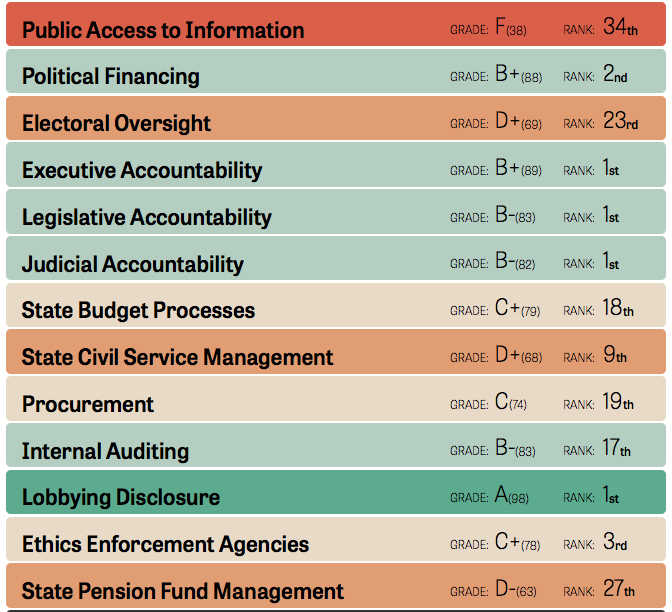
The state’s C grade and numerical mark of 76 are the best score in the nation. The score represents a significant jump from 2012, the first time the project was conducted, when Alaska received a D+.
The scores are not directly comparable, however, due to changes that improve and update the project and methodology, such as eliminating the category for redistricting, a process that generally occurs only once each decade.
But despite Alaska’s place on top, the assessment still reveals a number of areas where the state could improve its laws and practice.
Only three states score higher than D+ in State Integrity Investigation; 11 flunk.
Leading the nation
Alaska excelled in several areas, including oversight of lobbyists, easily-accessible political finance data, and strict ethics rules governing the executive and legislative branches.
One of the notable standouts is the category for judicial accountability, for which the state earned a B-, the best score in the nation.
When the delegates gathered at that long-ago Constitutional Convention, they wanted to create an accountable judiciary that was responsive to the people while being insulated from undue influence. The result was “a merit-based system that was isolated as much as possible from politics and money,” Fischer said.
For the selection of the state’s judges, the delegates created the Alaska Judicial Council, composed of the chief justice of the Supreme Court, three members selected by the governor and approved by the Legislature and three attorneys selected by the Alaska Bar Association.
The council recommends candidates based on a review of professional qualifications, and the governor selects a judge from that pool to fill any vacant seat. Voters weigh in during retention elections after a judge serves an initial term, and they are provided with an array of information about the judge’s performance, prepared by the council.
Judges are also required to file detailed financial interest disclosures that include information about immediate family members, and are subject to strict laws that regulate when and how they can accept gifts.
Room for improvement
When it comes to access to public information, however, the state’s founding fathers didn’t have the same foresight. The issue of public records didn’t even come up during the convention, Fischer said.
The result: Alaska’s open records laws are lacking, and their implementation is even worse. Alaska was one of many states to garner an F in this category.
Some agencies will promptly fulfill certain records requests, while others drag their feet or charge exorbitant fees. With no single entity to oversee the state’s open records law, the outcome of requests is inconsistent.
“I think this is probably the single worst thing where Alaska comes out worse than other states,” said media lawyer John McKay.
Procedures vary from department to department, and some agency heads tend to closely guard controversial records. Former Gov. Sean Parnell, a Republican, drew ire for slow responses to requests for state-funded studies on Medicaid expansion and a proposed billion-dollar bridge project.
In 2014, after Alaska Public Media and Alaska Dispatch requested emails related to an investigation into misconduct in the Alaska National Guard, the Parnell administration demurred.
Lori Townsend, news director for Alaska Public Media, said several months of unfulfilled promises from the governor’s office led to a curt denial in September 2014, when an official at the Alaska Department of Law essentially told her organization, “‘Well, actually no, we’re not going to give these to you,’” Townsend said.
Parnell was vying for a second term for governor that year, and based on recent history, his administration had little worry that its denial would be challenged. The only option for an appeal once a department head has weighed in is to take the matter to court, an expensive and arduous endeavor.
But in this case, that’s exactly what happened. The two news organizations sued and succeeded in gaining access to at least some of the emails they had requested before Election Day.
That was an exception to the norm. More often, public officials have simply rejected requests outright, and have faced few challenges, said Kyle Hopkins, digital director of KTUU Channel 2 News. “They knew that newsrooms couldn’t afford to see it through,” he said.
A conflict, or a dodge?
Alaskans like to point out that if the state was cut in half, each piece would still be bigger than Texas. But with fewer than 750,000 residents, in another sense Alaska is America’s largest small town. Everyone knows everyone else’s business, which makes for strange conflict of interest rules in the Legislature.
Under regulations enacted in the 1970s, lawmakers must declare if a bill poses potential conflicts of interest. It’s then largely up to the legislator to decide whether or not to vote on the bill. But even if lawmakers decide to recuse themselves from a bill, another member can object and force them to vote. The idea is to prevent legislators from grasping at inconsequential conflicts to dodge controversial votes, which was a common problem before the rule was enacted.
“People would stand up and say they have a conflict and don’t want to vote to get out of a tough issue, whether it’s a tax on fish, a tax on resources, or a funding bill,” said Senate President Kevin Meyer, R-Anchorage.
Longstanding debate over the rule resurfaced during a 2013 re-write of the state’s oil tax code, which, once it was passed, lowered the tax rate imposed on oil companies.
Meyer and Sen. Peter Micciche, R-Kenai, both of whom work for ConocoPhillips outside the 90-day lawmaking session, sought to recuse themselves from voting because of their ties to the oil company, which lobbied in favor of the bill, even though they both insisted they did not have a conflict of interest. The Legislative Ethics Committee found that their work for the oil industry did not violate the Legislative Ethics Act, and their legislative peers overruled their recusal attempts, a move that Meyers seemed happy with. He told Alaska Dispatch that a recusal would have disenfranchised his 70,000 constituents. The two ConocoPhillips employees then cast what could have been deciding yes votes in favor: the bill cleared the Senate 11-9. (Parnell, who signed the bill into law, had also worked for the oil company, before entering office.)
“It’s a small town. We all have to have jobs. It’s hard to avoid those conflicts,” said Tim Bradner, a longtime legislative analyst. “Probably one of the biggest safeguards is that it’s a small state. It’s easy to know what’s going on.”
• This article was originally written for the Center for Public Integrity, a nonprofit, nonpartisan investigative news organization in Washington, D.C. It is part of State Integrity 2015 campaign.
FOLLOW THIS SERIES
www.publicintegrity.org/accountability/state-integrity-investigation/state-integrity-2015?utm_campaign=syndication&utm_source=yahoo-news&utm_medium=taxonomy-link>
