Alaska birds suffered biggest die-off in recorded history in ‘Blob’ heat wave, new study says
Published 9:30 pm Sunday, December 15, 2024
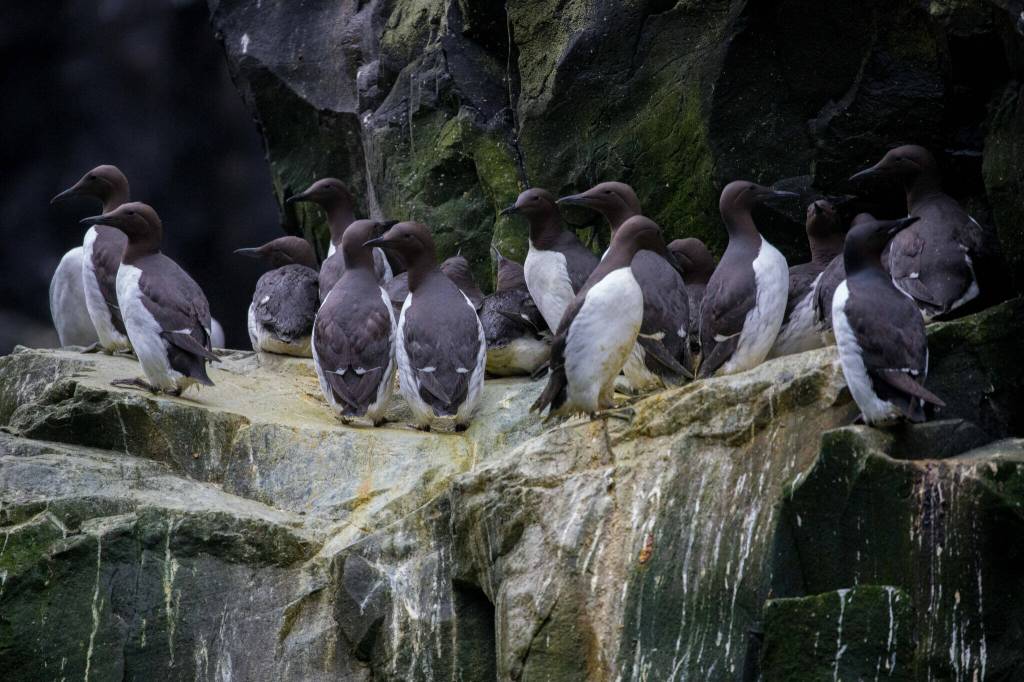
The loss of an estimated 4 million common murres during the marine heatwave known as the “Blob” was the biggest bird die-off in recorded history, and seven or eight years later, the population has not recovered, biologists report.
The findings, in a newly published study led by U.S. Fish and Wildlife Service biologist Heather Renner, show that the toll on common murres killed 4 million, about half the Alaska population.
It was not only the largest bird die-off in the modern era but also appears to be the largest wildlife die-off, said the study, which described the effect as “catastrophic” for the species.
Renner said the murre die-off indicates wider changes triggered by the extraordinarily intense heatwave.
“The thing about the Blob was that it was so big in geographic area, and also so long-lasting, and those two things combined to make it really just reset the whole ecosystem,” she said.
Common murres, black-and-white seabirds that somewhat resemble penguins in appearance, are among the most plentiful seabirds in Alaska. Prior to the marine heatwave that lingered in the North Pacific from 2014 to 2016, about 8 million of them were in Alaska, about a quarter of the world’s population.
The loss of about half of those birds happened quickly, in about a year’s time, Renner said.
The study is based on annual observations at 13 key bird colonies in the Gulf of Alaska and Bering Sea, sites that have been monitored for half a century. Annual monitoring is done by the Fish and Wildlife Service, which manages the sprawling Alaska Maritime National Wildlife Refuge that stretches from the Gulf of Alaska to the central Bering Sea, and the service’s partners. Renner is a supervisory wildlife biologist at the refuge and is based in Homer.
The new study updates a previous study, published in 2020, that estimated a loss of 1 million murres. Even then, it was seen as the biggest Alaska bird die-off on record.
“Now we have data from the breeding colonies, and we realize it was so much worse than we thought it was at the time,” Renner said.
During the peak years of the Blob, the carcasses of dead common murres and other seabirds littered Alaska beaches. Some were found even in inland sites distant from their normal ranges, like Fairbanks and Glennallen. The bodies were emaciated, indicating that starvation was the cause of death.
Animals other than birds also fell victim to the Blob heatwave, the new study notes. Humpback whale numbers dropped by about 20%, and Gulf of Alaska Pacific cod stocks crashed, forcing a closure of the commercial fishery there, it noted.
But for reasons yet to be fully understood, common murres were particularly hard-hit, and especially so in the Bering Sea, Renner said.
There are some theories as to why that is, she said.
Those birds have “high energetic demands,” she said. “Because they’re like tremendously deep divers and they’re pretty big seabirds, they have to eat about half of their body weight every day,” she said. Biologists think common murres depend on certain forage fish that school in dense groups, and those forage fish were not available during the intense heatwave. “As the conditions changed, they weren’t able to adapt,” she said.
There were other species that were less affected by the 2012-2016 heatwave or its aftermath. Among those that appear to have been more resilient are thick-billed murres, which are related to common murres but identifiable by their thicker necks and other features. Thick-billed murres are a bit more flexible in their prey, Renner said. “They were maybe able to just switch to other sources,” she said.
There are lingering effects of the die-off that are hindering the common murres’ recovery, even though waters have cooled and forage fish appear to be readily available.
Colonies are now so thinly populated that the normal murre defense against predators like egg-eating eagles – massing together shoulder-to-shoulder to protect nests – is no longer possible, Renner said. “They’re jumpy and they’ll flush really easily, and that makes them more vulnerable to things like predators,” she said.
Alaska’s population of common murres took a big hit in 1989 from the Exxon Valdez oil spill. It is estimated that the spill killed 250,000 birds, and most were common murres. The common murre population recovered from that disaster, according to the federal-state trustee council that manages money paid by Exxon Corp. to settle the federal and state governments’ spill damages.
But this time around, the opportunity for Alaska’s common murre population to recover may be limited.
“Our fear is that because heat waves are becoming more common that they may not even have time to recover before the next heat wave,” Renner said.
Scientists have predicted that climate change will set up repeat occurrences of the heatwaves that struck the Gulf of Alaska and Bering Sea in recent years. A recently published study by National Oceanic and Atmospheric Administration scientists forecast that in the Northern Bering Sea, conditions that led to an unprecedented scarcity of sea ice in 2018 will be repeated one to three times a decade through the 2030s.
• Yereth Rosen came to Alaska in 1987 to work for the Anchorage Times. She has reported for Reuters, for the Alaska Dispatch News, for Arctic Today and for other organizations. She covers environmental issues, energy, climate change, natural resources, economic and business news, health, science and Arctic concerns. This article originally appeared online at alaskabeacon.com. Alaska Beacon, an affiliate of States Newsroom, is an independent, nonpartisan news organization focused on connecting Alaskans to their state government.