
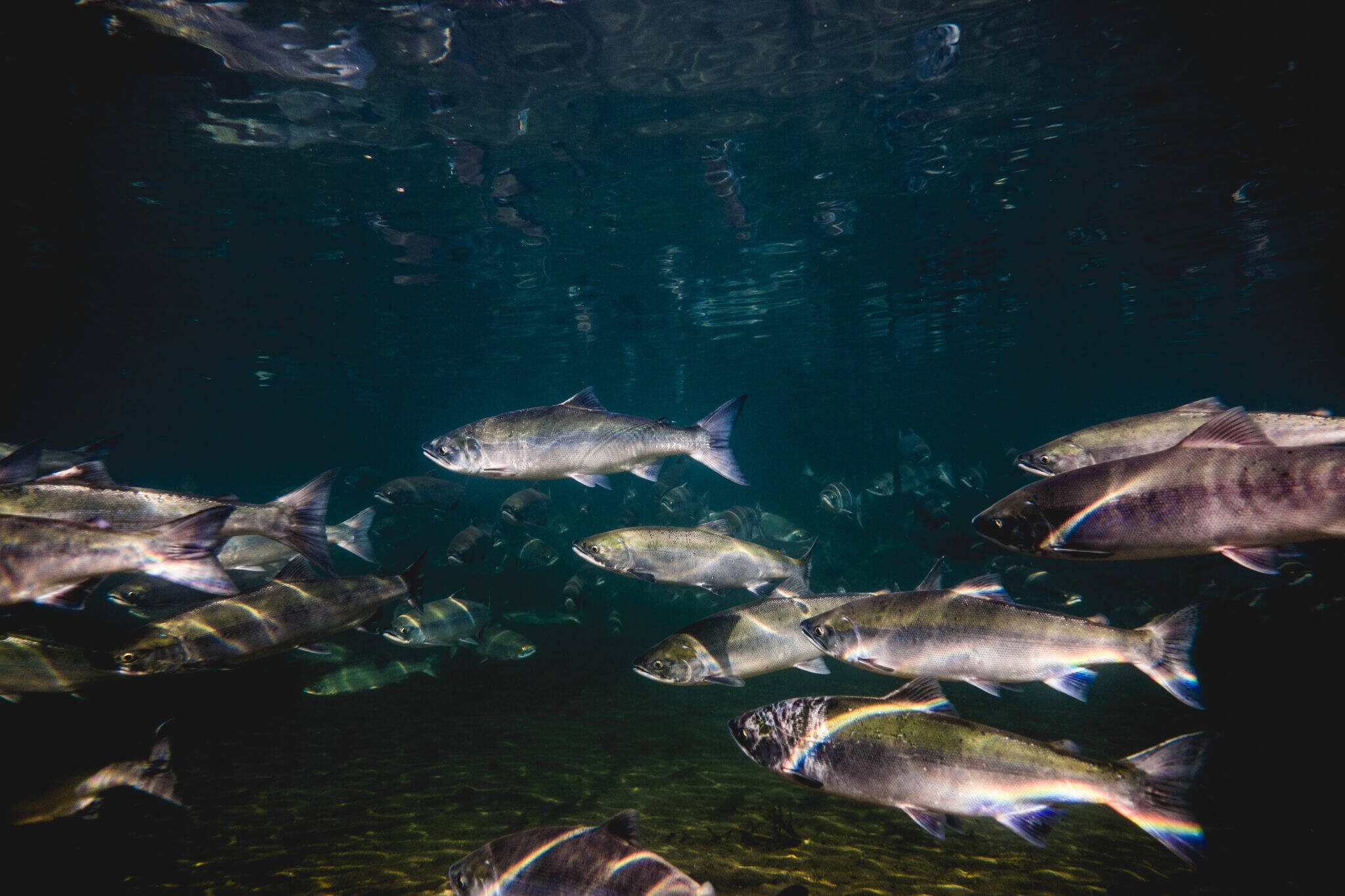
An underwater image captured in 2016 shows sockeye salmon swimming up the Brooks River in Alaska’s Katmai National Park to spawn. The U.S. Department of Agriculture is buying about 50 million pounds of Alaska fish — pollock, pink salmon and sockeye salmon — to use in its food and nutrition-assistance programs. (Photo provided by the National Park Service)

An underwater image captured in 2016 shows sockeye salmon swimming up the Brooks River in Alaska’s Katmai National Park to spawn. The U.S. Department of Agriculture is buying about 50 million pounds of Alaska fish — pollock, pink salmon and sockeye salmon — to use in its food and nutrition-assistance programs. (Photo provided by the National Park Service)

Agriculture Department commits to big purchase of Alaska salmon and pollock for food programs

The U.S. Department of Agriculture will purchase about 50 million pounds of Alaska seafood to use in national food and nutrition-assistance programs, state officials said on Tuesday.

The seafood purchase is to benefit needy children and adults and school lunches, said the Alaska Seafood Marketing Institute, which announced the department’s plans. The purchases are authorized through a portion of federal law called Section 32, which allows the department to buy surplus food products, and through the department’s Commodity Credit Corp., a government entity created to help stabilize agricultural income and prices.

In all, the Department of Agriculture has put bids on 1.4 million cases of pink salmon, 300,000 cases of sockeye salmon and 15 million pounds of pollock fish sticks and fillets, the Alaska Seafood Marketing Institute said. Each case of salmon holds 24 cans, with most cans holding 14.75 ounces but some holding 7.5 ounces.

It is a big purchase. In comparison, the USDA last year made purchases from Alaska of 3.7 million pounds of sockeye salmon, 47,000 cases of pink salmon and about 2.2 million pounds of pollock in combined transactions from May to July, according to ASMI. The USDA last year also bought $8 million worth of rockfish from Alaska and the West Coast, according to AMSI.

The purchase is likely timely.

Alaska’s industry is coping with a worldwide glut that has driven down prices and made sales much more difficult, ASMI Executive Director Jeremy Woodrow said in a presentation Tuesday at the Capitol.

“Due to inflation, really globally, consumer demand for seafood is incredibly low right now and our inventories are historically high. We aren’t able to push as much product through, so you get that supply and demand crunch,” Woodrow said during a “Lunch and Learn” session.

That leads to lower prices to fishers and processors, he said.

“So we’re in an incredible economic crunch that we haven’t seen for decades right now, where we’re looking at severe economic impacts,” he said.

• Yereth Rosen came to Alaska in 1987 to work for the Anchorage Times. She has reported for Reuters, for the Alaska Dispatch News, for Arctic Today and for other organizations. She covers environmental issues, energy, climate change, natural resources, economic and business news, health, science and Arctic concerns. This story originally appeared at alaskabeacon.com. Alaska Beacon, an affiliate of States Newsroom, is an independent, nonpartisan news organization focused on connecting Alaskans to their state government.

More in News

The northern lights are seen from the North Douglas launch ramp late Monday, Jan. 19. A magnetic storm caused unusually bright northern lights Monday evening and into Tuesday morning. (Chloe Anderson/Juneau Empire)
Rare geomagnetic storm causes powerful aurora display in Juneau

The northern lights were on full display Monday evening.

teaser
Juneau activists ask Murkowski to take action against ICE

A small group of protesters attended a rally and discussion on Wednesday.

A female brown bear and her cub are pictured near Pack Creek on Admiralty Island on July 19, 2024. (Chloe Anderson for the Juneau Empire)
Pack Creek permits for bear viewing area available now

Visitors are welcome from April 1 to Sept. 30.

Cars pass down Egan Drive near the Fred Meyer intersection Thursday morning. (Clarise Larson / Juneau Empire file photo)
Safety changes planned for Fred Meyer intersection

DOTPF meeting set for Feb. 18 changes to Egan Drive and Yandukin intersection.

Herbert River and Herbert Glacier are pictured on Nov. 16, 2025. (Mari Kanagy / Juneau Empire)
Forest Service drops Herbert Glacier cabin plans, proposes trail reroute and scenic overlook instead

The Tongass National Forest has proposed shelving long-discussed plans to build a… Continue reading

A tsunami is not expected after a 4.4-magnitude earthquake northwest of Anchorage Wednesday, Feb. 4, 2026. (U.S. Geological Survey)
No tsunami expected after 4.4-magnitude earthquake in Alaska

U.S. Geological Survey says 179 people reported feeling the earthquake.

ORCA Adaptive Snowsports Program staff member Izzy Barnwell shows a man how to use the bi-ski. (SAIL courtesy photo)
Adaptive snow sports demo slides to Eaglecrest

Southeast Alaska Independent Living will be hosting Learn to Adapt Day on Feb. 21.

Cars drive aboard the Alaska Marine Highway System ferry Hubbard on June 25, 2023, in Haines. (Photo by James Brooks)
Alaska’s ferry system could run out of funding this summer due to ‘federal chaos problem’

A shift in state funding could help, but a big gap likely remains unless a key federal grant is issued.

Photo by James Brooks/Alaska Beacon
U.S. Sen. Dan Sullivan stands with acting Coast Guard Commandant Adm. Kevin Lunday during the after the commissioning ceremony for the Coast Guard icebreaker Storis on Sunday, Aug. 10, 2025, in Juneau, Alaska.
Coast Guard’s new Juneau base may not be complete until 2029, commandant says

Top Coast Guard officer says he is considering whether to base four new icebreakers in Alaska.

Most Read