
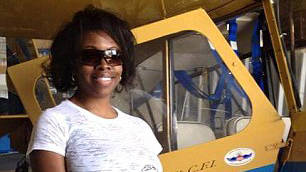
The National Transportation Safety Board has released its final report on the cause of the Wings of Alaska crash on July 17, 2015, that killed the pilot and injured her four passengers.
The probable primary cause of the crash was pilot error, the report said, but it also assigned blame to the failure of Wings of Alaska to follow its own procedures and to provide adequate training, and to the Federal Aviation Administration for failing to hold the company accountable for regulatory deficiencies.
Fariah Peterson, 45, of Birmingham, Alabama, died when the Cessna 207 she was piloting crashed 18 miles from Juneau on the way to Hoonah, near Point Howard and Point Couverden. Passengers Humberto Hernandez-Aponte, 57, and Sandra Herrera Lopez, 60, of Juneau; Ernestine Hanlon-Abel, 64, of Hoonah; and Jose Vazquez, 15, of Puerto Rico survived the wreck.
According to the report, poor weather conditions that morning had canceled most of the earlier flights to Hoonah. Despite that information, Peterson apparently did not review or retrieve any weather information before the flight.
“If she had obtained weather information, she would have seen that the weather was marginal visual flight rules to instrument flight rules conditions (with lowered ceilings and decreased visibility), which might have affected her decision to initiate the flight,” the report reads.
Peterson was cleared for takeoff and departed with no reported problems.
One of the passengers told investigators that the turbulence was heavy during takeoff and that the flight route the pilot was taking was “somewhat unusual.” Before the impact, he said, he thought Peterson was trying to climb over the mountain and skirt between clouds.
“He saw the trees coming at the windshield, and the pilot jerked back on the controls, and then he heard a ‘loud boom,’” the report reads. “The next thing he remembered was sitting outside the airplane.”
The passenger said the airplane appeared to be flying normally before the impact.
“Based on the weather reports … and the flight’s erratic movement just before impact, it is likely … that the pilot then lost situational awareness and flew into trees and terrain,” the report reads.
This typo of accident, a “controlled flight into terrain,” means there was no mechanical reason for the crash such as an engine failure, rather that the plane was airworthy and under the pilot’s control.
According to the International Air Transport Association, CFIT is not the most frequent of accident categories, but it accounts for a substantial number of fatalities. Between 2005-2014, fatalities occurred in 88 percent of those accidents.
Airline policy failures, FAA lack of oversight contributed to crash
The NTSB final report said a contributing factor to the accident was the failure of Wings of Alaska to follow its operational control and flight release procedures, and its inadequate training and oversight of operational control personnel.
Peterson was an experienced pilot of 13 years, family members said. She was hired as a pilot by SeaPort Airlines a few months before the crash and was assigned to Juneau to help during the tourist season. SeaPort Airlines owned Wings of Alaska at the time; it was subsequently purchased by Fjord Flying Services and went out of business in March of this year.
The pilot was required to fill out a flight risk assessment form and provide it to the flight coordinator, but that procedure was not followed. The flight coordinator did not discuss the weather conditions and risks with Peterson, and did not stop the flight when the flight risk assessment was not completed, contrary to company policy, the report said.
The company provided no formal flight coordinator training, and company personnel lacked fundamental knowledge that led to a loss of operational control for the flight that crashed, the investigation found.
The FAA also came in for criticism, for not holding the company accountable for correcting identified operational deficiencies.
Both the inspector for the FAA at the time of the accident and the previous inspector were aware that the company was operating contrary to federal regulatory standards, the investigation found.
“If the FAA had conducted an investigation or initiated an enforcement action … it is plausible the flight would not have departed or continued,” the report reads. “The FAA’s failure to ensure that the company corrected these deficiencies likely contributed to the accident.”
NTSB spokesman Eric Weiss said final reports issued by the board find a probable cause for accidents, and typically make recommendations to prevent accidents from occurring in the future. In this case, no recommendations were made; Weiss did not have a reason for that, but did stress that the issue of controlled flights into terrain has been a topic of concern for the NTSB for decades and that the board has long recommended terrain collision avoidance systems. Such a system was on the Cessna, but had been manually turned off, the investigation found.
• Contact reporter Liz Kellar at 523-2246 or liz.kellar@juneauempire.com.
