
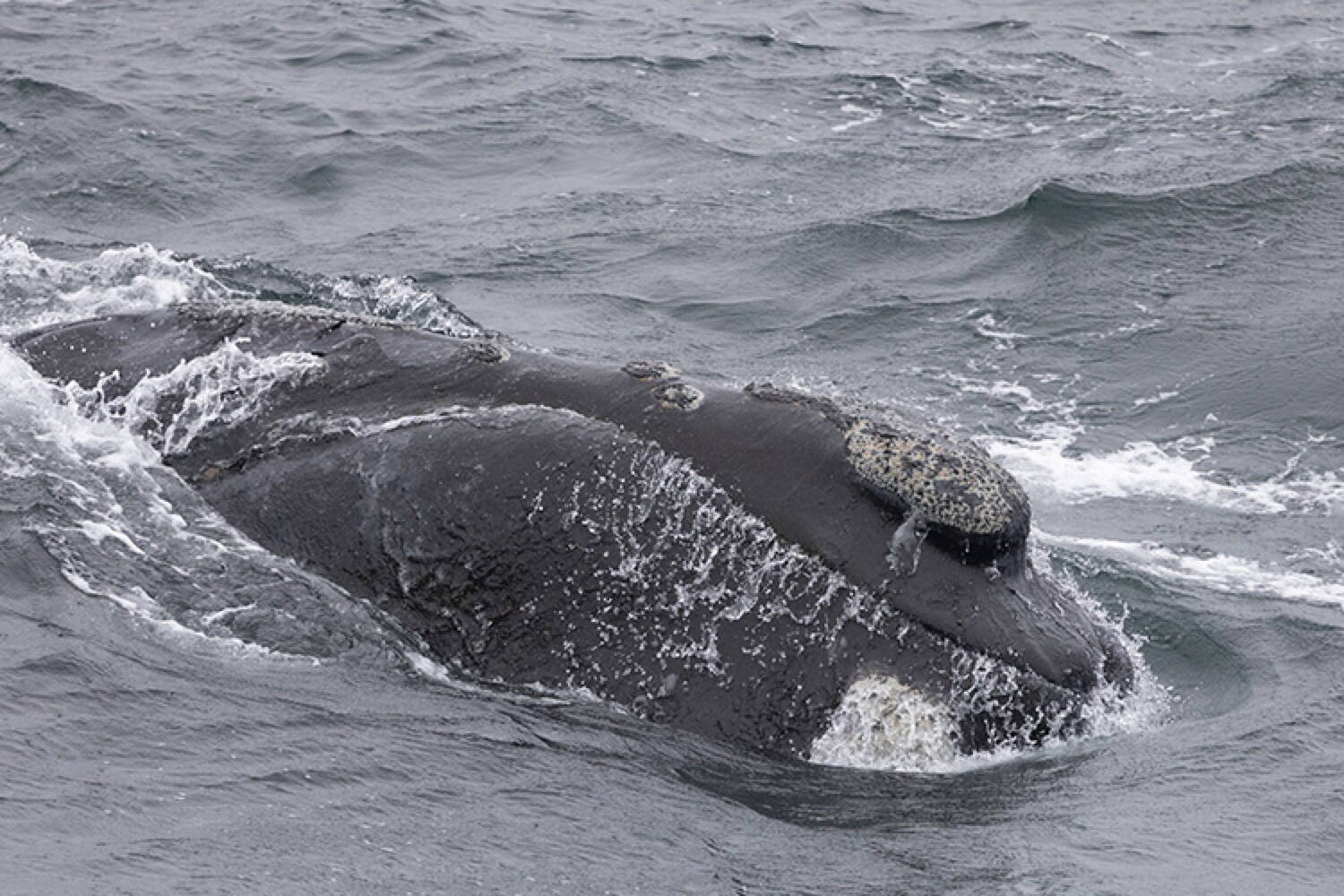
One of the world’s most endangered whale populations has a newly identified member, and federal biologists are celebrating the discovery with a special contest to select a name for the animal.
The Name That Whale contest organized by the National Oceanic and Atmospheric Administration is asking the public to come up with a name for the Eastern North Pacific right whale spotted last September during a research cruise in the Gulf of Alaska.
Scientists say there are fewer than 50 animals in the population, though a more precise number is hard to determine. The population is what remains from what was a near-total wipeout at the hands of commercial whalers in the 19th century, followed by illegal Soviet whaling that continued through the late 20th century.
Through a series of research cruises carried out over the years, scientists have amassed a catalog of about 68 Eastern North Pacific right whale photos of varying quality, said Jessica Crance, a biologist and right whale expert with the NOAA’s Alaska Fisheries Science Center. From those, they have identified 30 distinct individuals, she said.
The newfound whale is now in the catalog, said Crance, who was on last year’s cruise.
“This animal was cooperative for a few brief moments, just enough for us to get some great photographs and we were able to confirm that this was a new animal,” she said.

All the Eastern North Pacific right whales identified so far have been assigned numbers, and some have also been named by scientists, said Crance, who works in the Alaska Fisheries Science Center. There is Spot, for example, a whale with a distinctive white spot on its tail. There is Cuatro, a female with four distinctive head bumps known as callosities. And there is Phoenix, a calf spotted in 2017. “We named him ‘Phoenix’ as a kind of metaphorical sign that the population may yet recover,” Crance said.
Along with the newly found animal, researchers saw three other right whales during last fall’s cruise. However, there is still too little information to make any judgments about changes in the population, Crance said.
“All sightings are good. But they’re still too infrequent for us to have any kind of idea what the population trend is,” she said.
For the Name That Whale contest, the Alaska Fisheries Science Center will be accepting name nominations through Sunday; it began accepting nominations on Feb. 18, which happened to be World Whale Day. Nominations are to be submitted through a Google form. From there, eight top contender names will be pitted against each other in a bracketed competition, with three rounds of online voting. The winner will be announced on March 7, according to rules established by the science center.
The contest is in some ways like the National Park Service’s wildly popular Fat Bear Week online voting contest. In that event, held each October, Katmai National Park and Preserve bears that have gorged all summer on salmon are paired off against each other in a bracket competition. Voters compare photographs to select which one wins the title of “fattest bear.”
Fat Bear Week has raised awareness of Alaska bears, their biology and the Alaska coastal ecosystem that supports them, and NOAA officials said they hope the Name That Whale contest will help do that for Eastern North Pacific Right Whales.
While people may not know much about this tiny population, there is a lot of available information about how this whale species came to be in such a precarious state.
During the days of commercial whaling, they became known as the “right whales” to hunt because they move slowly and are so fat that they easily float when killed, according to NOAA. The North Pacific population was nearly wiped out in just two decades in the 19th century, according to NOAA.
When seen, Eastern North Pacific right whales can be identified by the V-shaped exhales they make through their blowholes, as well as by their callosities, which are unique to individual animals. Through sound, they can be identified by their unusual gunshot calls.
But there are plenty of mysteries about the population, which is genetically distinct from a slightly larger but also critically endangered Western North Pacific right whale population.
Sightings since 2000 have been clustered in the southeastern Bering Sea and the Gulf of Alaska region off Kodiak Island and the Alaska Peninsula. But some sightings have occurred in more distant places. The southernmost sighting was decades ago off Hawaii, and more recent southern sightings have been off California, Crance said. The northernmost sighting was of a single whale that swam in the Bering Strait in 2018 near Alaska’s St. Lawrence Island and off Russia’s Chukotka Peninsula,
Also yet to be determined are the greatest threats to the population in the post-whaling era. NOAA has said that potential threats include ship strikes, entanglement in fishing gear industrial noise, algal toxins and climate change.
For the better-known and larger population of critically endangered North Atlantic right whales, ship strikes are a confirmed threat. But for the eastern North Pacific population, which swim in areas important to fishing and cargo vessels, there have been no reports of ship strikes, Crance said. As for bad encounters with fishing gear there is little information, though two of the animals in the catalog have scars from past entanglements, she said.
“So the potential for those threats is quite high, but we have not been able to quantify the direct impact of them on the population,” she said.
As with other populations protected by the Endangered Species Act, areas of critical habitat have been designated for Eastern North Pacific right whales.
Those areas could be expanded. NOAA is currently reevaluating the designated area in response to a petition from environmental organizations that are seeking a vast expansion. The petition, submitted last year, urges that designated critical habitat extend much farther west to include heavily trafficked Unimak Pass, a tight spot where ships, marine mammals and fish pass between the Gulf of Alaska and the Bering Sea.
NOAA is currently analyzing data from acoustic devices, visual sightings, behavioral observations and other factors, said Jenna Malek, NOAA Fisheries’ North Pacific right whale recovery coordinator.
“We do not have a definitive timeline at this point for when we will publish a proposed rule as we are working through the data that we have in as timely a manner as we can,” she said by email.
Once there is a proposed rule, there will be public hearings and other opportunities for public comments, she said.
• Yereth Rosen came to Alaska in 1987 to work for the Anchorage Times. She has reported for Reuters, for the Alaska Dispatch News, for Arctic Today and for other organizations. She covers environmental issues, energy, climate change, natural resources, economic and business news, health, science and Arctic concerns. This story originally appeared at alaskabeacon.com. Alaska Beacon, an affiliate of States Newsroom, is an independent, nonpartisan news organization focused on connecting Alaskans to their state government.
