
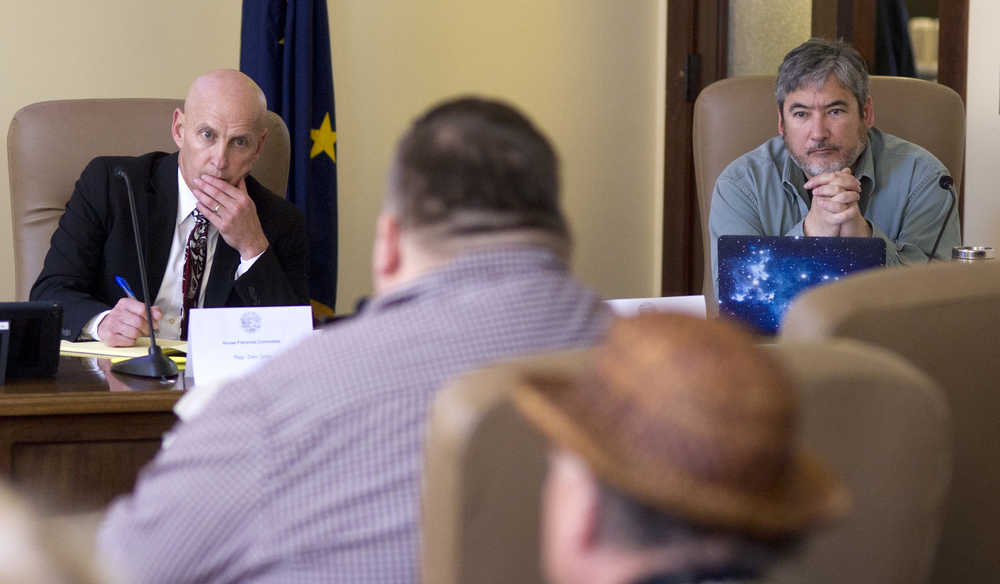
One week after Alaska agreed with British Columbia to research boundary-crossing rivers, a panel of Native leaders, environmental lobbyists, fishermen and scientists warned the Alaska House Fisheries Committee that the new deal is only a “first step” in protecting those rivers from mining-caused pollution.
“There are two economies that are clashing,” said Bev Sellars, chairwoman of the Canadian organization First Nations Women Advocating Responsible Mining.
“One (economy) grows and walks on the land and swims in the waters. That is the economy that has sustained generations on this land. … And the other economy is where the profit is the bottom line, and that is a dangerous economy when there are no safeguards in place.”
The principal pollution threat comes from tailings ponds, reservoirs of waste rock and contaminated water that are contained by a dam.
In 2014, a tailings dam at British Columbia’s Mount Polley Mine failed, contaminating a well-used fishing watershed. Alaska fishing and environmental organizations have been calling attention to the possibility of similar, larger disasters in Alaska rivers if large mines are dug on the Canadian side of the mountains that separate Alaska and British Columbia.
Several such mines are planned in the watersheds of rivers that flow into Southeast Alaska. These rivers are critical to the region’s salmon, and the salmon cycle is the cornerstone of the region’s culture and subsistence.
“This issue for us is really personal, as many of us can track our lineage to these rivers,” explained Richard Peterson, president of the Central Council Tlingit and Haida Indian Tribes of Alaska.
Fred Olsen, tribal vice president of the Organized Village of Kasaan, said people tend to talk about fish as if it’s a generic commodity, but it’s not “about fish and eating calories, it’s about eating this fish from this river by these people … and was prepared in a traditional way. I would never sell you this fish. I might give it to you, but I would never sell it to you.”
Until last week’s agreement, CCTHITA had taken a lead role in surveying the quality of the principal rivers that cross into Southeast Alaska from British Columbia.
Using money from the Bureau of Indian Affairs, the Central Council hired a consultant to take baseline measurements of the rivers, Peterson told the members of the Fisheries Committee and several Southeast lawmakers who sat in on the hearing.
The new state agreement with British Columbia calls for Alaska to take on some of that responsibility.
These tests are critical because if new mines are dug, the pre-mining measurements will be the yardstick to measure any changes that result from those mines.
Barbara Blake is a special adviser to Lt. Gov. Byron Mallott, who has been the state’s leading figure on the transboundary mine issue.
She said she agrees with the comments made by others that last week’s agreement is not an endpoint.
“It is not the final step,” she said. “We’re not done by any means as far as the lieutenant governor or the state of Alaska is concerned.”
[Mallott, BC ink agreement over transboundary mines]
David Chambers, an expert in tailings dams and the founder of the Center for Science in Public Participation, suggested that the next step might be to require tailings dams to meet the standards associated with hydropower and drinking water dams.
“Today, clearly economics drives the design” of tailings dams. Safety doesn’t.
“They’re being built and operated by companies under financial stress,” he said.
Because the mines are planned for Canada, Alaska needs to pressure British Columbia to act on its behalf. Chambers said it’s important for Alaska to require some kind of compensation for catastrophic accidents.
“By requiring that sort of surety, that will put pressure on operators to do a better job because it’s going to cost them more,” he said.
He also urged Alaska to require dry storage of tailings when a mine closes. If a dam fails in that case, it’s less likely to cause a significant natural disaster.
The alternative was illustrated in December 2015 when a tailings dam collapsed at an iron mine in Brazil. The resulting flood of toxic mud killed 17 people and caused more than $6 billion in damage as well as wiping out the life in an entire river.
“It’s a whole lot disconcerting (to learn) the prospects of what could actually happen,” said Rep. Louise Stutes, R-Kodiak and chairwoman of the fisheries committee.
• Contact reporter James Brooks at 523-2258 or james.k.brooks@juneauempire.com.
—
Read more news:
Alaska Airlines boots passenger for hooting at female flight attendant
Muñoz outpaces Parish and rest of House in election fundraising
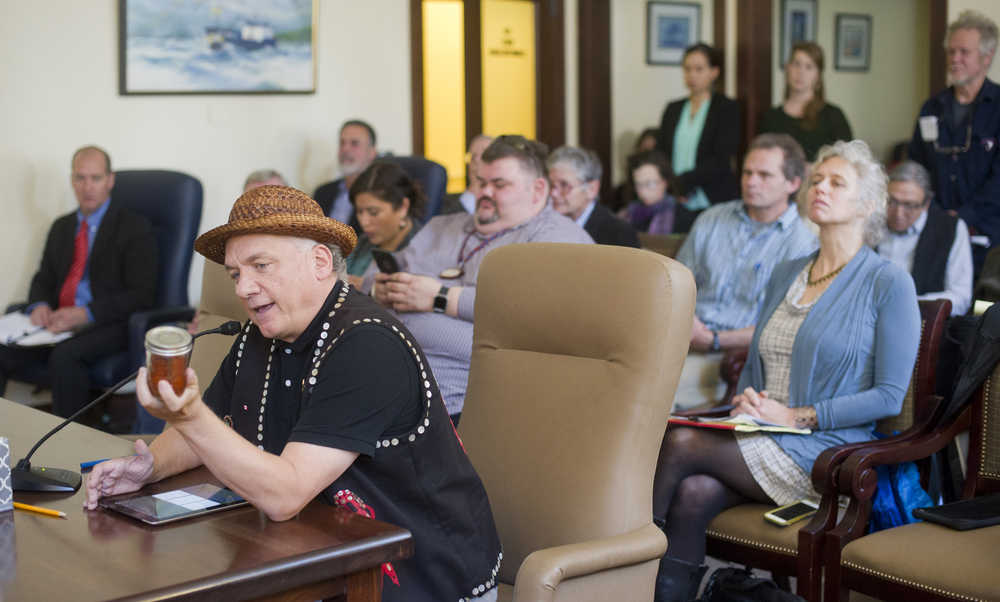
Tribal Transboundary Mining Work Group Chair Fred Olsen Jr., who is also tribal vice president of the Organized Village of Kasaan, speaks holding a jar of salmon during a House Fisheries Committee meeting on transboundary issues at the Tom Stewart Building on Wednesday.

Kirsten Shelton, of the McDowell Group, speaks during a House Fisheries Committee meeting on transboundary issues at the Tom Stewart Building on Wednesday.
