
ANCHORAGE — Kenneth Steck doesn’t know why a large brown bear that charged and mauled him in the thick brush near the Southeast Alaska town of Yakutat stopped its attack. Steck came to believe he may die in those brief moments, and he told God he accepted that outcome.
“I remember thinking ‘My wife is losing her husband,’ and then I thought ‘God, if you’re calling me home, I’m willing,’ “ said Steck Wednesday during an interview in a family member’s East Anchorage home, where he is recovering after being hospitalized at Providence Alaska Medical Center for four days.
Originally from a Chicago suburb, Steck came to the state four years ago after enrolling in the outdoor studies program at Alaska Pacific University. His courses, including lessons about bear safety, have carried over into his exploration of his new home.
Kenneth and his wife, Hannah Steck, were visiting friends and family in Yakutat last week from their home in Juneau. Eight of them headed for Disenchantment Bay on May 12; the Stecks wanted to explore somewhere they’d never been. The group traveled using a 22-foot aluminum skiff and set up camp on a gravel bar on the east side of Calahonda Creek.
The next morning was hot and sunny. Kenneth Steck decided around 10:30 a.m. to fill up water jugs at a snowmelt waterfall flowing nearby. He informed some of the other campers of his plans and set off, leaving behind the rifles that’d been brought along for the trip. He said he also didn’t have bear mace.
He filled the water jugs and started back, he said. On the trek back to camp, Kenneth Steck heard loud snapping and cracking of branches.
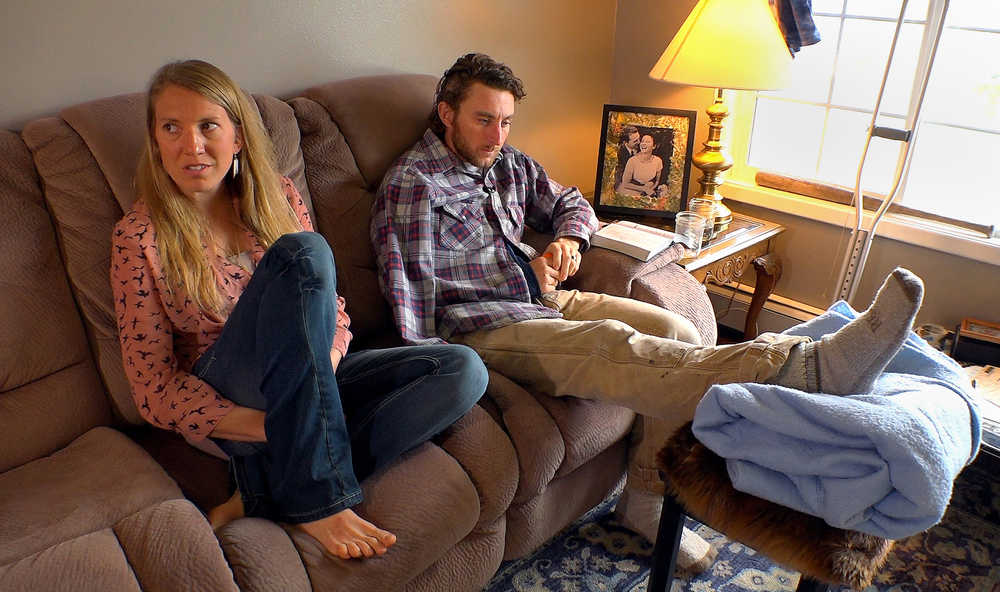
“I turned around immediately after hearing that commotion and there’s a brown bear in a full charge toward me,” Kenneth Steck said, sitting on a coach, his right leg propped up on a stool and his right arm in a sling hidden beneath a plaid button-up. “Immediately I yelled ‘Hey bear, hey bear’ to identify myself as a person and hopefully he will take off the other way or bluff charge.”
But the brown bear was on Kenneth Steck within seconds. Kenneth said he could hear the bear breathing as it was running toward him. At the same time Kenneth walked slowly backward and ended up falling on his back. He screamed as loud as he could.
“That’s when I heard him,” Hannah said.
Kenneth instinctively put his right foot up to try and distance himself from the bear, but it swiped and ripped his boot and leg “clean open.” The bear moved toward Kenneth’s upper body.
“I remember like feeling the bear was swallowing me. I remember feeling like I was in the bear’s mouth or throat. It was very wet … In those moments, it felt like an eternity, but I’m sure it was just a few seconds,” he said.
The thoughts of dying passed through Kenneth Steck’s mind. Too many thoughts one would think were possible in that amount of time, he said. He believes God intervened to help him.
The bear took off.
Steck suffered numerous injuries to his scalp, chest and calf. Hannah Steck said the bear just missed Kenneth’s femoral artery. The bear also wounded Kenneth’s right shoulder.
Despite large gashes in his leg, the bloodied and muddied camper stood up and decided to head for help, toward his friends. Adrenaline was in full gear, he said. Soon after, Hanna Steck and Clint Ivers, the boat captain, were at his side.
Hannah, a registered nurse of about four years, checked on her husband. He was aware and talking but it was apparent they needed to get out of the remote Alaska wilderness.
Kenneth was loaded onto a boat with four others — Hannah as well as her brother and sister-in-law Isaiah and Heidi Carlson, all three of whom are nurses. Ivers piloted the boat.
Yakutat police officer Jeff Lee said the U.S. Coast Guard was informed by radio of the attack shortly after noon on Friday. Hannah said the group boated for about 20 minutes before their marine radio got a good signal.
Lee said police monitoring the call learned that a group was still about an hour away. It was decided responders in Yakutat would intercept the boat, he said.
Kenneth arrived at Providence at 4 p.m. on Friday; doctors discharged him Monday afternoon. Family, friends and former church members from when the Stecks lived in Anchorage came to visit and wish him well in the hospital, he said.
According to Lee, the area’s bears outside Yakutat proper are “a different breed,” because they’re not acclimatized to humans.
“These bears just don’t run,” Lee said. “I’ve had them where you’re taking a photo, and they see you and they actually start coming at you.”
According to Lee, nobody at the Yakutat Police Department could recall a bear mauling in the immediate vicinity — but that if a mauling was going to occur, it was most likely to happen in Disenchantment Bay.
“We have a lot of bear incidents, but we don’t have a lot of bears actually getting a hold of somebody,” Lee said. “It’s not surprising that someone got mauled by one, given the amount of bear traffic in that area.”
Ken Marsh, an Anchorage-based spokesman with the Alaska Department of Fish and Game, said in an email that staff had decided not to seek out and kill the bear, because a biologist who investigated the mauling found signs that the attack wasn’t predatory in nature.
“The biologist was able to interview the mauling survivor at the hospital and determined that the attack was likely the result of the man (who was walking through dense brush) surprising the bear at close quarters,” Marsh wrote. “The attack lasted only seconds — just long enough for the surprised bear to neutralize a perceived threat.”
Marsh said that the mauling is the third reported to Fish and Game so far this year, following April attacks that injured two other men. Glenn Bohn, 77, was mauled by a grizzly bear while hunting off Mile 77 of the Denali Highway; his hunting partner shot and killed the bear involved. Later that month, University of Alaska Southeast mountaineering professor Forest Wagner was critically injured by a brown bear while leading a UAS class group on a trip near Haines.
Once things calmed down, Kenneth Steck said he spent time thinking about the mauling and how it could have gone differently. He could have brought a gun or bear spray, but he doesn’t believe he had enough time to fire a steady shot with either.
He also thinks injuring the bear may have only aggravated it, potentially making the attack worse. The incident has changed him physically and mentally for the rest of his life, he said, but he’s glad he was mauled and not his loved ones. He thanked everyone who helped him survive.
“I will cherish and appreciate life a little more every day from now on,” he said.
Kenneth also refuses to shy away from the outdoors. He was set to start a Bureau of Land Management job next week in Glenallen, but those plans have been put on hold. For now, the focus is recovery.
• This article originally appeared in the Alaska Dispatch News.
