
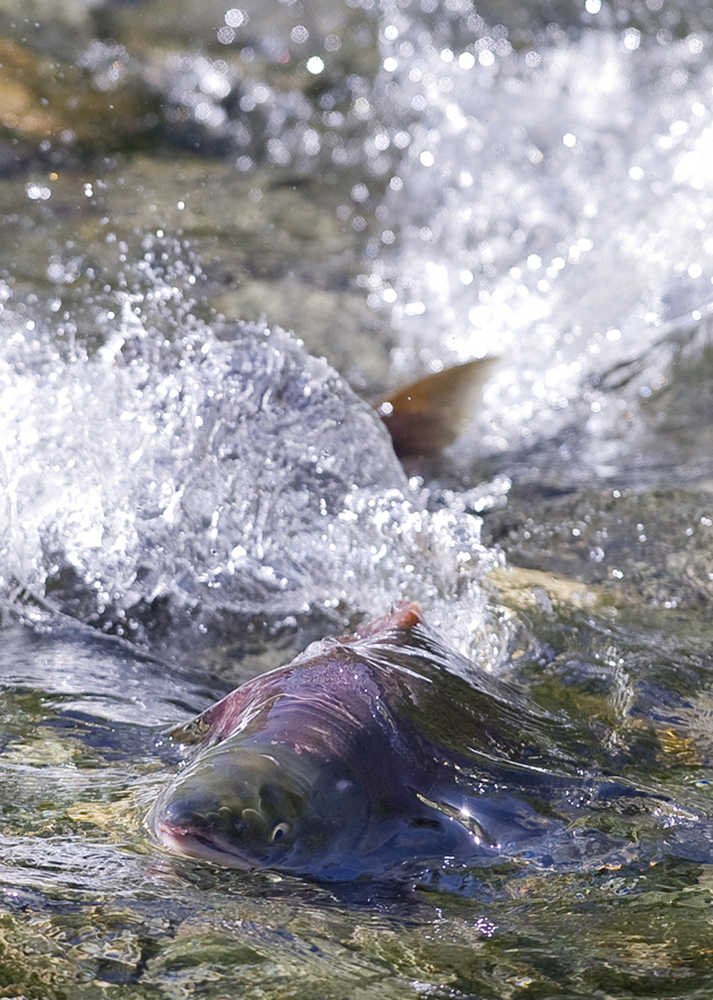
Forecasts for Upper Cook Inlet sockeye salmon have dropped precipitously, just in time for the state’s fishermen to have another beef with Alaska’s fisheries managers in a few months.
“In 2017, a run of approximately 4.0 million sockeye salmon is forecasted to return to UCI with a commercial harvest of 1.7 million,” reads an Alaska Department of Fish and Game release. “The forecasted commercial harvest in 2017 is 1.2 million less than the 20-year average harvest.”
The Upper Cook Inlet sockeye salmon harvest of 2.4 million, which was 17 percent less than the recent 10-year average, fetched an ex-vessel price of $1.50 per pound for a total value of $21 million.
With an average weight of 5.8 pounds per fish, 1.2 million sockeye are worth $10.4 million in 2016 prices.
For commercial Upper Cook Inlet sockeye fishermen, the forecast plays into a long-standing management feud the Alaska Board of Fisheries will have to pick up at the beginning of 2017, largely concerning whether or not management policies have been harming the sockeye stocks — and fishermen — by allowing too many to escape to their spawning grounds.
Managers predict the overall size of the expected run, then chip away how many spawning fish they need to send back up the river, then divide the rest between commercial, sport fishing, subsistence and personal use fisheries.
For all users, the forecast is 2.6 million fish, about 21 percent below average and among the lower third of harvest forecasts going back to 1985. Eight of the last 27 years have had forecasts as low or lower.
The commercial harvest expectation is 1.7 million. If the fleet harvests that much, it will be the lowest harvest since 2000 and 1998, when Cook Inlet fishermen harvested 1.3 million and 1.2 million sockeye, respectively.
Prior to that, the harvest hadn’t dipped below 1.7 million fish since 1981.
“It’s gonna be pretty tricky,” said Aaron Dupuis, the assistant area management biologist for the commercial section of the Upper Cook Inlet ADFG office. “Things will be much more restrictive.”
This small of a forecast triggers the most tightly controlled management tiers. Sockeye setnetters will only have 24 hours to fish in addition to their normal Monday and Thursday 12-hour openings. Drift netters will have to stay within certain sections, instead of fishing in the middle of Cook Inlet.
Commercial fishermen aren’t happy with the forecast.
“It’s pretty alarming,” said Andy Hall, a sockeye setnetter and president of the Kenai Peninsula Fishermen’s Coalition. Hall said he can’t remember off the top of his head the last time a season forecast gave his fleet so little. “I had a couple fishermen write to me and say they’re alarmed. It’s going to color how we respond to some of the proposals that go to the Board of Fisheries this year.”
ADFG biologists acknowledge that high escapements might be a part of the low forecast, but say the situation is still too complex and murky to know for certain.
“Yeah, it’s possible (that overescapement led to a small forecast),” said Dupois. “We won’t really know until we have complete brood information for the most recent escapements. It’s definitely a possibility.”
Pat Shields, the commercial fishing management biologist for the Kenai area ADFG office, went into more detail about the causes of next year’s small forecast.
Large escapements, he said, tend to produce smaller fry — the baby salmon waiting in river systems to swim out into the ocean to grow up. If fry survival drops, it could intensify low returns.
“There can be multiple reasons,” he said. “It appears ocean conditions have not been as favorable in the last couple years. I know it’s not satisfying for even me to say that…but there are different things that affect that.”
Water temperatures for the Gulf of Alaska and its river systems have been rising in certain areas, leading in 2015 and 2016 to a patch of water 2 degrees Celsius over the average, called “the Blob” by scientists. This warmer water, said Shields, looks to be a contributing factor to salmon marine survival.
Rising temperatures only mask the problem of overescapement, according to Dave Martin, president of the industry group Upper Cook Inlet Drift Association.
Martin said the forecast validates the group’s long held claim that ADFG and the Board of Fisheries have let too many sockeye salmon escape over the years, which both hurts the fleet’s bottom line and future salmon returns.
“It kind of goes along with what we’ve been saying all along,” he said. “You keep grossly overescaping the systems then it’ll produce smaller returns. If we managed the fishery scientifically, we wouldn’t have these ups and downs.”
By “scientifically,” Martin means managing to the federal fisheries standard of maximum sustainable yield, a different metric with more economic considerations than in state management.
Hall agreed.
“We’ve been overescaping these rivers year after year, and you have to wonder,” he said. “I’m not a scientist, but I’ve spoken with former and retired ADFG biologists who say, ‘we can’t keep doing this, this is going to come back on us one of these days.’”
Both Martin and Hall want the Alaska Board of Fisheries, which sets management playbooks for Alaska’s in-state fisheries within three miles of the shore, to use this forecast as an example of failed, allocation-driven policy making.
“It’s frustrating to see this happening,” said Hall. “I just wish all these political proposals weren’t there and the biologists could just manage. But a lot of what’s happening isn’t driven by science. It’s driven by politics.”
The Board of Fisheries will hold a meeting in February for Upper Cook Inlet finfish, which includes salmon. These meetings, held once every three years, are typically among the most combative and political in the state’s fisheries, and have already been the subject of heated discussions in 2016 simply around where the meeting will be held.
In 2017, the Board of Fisheries will also have to deal with a recent federal court decision that will require state managers to have a federal fishery management plan and stick to the standards required by federal law.
• DJ Summers is a reporter for the Alaska Journal of Commerce. He can be reached at daniel.summers@alaskajournal.com
