
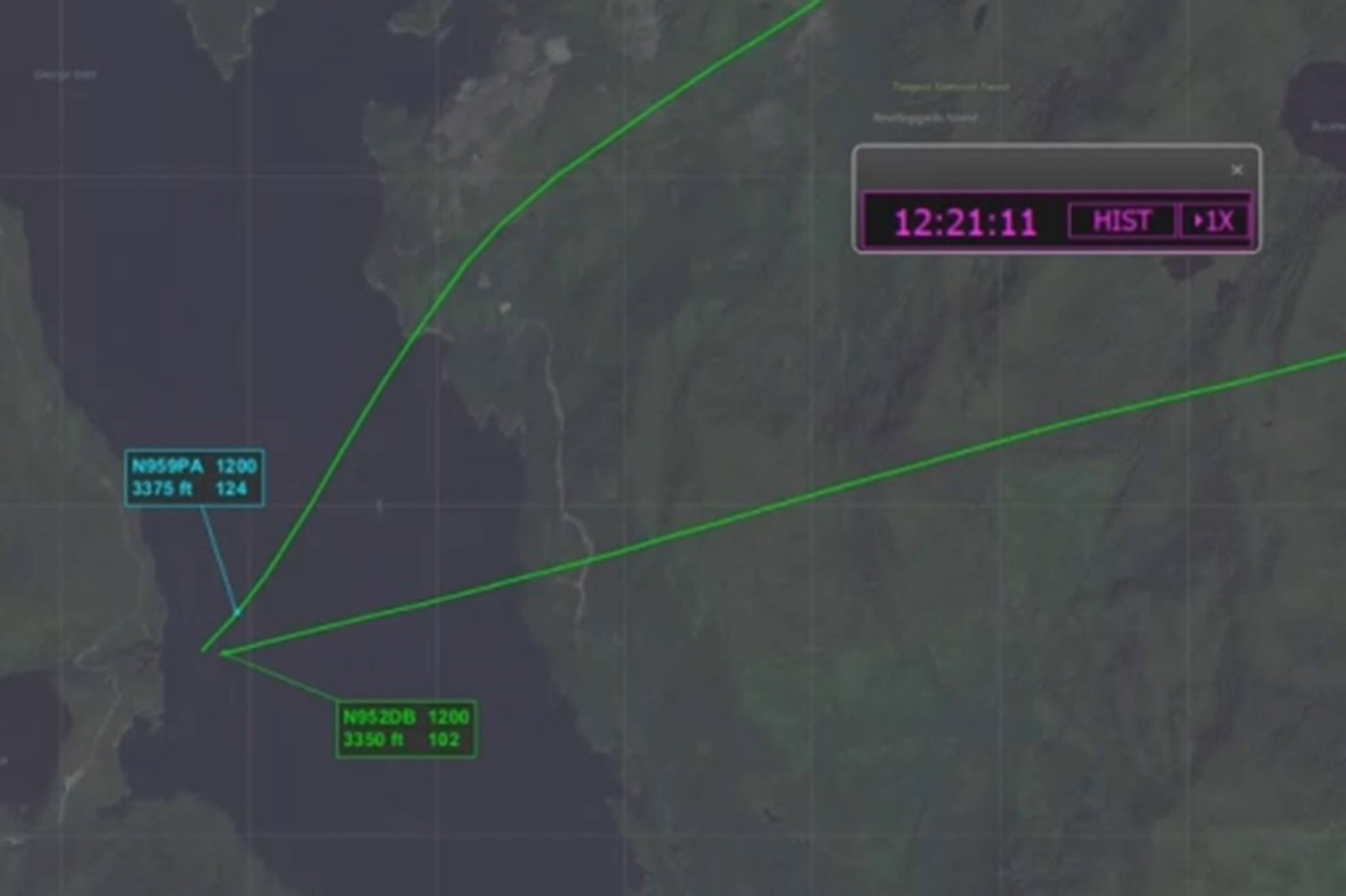
The pilot of one of the planes involved in the fatal May 13 crash near Ketchikan told investigators that just before the crash, he dropped his plane to a lower altitude to show the passengers a waterfall, according to a preliminary report from the National Transportation Safety Board.
The report, dated Wednesday, provides detail of the crash from the pilot of a Taquan Air Otter airplane. The pilot of the Mountain Air Beaver airplane, 46-year-old Ketchikan resident Randy Sullivan, died in the crash. Five others were killed in the crash, and 10 were injured.
The Taquan pilot, who has not been identified, told investigators that he hadn’t seen any conflicting traffic on his flight display that included Automatic Dependent Surveillance-Broadcast data. He had last looked at the display when he was flying over Carroll Inlet, according to the report. The crash occurred near the west side of George Inlet, east of Mahoney Lake, at about 3,350 feet, investigators say.
Prior to descending to view the waterfall, the Otter was flying at about 3,700 feet. The Beaver was traveling at 3,350 feet as it approached the scene of the crash, according to the report.
Right before the collision, the pilot saw a flash from his left, he told investigators. After the impact, the plane rolled right and began to dive nose-first toward the George Inlet water. The pilot was able to regain some control over the plane in the next five seconds before it hit the water, the pilot told investigators.
The Otter’s wreckage came to rest about 80 feet underwater. The pilot and nine passengers were able to get out of the wreckage, but one passenger died, according to previous reports from NTSB and other agencies.
The Beaver broke up in the air and the wreckage was scattered over water and mountainous and tree-covered terrain northeast of Mahoney Lake on the west shore of George Inlet. The main wreckage (floats, engine, firewall, instrument panel, lower fuselage structure and right fuselage structure) was found near the mouth of Mahoney Creek, investigators say. The debris field was about 2,000 feet long and 1,000 feet wide.
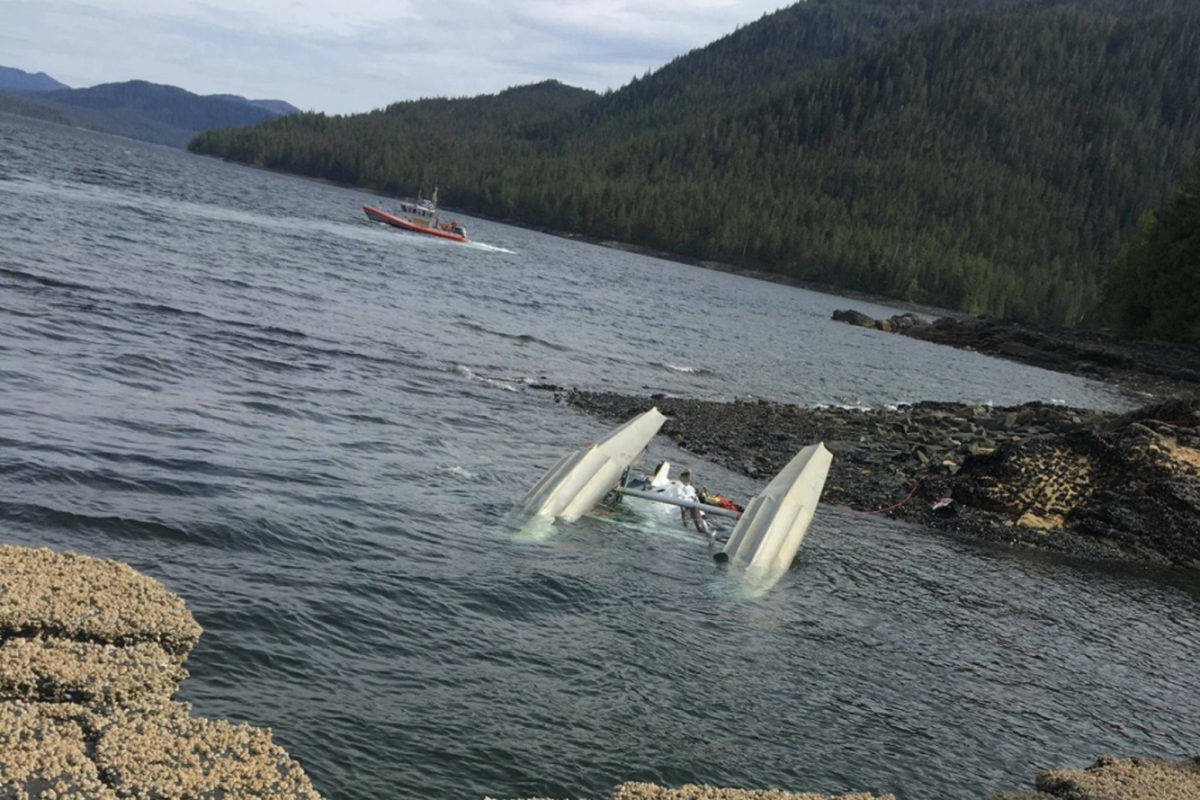
A Coast Guard Station Ketchikan 45-foot Response Boat-Medium boat crew searches for survivors from downed aircraft in the vicinity of George Inlet near Ketchikan, Alaska, May 13, 2019. The Coast Guard, Ketchikan Volunteer Rescue Squad, good Samaritans and multiple other agencies have searched extensively and continue to search for survivors from the crash. (Courtesy photo | U.S. Coast Guard)
Investigators found that the Beaver’s right wing had several cuts in it that were consistent with cuts from propeller blades, according to the report.
Neither airplane was equipped — nor was required to be equipped — with a crash-worthy flight data or cockpit voice recorder, according to the report. Some avionics components and personal electronic devices were recovered from the area, and were shipped to the NTSB Vehicle Recorders Laboratory in Washington, D.C. for examination.
The report came out the day after 75-year-old William Resinger of Palmer died in a floatplane crash in Prince William Sound between Whittier and Valdez. That crash marked the third fatal crash in eight days, as a floatplane crashed near Metlakatla on Monday, killing the pilot and his passenger.
The Metlakatla crash also involved a Taquan Air plane, authorities said, just like the crash near Ketchikan. Taquan suspended its air operations indefinitely after the second crash. NTSB is investigating all three crashes.
• Contact reporter Alex McCarthy at amccarthy@juneauempire.com. Follow him on Twitter at @akmccarthy.
