
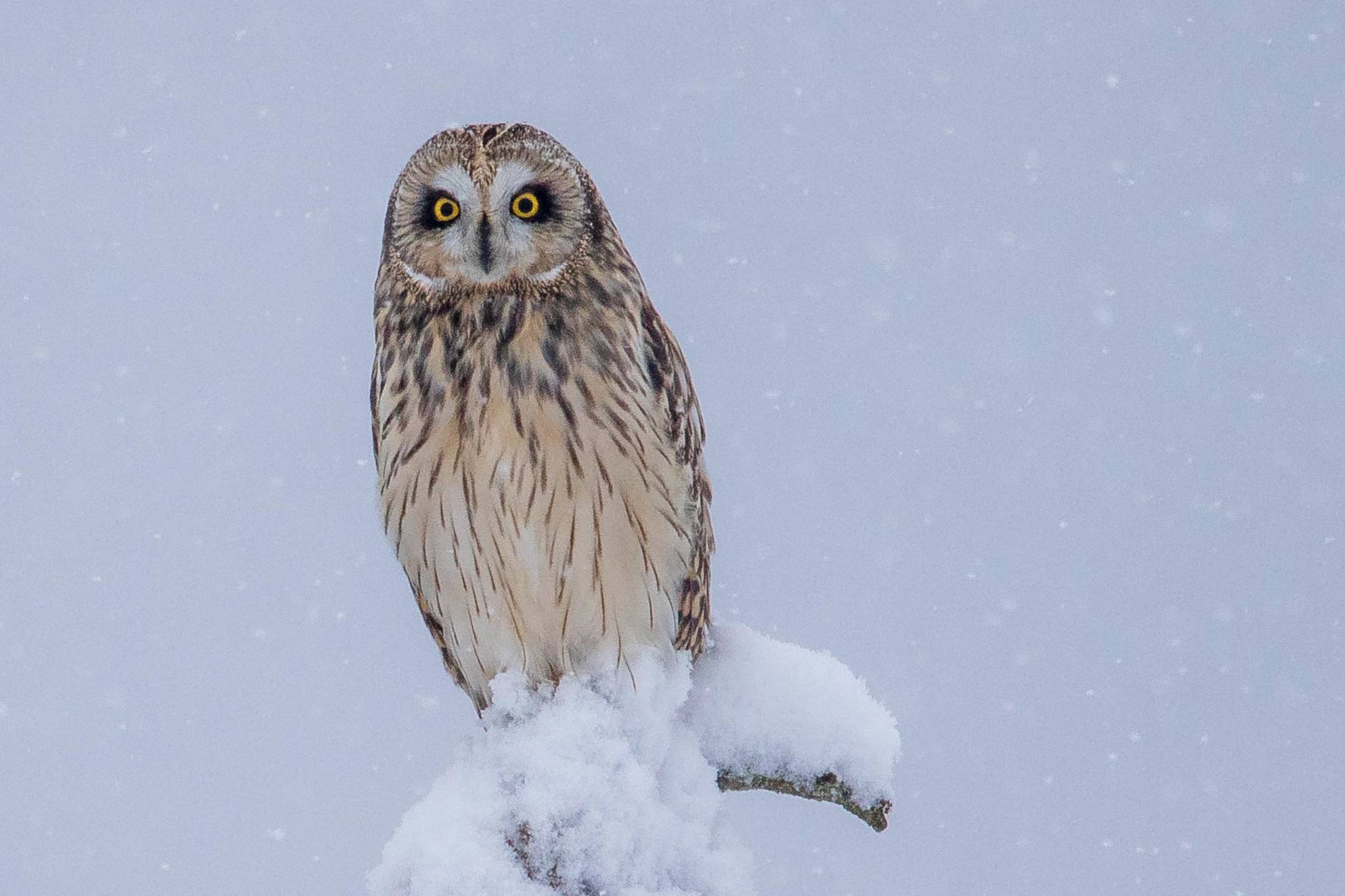
A walk on the dike trail near the Mendenhall wetlands in early March revealed the usual resident Canada geese, grazing in small groups but alert to passing humans some distance away. Gangs of mallards nervously shifted from the edges of an incoming tide to deeper water as humans passed by on the trail. Little flocks of juncos dashed for cover in the nearby trees. It was too early in the season for migrating shorebirds, but I was hoping for something out of the ordinary — and I got lucky.
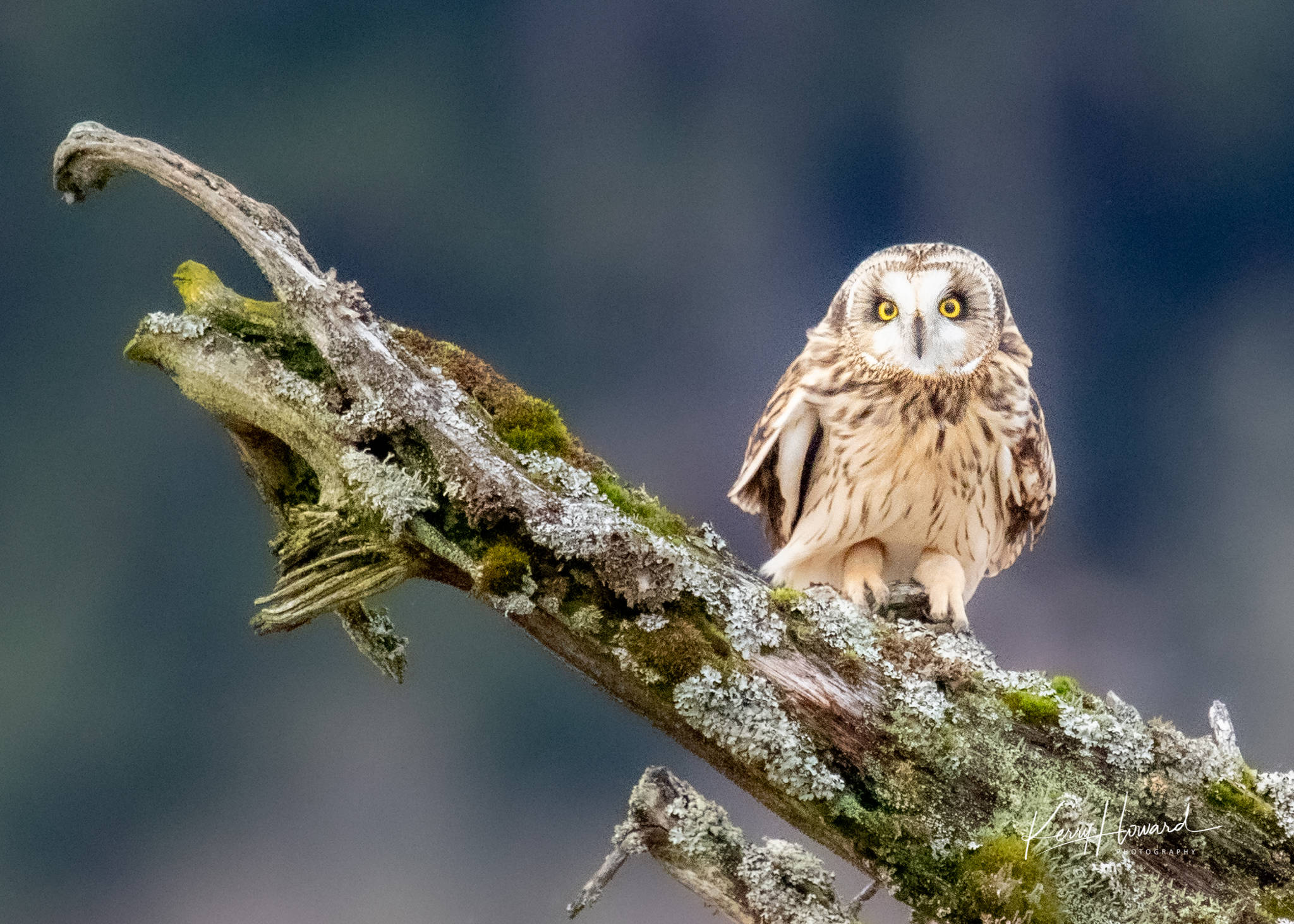
Courtesy Photo | Kerry Howard A short-eared owl perches on a mossy snag.
I don’t often walk out there, because I dislike the tremendous noise of the planes, large and small. But I know that short-eared owls come through on migration or sometimes visit in winter. So it happened that less than half a mile from the trailhead I saw one of these owls swoop up from the meadow, turn in front of some conifers and sail off over the meadow again.
Then, I watched this owl coursing back and forth, low over the grass, many times. The flight style is distinctive: A slow, deep flapping beat with short glides in between, often described as moth-like. This individual landed once, looked down at its feet, and took off again, apparently without prey. It sailed off between the spruces toward the airport, which it may see as just another meadow but the airport officials prefer that it does its hunting elsewhere.
Short-eared owls have a huge geographic range across North America and Eurasia, though South America and into northern Africa. The species has established endemic, resident populations on far-flung islands, including Iceland, Hawaii, the Galapagos, and the Antilles in the Caribbean. These island populations are different enough that they are ranked as sub-species, but further study may decide they are separate species.
[Researchers use dogs to find bats]
Their name comes from the tiny feather tufts — ‘ears’ — on the forehead. The tufts are often indistinguishable, showing only when erected; they may be used in social signals with other owls. The tufts have nothing whatever to do with functioning ears that register sounds. The real ears of most owls typically are asymmetrical: The shape and location of the ear opening is different on right and left sides of the head. Along with the facial disc of feathers, that’s what lets them localize their prey so well, even in darkness. The facial disc and ear asymmetry are best developed in owls that only hunt at night. The short-eared owl, however, hunts by both day and night, and uses vision as well as hearing.
Short-eared owls are hunters of open areas, flying low over meadows, sometimes hovering, sometimes scanning an area from a convenient stump or snag. They catch and eat all sorts of prey, from large insects to muskrats and grouse. Birds are major prey in some areas, especially near shorelines where waterbirds are popular food items. But in most places, small mammals, especially voles or lemmings, are the main prey. Both the numbers and the reproductive success of the owls often reflect the abundance of these prey items.
In general, prey is decapitated — or de-winged — before being swallowed whole. Later, the owls regurgitate pellets of neatly packed indigestible bones and feathers. We curious naturalists love to find these deposits, so we can figure out the identity of the victims.
Short-eared owls nest in open areas—grasslands, tundra, marshes. Southeast Alaska is not well-endowed with those habitats, compared to much of the rest of Alaska, and if short-eared owls nest here, it must be uncommon. A pair of short-ears defends an area around the nest from other owls but reportedly does not defend a big feeding territory. As a result, nests are sometimes not very far apart (a few tens of meters).
The female of a pair scrapes out a shallow bowl on the ground, lines it with grass and a few feathers, and lays her eggs. A typical clutch of eggs has about four to seven eggs, but occasionally more, particularly when prey is very abundant. She does all the incubating (about a month); the male delivers food to her. When the eggs hatch, he still brings food to her and she doles it out to the chicks.
She lays one egg a day and starts incubating with the first egg, so the eggs hatch asynchronously, in the order of laying. Thus, the chicks are all of different sizes, and cannibalism of the runts may sometimes happen. The chicks are fluffy and nest-bound for a couple of weeks, after which they start to wander — eldest first, youngest last. But it takes another four or five weeks before they can fly and a year until they mature.
Populations of short-eared owls are declining, due primarily to habitat loss.
• Mary F. Willson is a retired professor of ecology. “On The Trails” is a weekly column that appears every Wednesday.
