
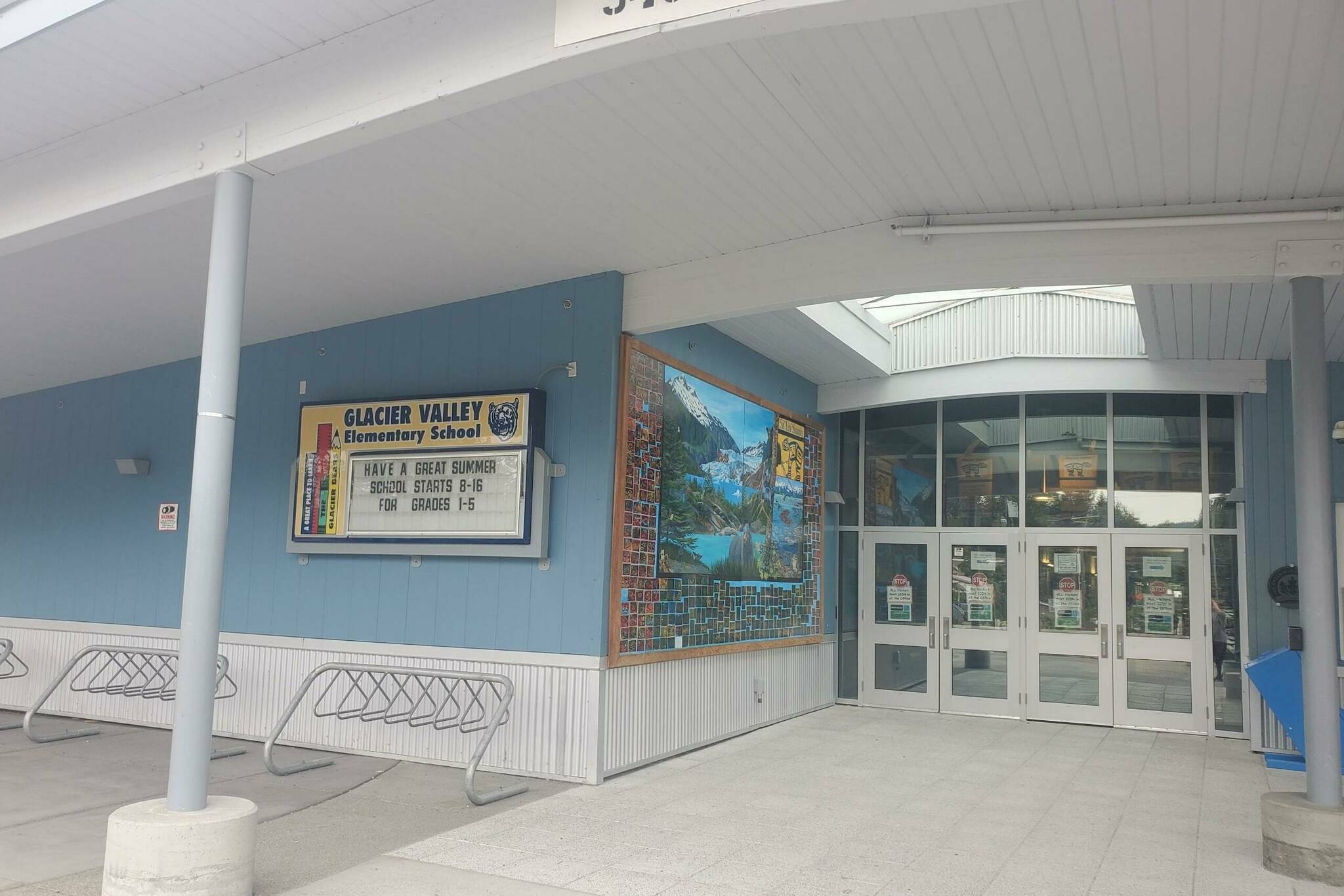
A Juneau elementary school principal got the attention of district officials last week by reporting 55% of her students were “chronically absent” during the school year. But with the concern came questions about causes, solutions and context — at a time when high absentee rates are being reported nationwide.
The discussion was provoked when Lucy Potter, who is retiring as the principal at Sítʼ Eetí Shaanáx̱ – Glacier Valley Elementary School, told the Juneau Board of Education at its meeting last Tuesday about the dismal attendance.
“When we calculated our attendance our school had a 55% chronically absent rate,” she said. “So that means that over half of our students were chronically absent. And so that’s a big goal for us to try and figure out. We have some different things that we’re hoping to do — more family outreach, increasing student engagement within the classrooms and celebrating students’ success more often.”
While remarks by other school administrators and board members suggested absenteeism is a problem at other schools as well, Superintendent Bridget Weiss said after the meeting district-wide statistics for the past year are not yet available.
Recent headlines in numerous states — including Idaho, California, Pennsylvania and South Dakota — have reported concerns about chronic absenteeism, often adding phrases such as “there’s no perfect solution.” A story published June 12 by USA Today, examining reasons for the trend, states “families are still in a COVID-19 mindset.”
The first few years of the pandemic disoriented parents, with constantly evolving policies on what to do when their children said they were sick or had any sign of illness,” the article states. “Especially in the beginning, the guidance was to take extreme caution – to keep kids home even if they were feeling well, but had potentially been exposed to the virus.”
Educators, students and board members have generally called the past year a return to normal after various degrees of disruption caused by the COVID-19 pandemic since early 2020. But Deedie Sorensen, the school board’s president, said during an interview Friday students with COVID-19 or another virus are among a number of possible explanations for high absentee rates that deserve further clarification.
A student is considered chronically absent if they miss more than 20 days of school, so a critical question for each student is whether those days are a one-time cluster or scattered throughout the year, Sorensen said.
“If you kind of think about school as a book with 180 days in it and tear out 20 pages just randomly, you can see how you’re struggling over the long term because you’re going to be missing pieces constantly, where if you’re gone for (one) long period of time you can make it up,” she said.
Among the possible solutions discussed during last Tuesday’s meeting was hiring a districtwide truancy officer.
“We used to have a truancy officer here,” said Brian Holst, one of the board members. “Another principal out at an elementary school suggested to me recently that having a truancy officer would be helpful. Because we had that — I understand it predates me — but it was providing constant follow up. Is that the kind of solution that we need?”
Sorensen, in her interview Friday, said a single officer can have a districtwide impact because “it makes a difference when somebody shows up and talks to parents about it.”
“I think there’s kind of a pervasive attitude that not that much happens in kindergarten and first grade from day to day,” she said, adding that students during their initial years in school now have a far more involved curriculum than a few decades ago.
The emphasis on parental involvement was also expressed during the board meeting by Kelley Harvey, principal at Harborview Elementary School.
“I think another important piece is to educate families on the effects of being absent,” she said. “Even missing 10 days of school there’s research that shows the effect that that can have on reading achievement, and I think when families are informed then at least we give them the opportunity to make an informed decision about trips and things like that.”
Potter said the effort needs to go beyond families and a truancy officer.
“I also think that it needs to be as a city, we need to promote attendance and the importance of attendance,” she said. “So I don’t know that just a truancy officer is going to work. I think it needs to be citywide.”
• Contact Mark Sabbatini at mark.sabbatini@juneauempire.com or (907) 957-2306.
