
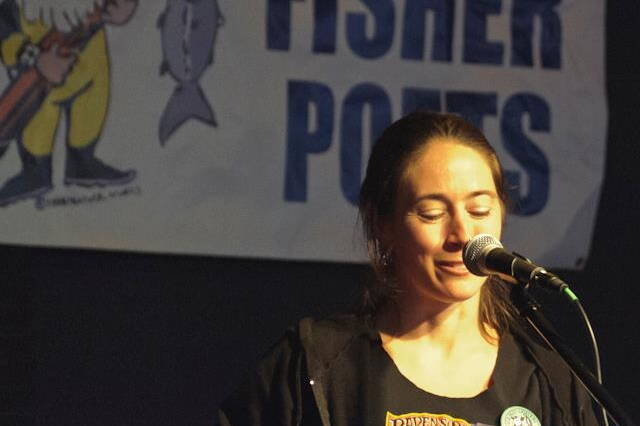
The world of commercial fishing may seem an unusual place for prose to thrive, but it has done so in abundance for author Tele Aadsen and others like her.
“What Water Holds,” her book of essays from the perspective of a “female commercial fisherman” extends well beyond fish stories. The author, who is visiting Juneau for a reading, and a meet and greet, at Hearthside Books at 6 p.m. Sept. 17, describes the collection as being about equity, identity, community, the changing climate, and sustainability.
Aadsen and husband Joel Brady-Power operate their 43-foot troller Nerka from a Sitka base, fishing for king and coho. They both grew up there, seasonal “boat kids,” working on family fishing vessels.
Her parents were veterinarians who built a boat in their backyard in Wasilla, sold their practice and headed to Sitka for a life as fishers. Joel’s family owned the Nerka, which shares the scientific name for sockeye.
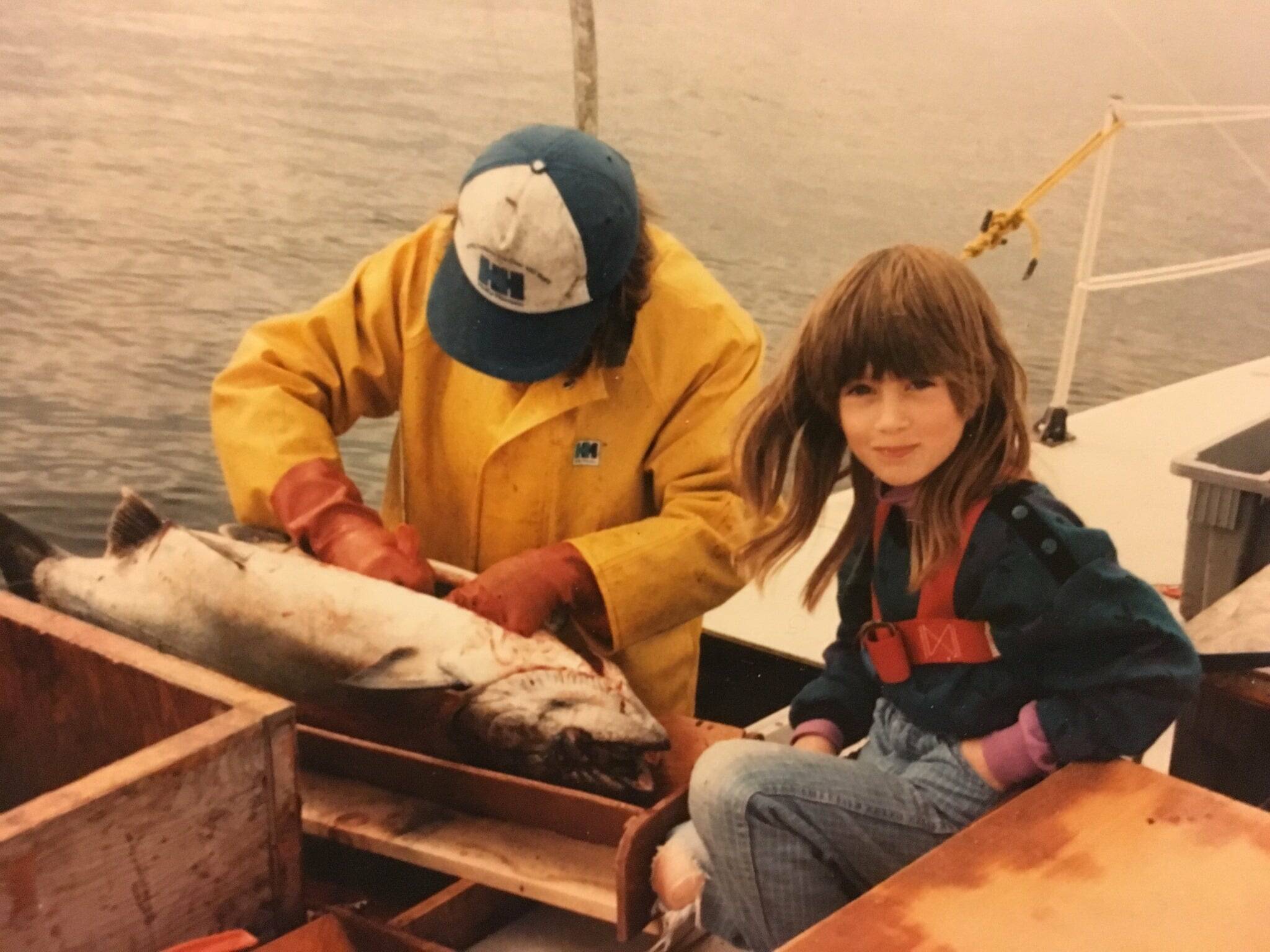
A young Tele Aadsen with her father Ken Aadsen on the family’s 40-foot trimaran hand troller in 1985. Aadsen, a commercial fisher and author of “What Water Holds,” will be visiting Hearthside Books downtown at 6 p.m. on Sunday, Sept. 17. (Photo courtesy Val Aadsen)
Seasonal is an important distinction to make, Aadsen said, because “the lens is seasonal. I’m a person who comes in and washes out,” she said. The concept comes from a friend who lives in Sitka year round who noted the seasonal people “washing in and washing out.”
Aadsen and Brady-Power spend winters in Bow, a town in northwest Washington.
It was in the off-season in 2012 that Aadsen first attended the FisherPoets Gathering in Astoria, Oregon. It turned out there were a lot of people who found commercial fishing connected well with poetry, prose and song. She was a performer from the first year, and the event served to spur her to write more.
Jon Broderick, who founded the FisherPoets Gathering in 1998, said the event welcomes people who work in the commercial fishing industry, or who have worked in it, “to give us a poem, a song or a story.” Some 100 people will participate from the stage this year at the three-day event, which runs from Feb. 23-25, 2024. Tickets are $20. Asked how many would attend, Broderick said, “probably a couple thousand.”
Book blurbs describe “What Water Holds,” as a collection of “lyrical essays,” which Broderick said was an apt way to describe Aadsen’s work.
“It can be hard to go in front of a crowd in a bar, or a gallery, or wherever we are, for 15 minutes. “Tele is one of the few people who can cast a spell for 15 minutes — and you want her to go on. She’s a real gem that way, articulate, thoughtful and observant.”
The essays in “What Water Holds,” were written over 12 years as Aadsen prepared for the festivals. “It was a great motivator, writing in terms of what was important to me over the last season, and what was important to the audience, and coming up with some kind of medley between the two.”
One of the essays takes on boat relationships where there are two captains with the same credentials, but they still have to fit within the hierarchical maritime law that requires one be deemed the top decision-maker.
“It is not me and that is okay,” Aadsen said. “It was a struggle in deciding to fish with a partner because I had my own commercial experience that predated our relationship. It was hard for a while. We figured it out.”
She marvels at unique aspects of life on the water.
“I think a lot of folks can relate to that communal spirit of boat life, your dock neighborhood, the mix of independence with needing to be there for one another,” she said.
Aadsen knows that the non-gender-specific term “fisher” is the current vernacular for people who fish. It’s entrenched enough to be in the Associated Press stylebook.
“A lot of us are told that, and a lot of us in the industry choose not to use it,” she said. “(Fisher) doesn’t reflect my language choice. I think of weasel creatures, minks and fishers.”
Aadsen said when her parents split, it was her mother who kept fishing.
“I had a front-row seat to the fisherwoman who was doing all the same work,” she explained. “I could spend a lot of time trying to parse out the meaning of language and what we choose. It’s ‘female commercial fisherman’ for me, at least for now.”
Know & Go
What: Author talk, signing, meet and greet
Where: Hearthside Books, 2 Marine Way
When: Sunday, Sept. 17, 6 p.m.
• Contact Meredith Jordan at meredith.jordan@juneauempire.com or (907) 615-3190.
