
And now for some fun and simple holiday projects field tested by your crew at Woodshed Kings. They’re all clever and made of inexpensive and/or free recycled components. People like them because they’re useful, different, don’t take up a lot of room, and because you cared enough to make them. Links to good tutorials are included. Remember once you’ve made it the first time things go much faster.
Beer Can Alcohol Stove
Here is such a guy tutorial. It’s put up by an English hiker who introduces us to Armen, a gypsy-looking fellow with a long ponytail and lots of knotted bracelets and talismans. In a few minutes Armen, with a pocket knife and a beer can, makes a working alcohol stove that can boil tea water in less time than it takes him to make the stove. You watch, riveted, thinking Armen is going to slice his finger off. He doesn’t, so you think, “Hmmmm. I could do that.” And you can.
Two things to note: You can use a rotary can opener to take off the top of the can. It doesn’t have the cachet of a knife but it’s faster and easier. The other thing is that they mean it when they say you need the over 90 percent alcohol. The usual 70 percent isopropyl alcohol doesn’t want to burn.
See: The Original Beer Can Stove Video. 7.58 minutes.
Two T-Shirt Tote Bag
This project needs a sewing machine. If you don’t have one and want to make T-shirt tote bags with the kids, there are tutorials for no-sew T-shirts on YouTube.
Amy is a young power sewer who repurposes two T-shirts, explaining each step as she goes. The straps are cut from the base of the shirts and sewn to the sides and under the bottom so it’s a lot sturdier than most T-shirt bags. Amy makes this a fast, fun project good for anyone learning to use a machine. She shows how to measure, fold, pin and hem, and she adds nice touches, like squaring corners, without belaboring them. Save your old T-shirts from the landfill. If you need more shirts they usually have a good variety at the thrift stores for cheap.
See: DIY T-shirts Recon to Tote Bag. 5.25 minutes.
Felted Wool Mittens
These are very cozy walking mittens made from old wool sweaters that you felt by simply running them through a hot washing machine and dryer. Sweaters have to be wool or mostly wool or they won’t felt. Once the wool is felted it doesn’t unravel so you just cut sweaters into the needed shapes and sew them together. There are four wool parts on each mitten. Two for the front, one for the back and one cuff. Once you’ve sewn the mittens you cut out the same pattern (except the cuff) in polar fleece. Sandy, who does the video, gives her website address which has a pattern that works well but you may want to modify it to fit. In fact, before you cut up the sweater, it’s a good idea to make a prototype from an old piece of fabric to check the fit. If you make kid mittens, make them a little bigger so they’ve got room to grow but not so big they fall off. Kids know an extra three inches above the fingertips means they’re dead meat in a snowball fight.
Things to note: 1) Some how-to mitten videos recommend using T-shirts or flannel for the liners but with polar fleece available as blankets at the thrift store it’s cheap and warmer to use fleece. 2) Most people who make felted mittens for sale have a ‘walking foot’ on their machine. A walking foot grabs and feeds material from the top at the same speed as the feed dogs grab and feed material from the bottom. It makes things easier with very thick bunches of material but they’re expensive and not worth it unless you’re going to do a lot of this sort of thing. 3) Throw the sweater into a mesh laundry bag before you run it through the washer and dryer. That way the fibers don’t gum up your machines.
See: Make mittens from old sweaters—Fast and Easy. 4.27 minutes.
Seven Dollar Archery Bow
This is a great project if you think someone, one of the teenagers maybe, might like archery but you don’t want to spend two hundred dollars on a bow to find out. You can do the test in your own back yard.
Nick, the Backyard Bowyer, is the epitome of someone who took a simple idea to the next level, then the next and the next after that until now people just shake their heads in amazement. He has videos that show how to make all sorts of archery gear from 15 pound kid bows to Mongolian recurve bows to monster longbows with an 80 pound pull. The thing is, Nick makes his bows out of PVC pipe that costs next to nothing. The easiest bow in the arsenal is the no heat bow made from a five foot piece of ¾ inch PVC pipe, two 5/16 width fiberglass rods (those orange ones that people use to mark the sides of their driveways with) and parachute cord. I saw the video and thought, “No way! I’ve got to try this.” Turns out that even when it’s below freezing you can take a hundred shots in the back yard with one of these, no problem. The reason it doesn’t break in half is that you cut the fiberglass rods to various lengths—Nick shows you how—duct tape them together, slide them into the PVC tube, and they act like a leaf spring to absorb the load on the center of the pipe. A minor drawback of this bow is the line tends to wear through after a few hundred shots so you have to cut another piece. If you don’t want to buy arrows Nick has videos on how to make all sorts of them.
See: How to Build a 40 Pound No Heat PVC Bow for Less Than $7. 18.24 minutes.
Wrapping with recycled paper and Furoshiki
A hidden cost of holidays is wrapping paper. Holiday wrapping paper is one of those twentieth century constructs that seemed like a good idea at the time. But now spending $3.2 billion a year on something made to be used once and thrown away is less popular than it used to be. Christmas wrap itself has become mostly packaging with those big rolls having the minimum of colored paper wrapped around them. Plus the paper has dyes and metallic bits that are toxic when they burn and you can’t compost them. We can do better.
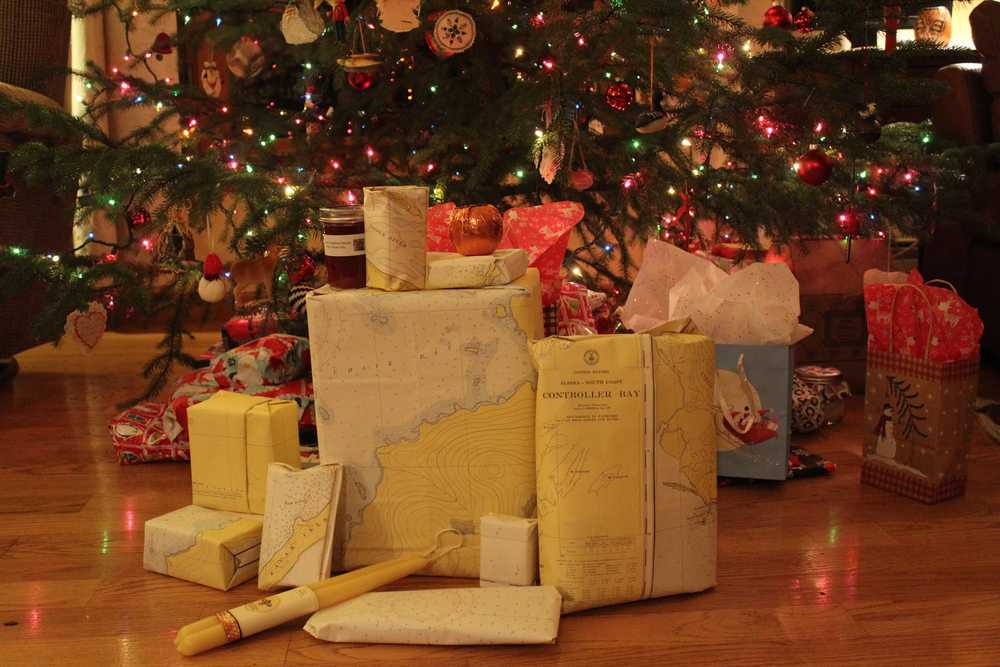
What about wrapping gifts in paper and cloth that we already have and can reuse? We have old maps, posters, rolls of craft paper or unused wall paper. Jettisoned nautical charts are amazingly tough. Charts can serve over and over. In fact, the easiest way to get at the present is to open the package and slide it out. Homemade cloth bags are sturdier yet and always welcome because people can reuse them. The Japanese have long since made wrapping cloth into an art form called Furoshiki. This is a practice where the wrapping is part of the gift. Furoshiki is enjoying a renaissance today because it is simple, elegant, saves paper, saves waste and is a pleasant thing that people like to do.
See: Japanese Furoshiki: How to wrap boxes. 4.08 minutes.
https://www.youtube.com/watch?v=6fhPumcPla0
• Dick Callahan is a Juneau writer. In April 2016, he won first place in the Alaska Press Club Awards for best outdoors or sports column in the state.
