
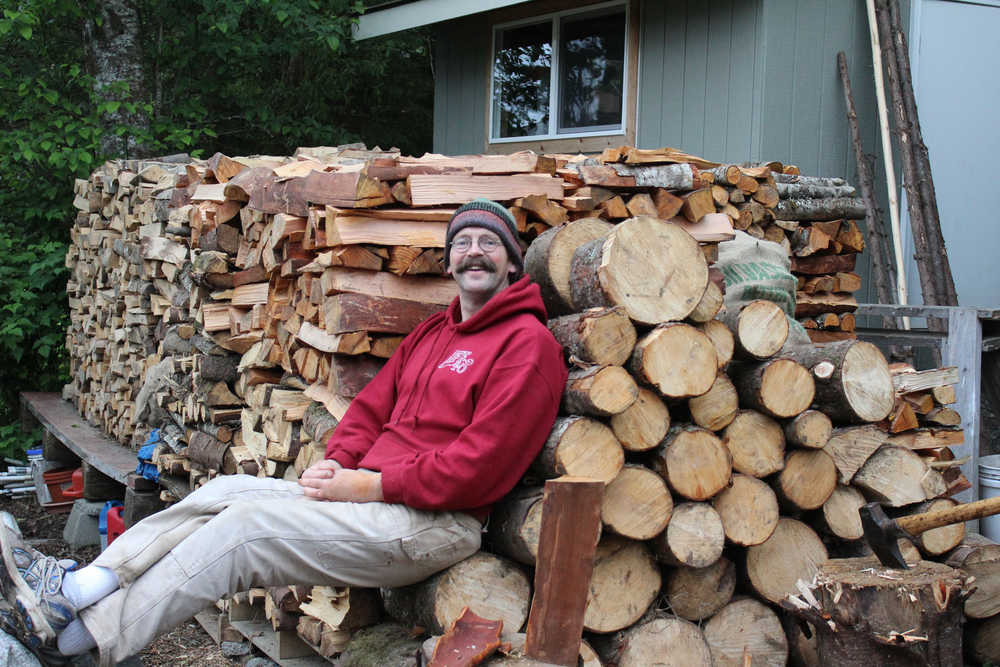
HOW MUCH WOOD IS ENOUGH?
The junk mail du jour was one of those women’s sportswear catalogs where trim, angular-jawed yuppies peer intently into the distance as they trot on a beach in eighty dollar jog bras made by poor women in the third world. On the cover, rear end facing the camera, was one of the above yuppies, swinging girlishly by her arms from the door jamb of a wood shed. Her curvaceous butt, displayed in designer sweat pants, was clearly the focal point of the shot. Standing at the mailbox gazing at the composition my first thought was profoundly inappropriate: “There’s not enough wood in that shed to last three days.”
Naturally I was embarrassed and upset by this thought, so I kept the catalog for a few weeks to pull out when men my age who heat with wood came over to the house. I’d show them the cover and ask, “What do you notice about this picture?” All of them — every one — said something like, “That guy doesn’t have enough wood.”
How much firewood is enough depends on: 1) How cold the winter is. 2) How efficient your stove is. 3) How weatherized your space is. 4) How big an area you’re heating. 5) What kind of wood you’re burning. 6) How much you trust the talking heads on television when they say fossil fuel distribution networks that start thousands of miles away and end your house are guaranteed. Taking those in order:
1) Alaska’s Congressperson-For-Life, Don Young, famously called global climate change science, “…the biggest scam since Teapot Dome.” The Alaska Climate Research Center, on the other hand, says average (mean) winter temperatures in Juneau rose 6.6 degrees (F) between 1949 and 2015.* Given that our crocuses came out at the end of February last winter, I’m going to have to go with 21st century instrumentation on this one. Warmer winters mean less firewood. That said, those errant jet stream currents that have hammered the Eastern U.S. with cold winters the past few years could conceivably redistribute themselves enough to set a 1940’s cold winter down on us. This possibility, and maybe OCD, keeps woodshed kings always on the lookout for the next log. Worst case scenario is we use it a year later.
2) Our house came with an old Earth Stove big enough to throw a Volkswagen into. It had an eight inch diameter stove pipe going straight up from the box. Most of the heat went straight up, too. Newer stoves hold and distribute the heat more efficiently, which cuts wood consumption. Rocket mass heaters you build yourself can cut your wood needs by more than three quarters. I’ve been talking with friends about building one of those. We’ll do an article at some point. If you’ve built one, or want to, feel free to contact me.
3) Basic things recommended by the Alaska Home Energy Rebate Program like thermally efficient windows and doors, stopping up drafts and proper insulation cut wood consumption radically. Keeping or planting trees around the house to block wind helps, too.
4) New stoves come with ballpark estimates of how many square feet they’ll heat, but a lot depends on how the place is configured, whether it has vaulted ceilings etc. Just closing doors to rooms you’re not using so you don’t have to heat them saves a lot of trips to the wood pile.
5) Wood species are like salmon species. People who know the difference will usually choose salmon in order of: king, sockeye, coho, pink and chum. Salmon snobs will argue long and loud, with the glasses off and spittle flying, that sockeye is better than king, or that coho’s better than sockeye. Nobody says they’d rather have chum fillets than kings. For wood, people around here tend to go for alder, then hemlock, then spruce, (even though alder has fewer BTUs than either. Go figure). Cottonwood and willow are the pinks and chums of firewood. Not many people argue for putting those in the wood pile though variables can change the order of what you want. A fresh coho is better than a washed out king. Likewise, a slow-growth hemlock packed with twenty rings to the inch is better than a fast growth alder with rings that are half an inch apart. A fresh pink salmon roasted over a campfire is better than anything when you’re hungry and that’s what you’ve got. If cottonwood, with maybe 2/3 the BTUs of Western hemlock, is what you’ve got when the furnace dies, it rocks. Both cottonwood and willow hold a lot water so they should be well seasoned. I took down a heart-rot willow and seasoned it for a year and a half. It wasn’t hemlock or alder but it burned just fine. Bottom line: you don’t want to fill the freezer with chums, you don’t want to fill the wood shed with cottonwood, but both work in a pinch.
6) As to thermal security, the men and women of Woodshed Nation have long since turned off their televisions and are chopping and stacking to the Six Syllables of Avalokiteshvara on the Path to Enlightenment, “Om…one more cord me…Hum. Om…one more cord me…Hum…”
* http://climate.gi.alaska.edu/ClimTrends/Change/TempChange.html.
• Dick Callahan is a Juneau writer. In April 2016, he won first place in the Alaska Press Club Awards for best outdoors and sports column in the state.
