
The Boy Scout/Crow Point trail is one that some of us walk several times a year. We get to know every rise and turn pretty well. One might think that a trail so familiar could not offer much in the way of interest. Yet it does, regularly — at least to those of us who look for things to pique and tweak the curiosity. Every season brings different things to be noticed.
One day in late August, as we emerged from the forested part of the trail, a ruckus arose out over the river behind us, somewhere near the Eagle Beach State Park parking lot. A horde of noisy crows took to the air and circled over the river, along with numerous gulls, and then disappeared from sight. I’ve never seen so many crows in a flock; there were at least a thousand of them (no exaggeration!). What would draw so many crows to that particular spot, and what would send them all up and away in such a flurry?
A little way before the junction where the Boy Scout trail splits off from the Crow Point trail, we commonly see a little flower that blooms late in the summer. On this day, there were just buds, some of them ready to open and show off the light blue, star-shaped flower. This small annual plant is known as star gentian (in one field guide) or marsh felwort (in another). It seems to favor areas of sparse, low vegetation, and we see it close to the trail. I’ve not noticed it elsewhere around here, although maybe I’ve just not been in the right place at the right time of year. Unfortunately, I have not found any information about its pollination biology, but I’d love to see what insects visit the flowers.
Recent high tides had stranded dozens of chum salmon carcasses and a few body parts alongside the trail and sloughs, which still harbored lively spawners. Many carcasses seemed to have spawned before they were stranded. The carcasses were interesting because all but one of them had intact skulls. However, several bodies had been ripped open, eggs taken from unspawned females, and a good portion of the muscle eaten. If bears had been feeding here, I would have expected to see some skulls opened up so the bears could eat the brains, which are full of fat (every neuron is coated with it). That’s what we often see at Steep Creek, especially on male salmon, which — lacking succulent eggs — have the next best stuff in the braincase. So when a bear happens to catch a male salmon, if it doesn’t reject the fish outright, it often crunches the skull for the brains. But that didn’t happen to these chum salmon by the sloughs. Those with torn-up bodies were, I presume, ripped up by birds — eagles and ravens, probably; they and gulls also took the eyes, as usual.
As we wandered out into the big flat meadow, we noticed an unusually heavy infestation of ergot on the beach rye. This fungus sends up conspicuous blackish spikes from the seed heads in late summer. It’s hallucinogenic and is thought to have been responsible, historically, for such madnesses as witch hunts; rye grain was commonly used for bread, especially by poor folks. In some stands of beach rye, there were 12 to 15 ergot spikes on a single seed head and 99 percent of the seed heads had at least one, while other stands had little infestation.
On the approach to the south-facing beach, near the edge of one of the spruce groves, there were yellowish, small piles of seed fragments and the occasional dropped seed. They lay beside the empty seed pods of chocolate lily. I’m guessing that a red squirrel ventured out of its grove and made a small feast of these seeds.
Little mixed flocks of sparrows fossicked about for grass seeds in the meadows, while some migrating warblers flitted in the bordering trees. I always enjoy that stand of red alders festooned with beautiful draperies of old-man’s-beard lichens, especially when high-lighted by an errant shaft of sunlight. Bright red fruits of baneberry, elderberry, and highbush cranberry made spots of color at the forest edge.
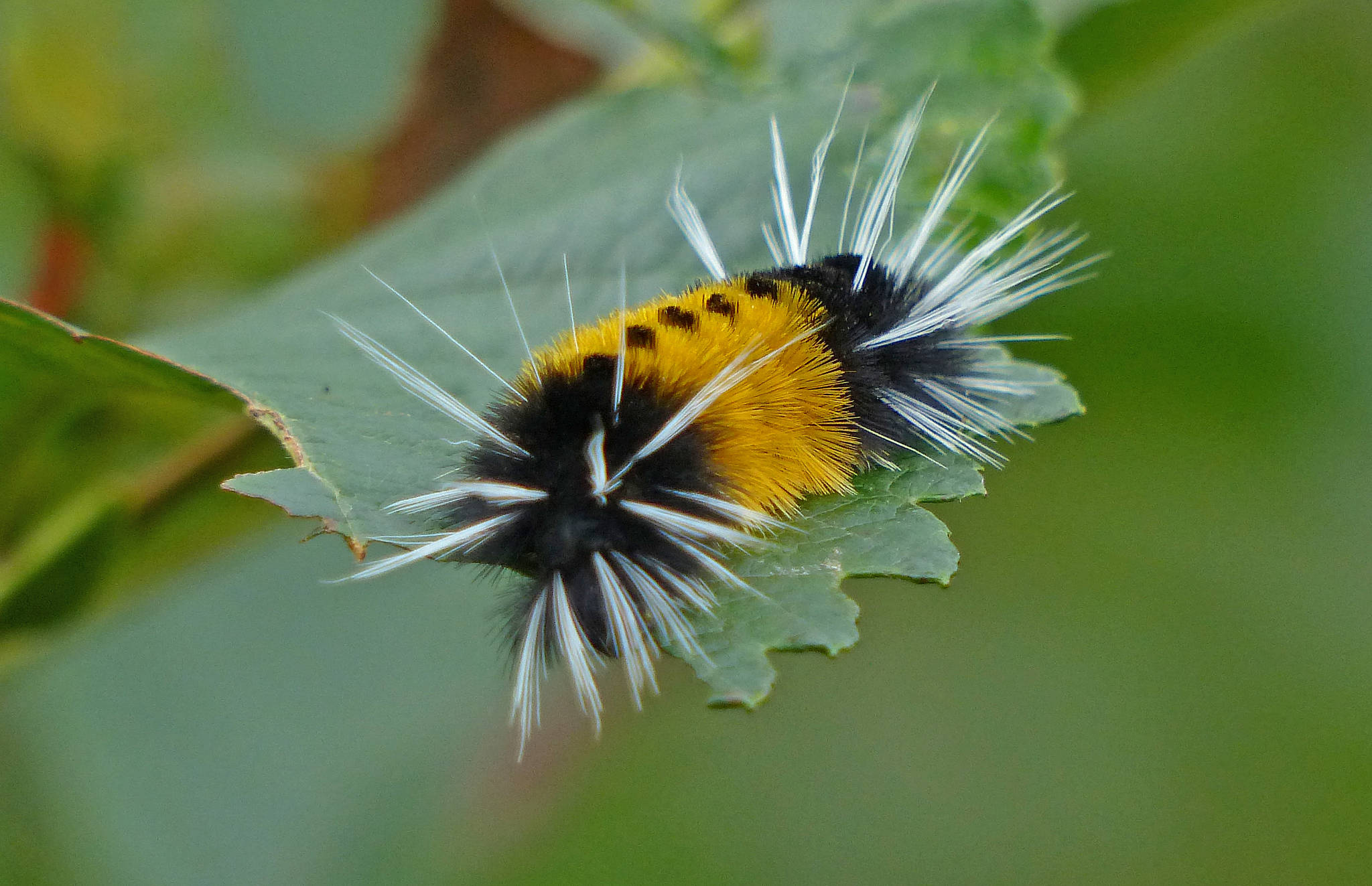
I harvested a few of those so-called cranberries (they are not even related to true cranberries), with the thought of making some of that savory ketchup. When I spread out my collection on the kitchen counter in order to pick out some little stems and leaves that had found their way into my stash, I found a tiny hairy caterpillar, the kind that most of us call “woolly bears.” And that reminds me to say that these caterpillars with broad black and orange bands are not true woolly bears. They belong to another genus entirely (Lophocampa), distinguished from true woolly bears (genus Pyrrharctica) by the long white plumes emerging from the black bands. Both are the larvae of tiger moths but they tend to eat different kinds of leaves. The proper common name of the black and orange caterpillar in our area is the spotted tussock moth. What? Our caterpillars don’t (usually) have spots! But reportedly, in some regions, this species sports a row of black spots on its all-yellow back. And even certain of our local specimens (but not all!) show some black spots on the orange/yellow band. In fact, the color pattern is extraordinarily variable across North America, for reasons unknown. Another mystery, for someone to unravel.
• Mary F. Willson is a retired professor of ecology.
