
On a gorgeously sunny day in mid-April, a group of hikers stopped for lunch on the beach near the Boy Scout camp. And a leisurely lunch it was! Who wanted to go home when you could just bask in the sun and look for whale spouts in the distance?
We were visited by several bumblebees, newly emerged from hibernation. The bees were busily searching for something. There were no open flowers near the beach, but they may have been looking for places to dig nests in which to raise their broods of workers. Whatever they were looking for, they showed a clear tendency to buzz and crawl near certain hikers. In almost every case, those chosen individuals wore blue or purple shirts and jackets.
Bumblebees are well known to prefer colors in the blue and purple range of wavelengths. Their range of color perception is not like that of humans: their color receptors are sensitive especially to blue, green, and ultraviolet, and they are not sensitive to red at all. Because they can see ultraviolet, objects look different to them than to us. For example, many bee-visited flowers look uniformly colored to us, but bees can see distinct patterns on the petals. So I wondered if those attractive blue and purple jackets and shirts might have some UV reflectance that made them especially winsome.
People responded to the searching bees in various ways. Some quietly observed the bees. One person in a bright blue shirt sat calmly, letting the bees inspect the shirt, and being very careful not to inadvertently squeeze one between an arm and a rib or to harass the bees in any way. Agitated bees are far more likely to sting than calm bees that are just going about their business. Therefore it is a good policy not to flail and swat and stomp the visiting bees, which only makes them feel threatened and more likely to sting. Better to wait until the bees figure out the shirt is not a flower, or better yet, change or cover up the colorful shirts.
On the way back to town, several of us stopped off at the Arboretum. Along the slope was a planting of a horticultural type of coltsfoot in full bloom; the big balls of tiny flowers were a-swarm with happy bumblebees. Nearby, we found a beautiful swath of purple and white crocuses, with lots of bumblebees diving deep into the floral cups, gathering pollen (and perhaps nectar, too), which will be used to feed themselves and their broods of young. The bees’ bodies and wings picked up pollen, which could be deposited when the bee visited the next crocus.
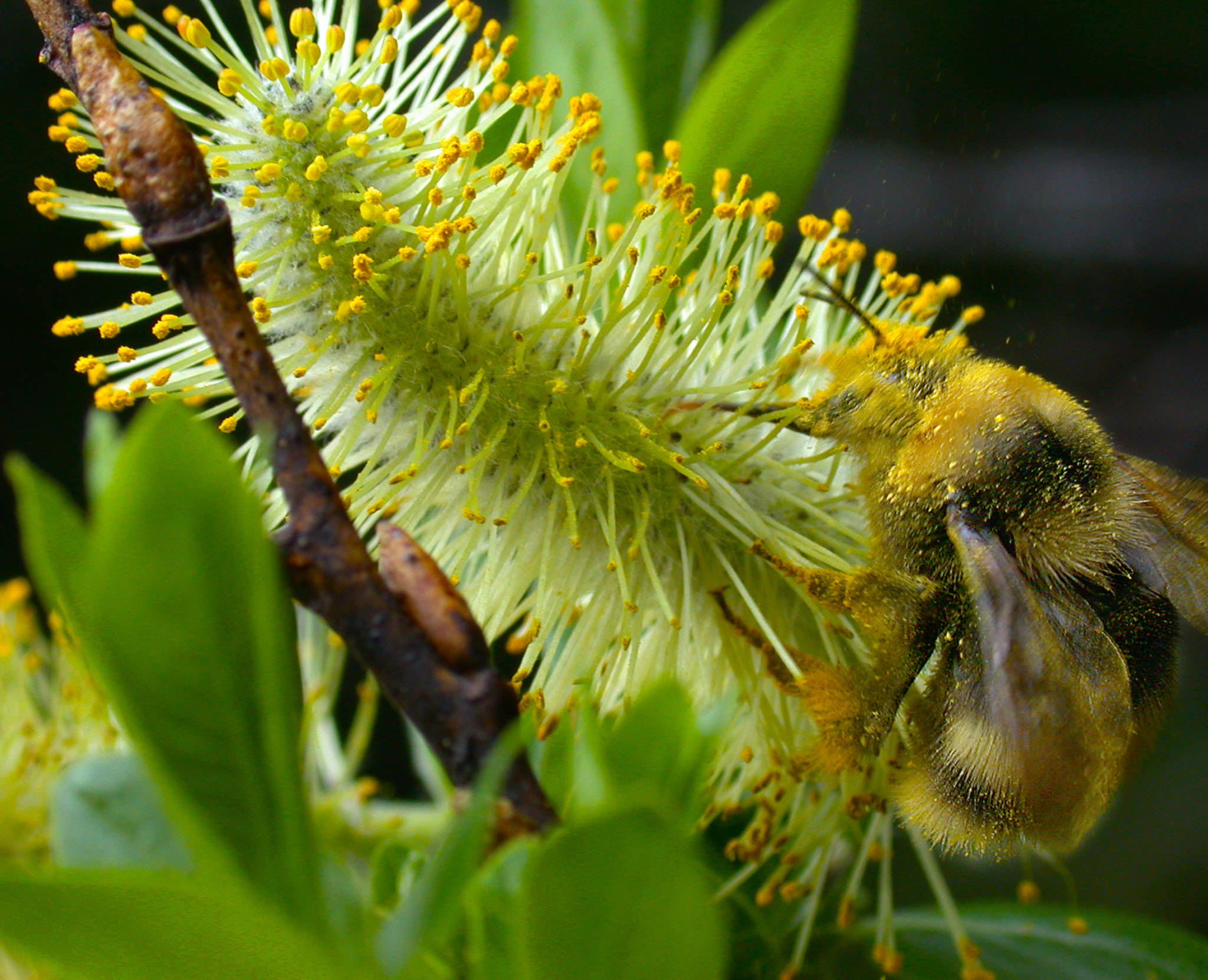
All these bees were queens: females that had mated at the end of the previous summer, so their eggs were fertilized but not yet developed. Queens have to eat nectar and pollen in order for the eggs to develop; so those beach queens were hard pressed — there weren’t even any male pussy-willows to provide a drop of nectar and some pollen (an important early-season source of food in some areas) nearby. When she is well fed, the queen makes a nest, sometimes in a small burrow or perhaps in an old mouse nest, makes a little wax pot full of collected nectar (“honey”) and lays her eggs, typically on a little ball of pollen mixed with nectar and saliva. Then she incubates them for a few days, generating her own body heat, sitting next to the honeypot and feeding herself. When the eggs hatch, the larvae feed on the pollen ball (“bee bread”) and then pupate while they transform into adults; this period of development takes a few weeks. While the first brood of larvae is feeding, the queen produces another one; each brood is comprised of several dozen (or sometimes more) young ones. She may make several broods in the course of a summer.
When summer rolls around, the larvae begin to emerge as adult workers; all of these are females. They cruise around the landscape, feeding and also collecting nectar and pollen to take back to the nest for the larvae. Later in the season, unfertilized eggs develop into males, which visit lots of flowers, feeding on nectar, but they do not help feed the developing broods of larvae. Some of the larvae receive special feedings, and these become new queens, which mate with the males, and then put on fat to tide them over the winter while they hibernate. The new queens are the only ones to overwinter and emerge the next season.
Bumblebees are very important pollinators of many native plants in our area. We see them crawling into iris flowers in summer, taking naps in fireweed flowers, zipping from one salmonberry flower to another. For some plants, bumblebees are the most effective pollinators: there would not be a blueberry crop for humans, bears, and thrushes to enjoy if it were not for bumblebees. Blueberries (and shooting-stars and cranberries) are pollinated by a special technique called buzz-pollination or sonication, when a bumblebee lands on the flowers and vibrates (buzzes) in a particular way, shaking loose the pollen, which collects on the bee’s body, ready to be transferred to the next flower as the bee forages.
• Mary F. Willson is a retired professor of ecology.
