
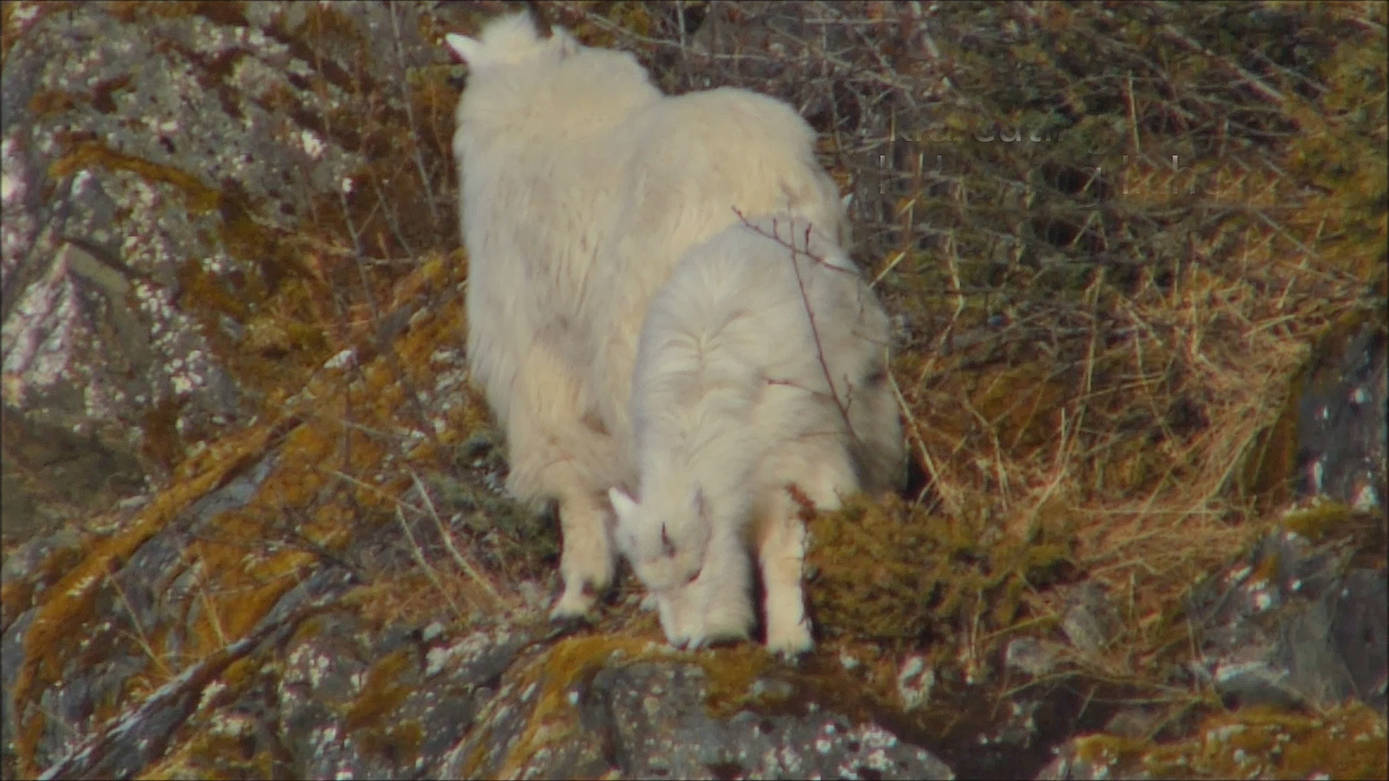
Mountain goats appeared on the cliffs near Nugget Falls by Mendenhall Glacier in Juneau in February, as they often do. My occasional visits to the area have revealed two females and one juvenile, sometimes feeding on alder twigs and once I saw an adult engulf a whole conifer branch. They also nibbled on mosses and lichens close to the ground; we could see that one of their choices was the white foam (or snow) lichen (Stereocaulon).
Here in Southeast Alaska, deer, moose and goats commonly eat lichens, especially in winter when there is no greenery. I’ve seen browse lines in the forest, where deer have munched all the hanging lichens (such as witch’s hair, Alectoria) up to a certain height. Up north, and across the Arctic, caribou and reindeer depend on lichens; in winter they dig away the snow to reach lichens on the ground.
These observations begged the question: What nutrition do lichens provide? Most lichens are low in protein (around two percent) but offer substantial amounts of carbohydrate. Some lichens contain cyanobacteria that fix nitrogen, and these have higher protein value, but they are reported to be less favored by some mammalian lichen-eaters. However, mountain goats are known to eat them. The white foam lichen that the goats by Nugget Falls were eating has about 7 percent protein, which is not high, but better than many other species.
Goats, deer, moose and caribou are herbivores with four-compartmented stomachs adapted to help break down the complex carbohydrates that compose the bulk of the lichens and summer herbage that they eat. A well-developed bacterial flora turns the big carbohydrate molecules into simple sugars that can be absorbed in the intestines. Regional differences in the available species of lichens are accompanied by regional differences in the bacterial flora adapted to these dietary differences. A well-adapted bacterial flora can increase digestibility several-fold.
A now-classic story is that of the introduction of reindeer to St. Matthew Island in the Bering Sea. The Coast Guard had a station there and in 1944 brought in 29 reindeer for an emergency food supply. But the Coast Guard departed a few years later, leaving the reindeer. By 1963, the herd had increased to about 6,000 animals. But the population crashed, during the next two years, to just 42 animals. They had eaten up most of the lichens, and an extremely severe winter, with deep snow, high winds and low temperatures, quickly finished off thousands of them. By the 1980s, not one was left.
Other mammals eat lichens, too. In some areas, horsehair lichen (Bryoria), which is often common on tree trunks and branches, along with certain other arboreal lichens, comprised 80 or 90 percent of the diet of flying squirrels. Red-backed voles eat horsehair lichen and reindeer lichens. These rodents do not have the complex stomachs found in deer and goats, but they must have a good community of bacterial to help digest all the lichen that they eat.
Hordes of invertebrates eat lichen too. There are mites, springtails, small insects, snails and slugs that include lichens in their diets. Sometimes one can see the distinctive scrape marks made by snails or slugs that rasped off the surface of flat, leafy lichens.
Humans eat lichens too, but they often boil it in several waters to remove bitter flavors and cook the lichens in various other ways. These treatments probably improve digestibility as well as flavor.
Lichens are known to accumulate pollutants from the air; in fact, some are useful indicators of air pollution because they sicken and die off in filthy air. They also accumulate radioactive fallout. Even low levels of air-borne pollutants and fallout build up in these lichens, and therefore the animals that eat lichens may regularly accumulate lots of pollutants and radioactivity in their bodies. And then the predators of the lichen-eaters get poisoned too: The wolves and humans that eat deer and caribou, the eagles and ravens that scavenge the carcasses, the owls that hunt rodents, the birds that glean small insects … all of them can accumulate damaging material from polluted and radioactive lichens. In some cases, the buildup of dangerous stuff may be sufficient to change their behavior, impair disease resistance or diminish their ability to reproduce.
• Mary F. Willson is a retired professor of ecology.
