
Things are changing here in Juneau. The fireweed, fully bloomed into brilliant magenta flowers just a month ago, have turned to cotton. The morning air has a crispness to it that didn’t exist during the peak of summer. Fog often hovers low over the channel in the morning, quickly burned away by the sun’s lazy ascent.
As the leaves start making a downward journey, so too does the big, beautiful rock we call home. It’s now the northern hemisphere’s turn to point away from the sun, and the days are getting shorter by the minute. On clear nights, more stars than I’ve ever seen paint the sky, finally visible thanks to a black backdrop. I’ve watched the sun trade places with the moon several times over the last two summers, patiently waiting to catch a glimpse of my favorite performer in the sky.
It’s hard to say how many times I’ve chased the aurora borealis. She’s hard to find, and even trickier to photograph. She moves quickly enough that the slowest shutter speeds turn her shape to a blur, but because she only comes out when it’s dark, a long exposure is necessary.
It’s rare for her to make it all the way to us. She travels through solar particles and rockets through space, directed by solar winds and colliding with atoms in the atmosphere. Only when these collisions release their excess energy by emitting light particles can she illuminate the sky.
Juneau’s latitude is both a blessing and a curse when it comes to seeing the northern lights. On one hand, our position near the top of the planet means more solar particles are being funneled in our direction as they make their way to the North Pole’s magnetic field. On the other, it has to be truly, pitch-black, darker-than-the-inside-of-a-cow at night to see the aurora. This requirement essentially means she won’t come to town between the months of May and August.
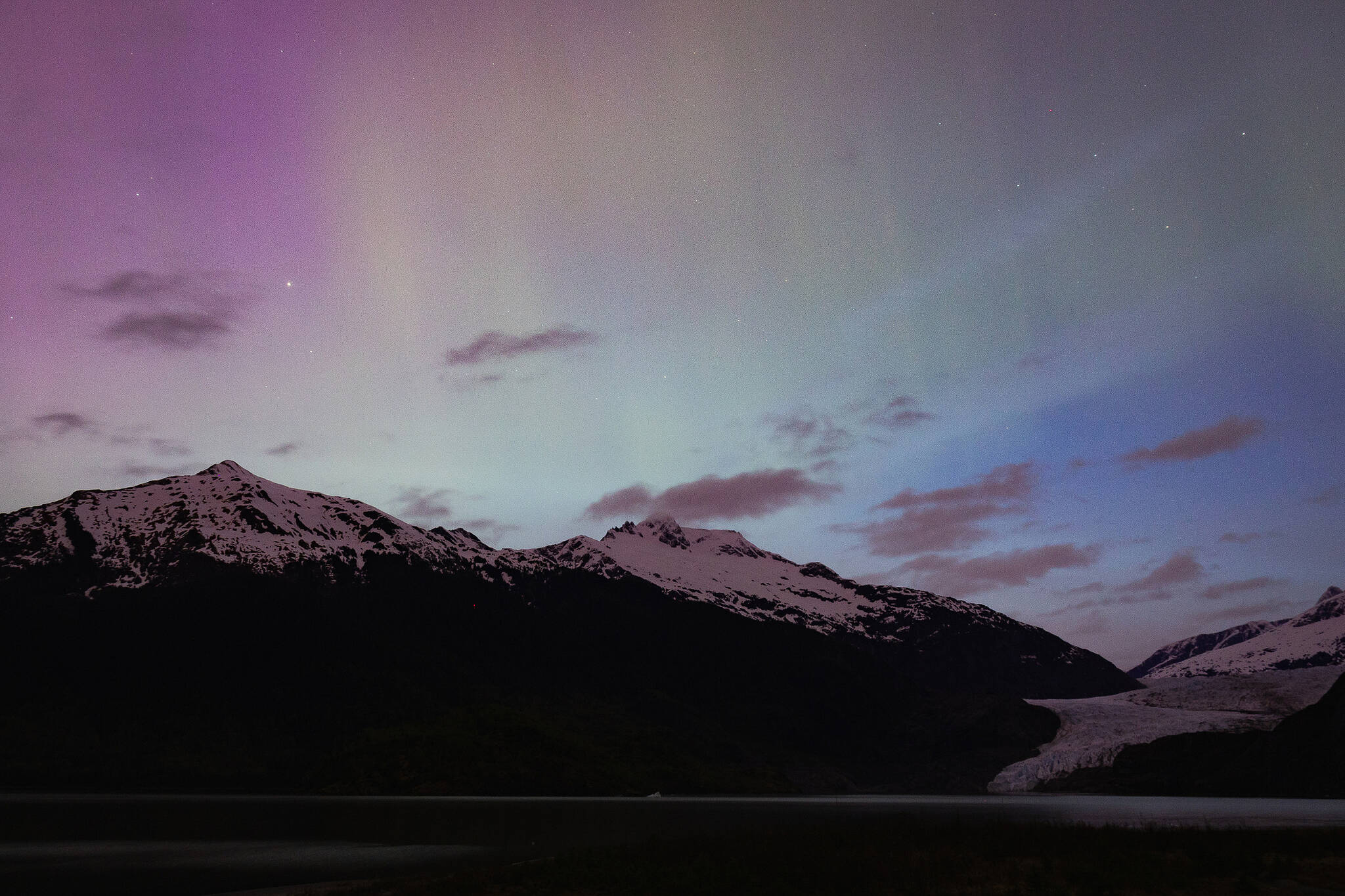
September through April like to keep us guessing. My phone alerts me when geomagnetic activity suggests auroral activity, but most of the time she’s dancing for a blind audience of clouds. Every once in a while, however, the stars align, and ribbons of green, purple, yellow and red bring the night sky to life.
So many things in Juneau — and in life in general — require a tremendous amount of patience and luck. I’ve spent a lump sum of several months on the water. All that time has resulted in maybe a cumulative hour of watching whales breach. My right eyebrow is permanently bruised from pressing it against my camera’s viewfinder, and I’ve only ever captured a handful of images I feel proud enough to share. After dozens of long nights that eventually faded into early morning spent peering up at the sky, I’ve seen the aurora maybe five times.
Maybe my average isn’t great, and maybe it’s a shame it took me 22 years to see the northern lights for the first time. I don’t know or particularly care. It feels incredible to say I’ve witnessed this phenomenon even once.
All winter long, I’ll keep one eye on the sky and one on my phone’s aurora app. When the sky is clear and the KP index is right, I’ll bundle up and rush outside in search of Alaska’s wintertime gift. It’s OK if some those nights spent searching end up in vain; the pursuit is half the fun.

The northern lights are pictured from False Outer Point on Sept. 2, 2025. (Chloe Anderson for the Juneau Empire)
