
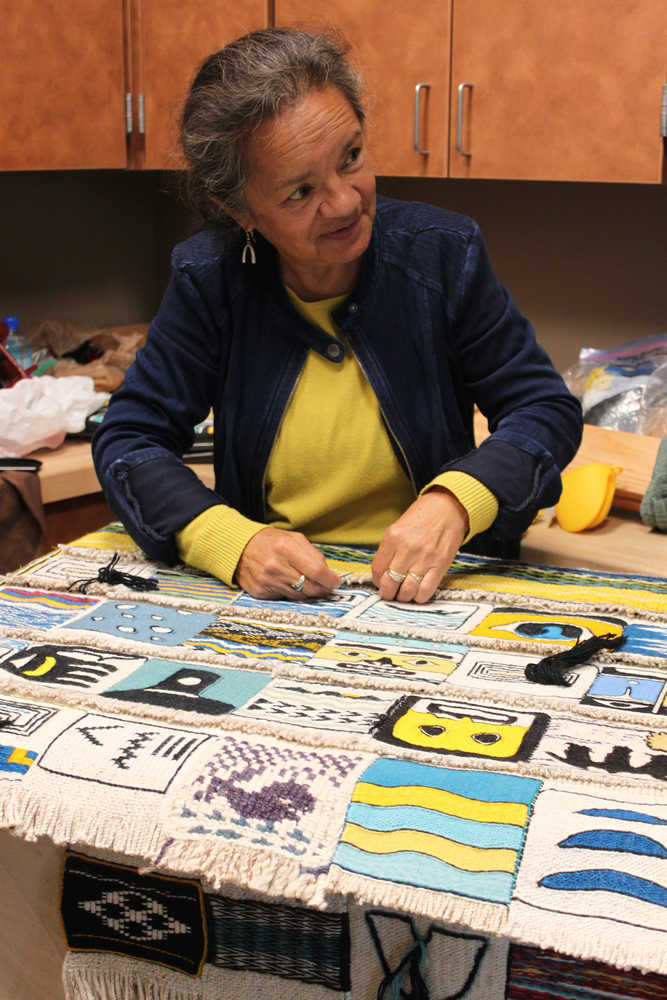
Clarissa Rizal and 40 contributing weavers from around the Pacific Northwest have completed a Chilkat and Ravenstail robe that will be used to celebrate canoe gatherings and the maiden voyages of new dugout canoes — and it will get its first use Aug. 25, during the dedication of Xunaa Shuká Hít, the Huna Tribal House in Glacier Bay.
The idea for the robe struck suddenly this February, when Rizal — a renowned weaver, 2016 National Endowment for the Arts Heritage Fellow, and apprentice of celebrated Chilkat weaver Jennie Thlunaut — was speaking with her friend Susie Williams.
“She’s telling me about all the projects she wants to knit, and I said ‘Really, all I can see is Chilkat,’” Rizal said. “We both laugh about how we are, obsessed about whatever we see.”
Williams asked Rizal if she had ever done a “crocheted granny square blanket.”
“I could see it and it was like this image coming at me, and it got closer and closer and then I saw it … and I said ‘It’s a Chilkat Ravenstail robe that’s made with little squares done by different weavers up and down the coast.”
A month and a half later, she began reaching out to fellow weavers.
Forty weavers contributed a square to the robe. Some are Chilkat designs; some are Ravenstail.
For those who are not familiar with the styles, Chilkat weaving is sometimes referred to as “painting with wool.” It’s the style used for complex images. Ravenstail is referred to by Ravenstail weaver Teri Rofkar as “binary code” — it employs complex patterns and shapes. Both are traditional, but very different, styles of weaving in the Pacific Northwest.
Chilkat weaving, Rizal said, is a spiritual experience. She’s worked in many different artistic mediums, but has “never experienced an art form that has such a strong spirit to it,” she said. “It chose me. I didn’t choose it … and when I chose it (back), my life seemed to fall into place.”
Rizal first apprenticed with Jennie Thlunaut when Thlunaut was 95 years old. She has a moving entry about the apprenticeship, and her call to Chilkat weaving, on her blog.
Thlunaut won a National Endowment for the Arts award in July 1986. She died soon afterwards, and when Rizal moved back to Southeast Alaska, she was asked to teach Chilkat weaving to Thlunaut’s granddaughters. Rizal hadn’t been able to weave since Thlunaut’s death.
“My fingers just lock up. I get all emotional,” Rizal said, recalling that time. The thought of teaching Thlunaut’s granddaughters, however, helped her accept the call.
None of the weavers for the “Weavers Across the Waters” robe have been paid or have asked to be, though Rizal said she’d like to find a way for them to, potentially by finding an art benefactor to become the robe’s patron.
The robe will be housed in the soon-to-be-complete weavers studio at Evergreen State College in Washington and will travel to communities in Canada and Alaska, hopefully associated with events involving workshops and classes on weaving, Rizal said.
Weavers are from Haida Gwaii, Prince Rupert, Juneau, and many other places. The name of the Facebook group they used to communicate is “Weavers Across the Waters” — an apt name, weaver Lily Hope, Rizal’s daughter and a contributor to the robe, pointed out.
While 40 weavers contributed squares for the robe, Rizal’s job isn’t easy. She’s been weaving the “mating loons” patterned three-inch borders (they are thicker than is usual) eight to 10 hours a day for the last 30 days, she estimates, and still needed at least another 40 hours to finish it when the Capital City Weekly spoke with her. And that’s just time weaving — not organizing or communicating with fellow weavers.
Each square Rizal estimates took contributors around two to three weeks of work and measures around five inches by five inches, though only a few are exactly the requested size.
The border design was inspired by a contribution by Teahonna James of Klawock, whose square will be the robe’s clasp. It’s Rizal’s favorite pattern. James also helped weave parts of the border, and other weavers helped finish it in the final days before the Aug. 25 dedication.
Kevin Belin, James’ boyfriend and a Navajo jewelry-maker and teacher, measured each square and created a detailed grid of how to lay them out, which Rizal said was invaluable to the final product.
The robe’s first use will be during the dedication ceremony for Xunaa Shuká Hít, the Huna Tribal House in Glacier Bay, on Aug. 25.
When she had the idea for the robe, “I thought of Wayne Price right away,” Rizal said. (Price is the master carver who has been leading the carving of two 40-foot spruce dugout canoes that Hoonah community members will paddle to Glacier Bay.) Lt. Gov. Byron Mallott may wear the robe during the public ceremony.
Weavers who have contributed to the robe are Della Cheney, Suzi Williams, Lily Hope, Vicki Soboleff, Margaret Woods, Veronica Ryan, Catrina Mitchell, Chloe French, Annie Ross, Stephany Andersen, Karen Taug, Dolly Garza, Nila Rinehart, Teahonna James, Ursala Hudson, Edna Lamebull, Courtney Jensen, Sandy Gagnon, Kay Parker, Marilee Petersen, Alfreda Lang, Georgia Bennett, Willie White, Pearl Innes, Koosnei Rainy Kasko, John Beard, Joyce Makua, Michelle Gray, Gabrielle George, Sally Ishikawa, Darlene See, Douglas Gray, Peter McKay, Shgen George, Debra O’Gara, Marsha Hotch, Irene Lampe, Davina Barrill, Yarrow Vaara, Mary Ebona Miller, and, of course, Clarissa Rizal.
Look for coverage of dedication of Xunaa Shuká Hít in the Aug. 31 Capital City Weekly and at www.facebook.com/capitalcityweekly.
• Contact Capital City Weekly editor Mary Catharine Martin at maryc.martin@capweek.com.
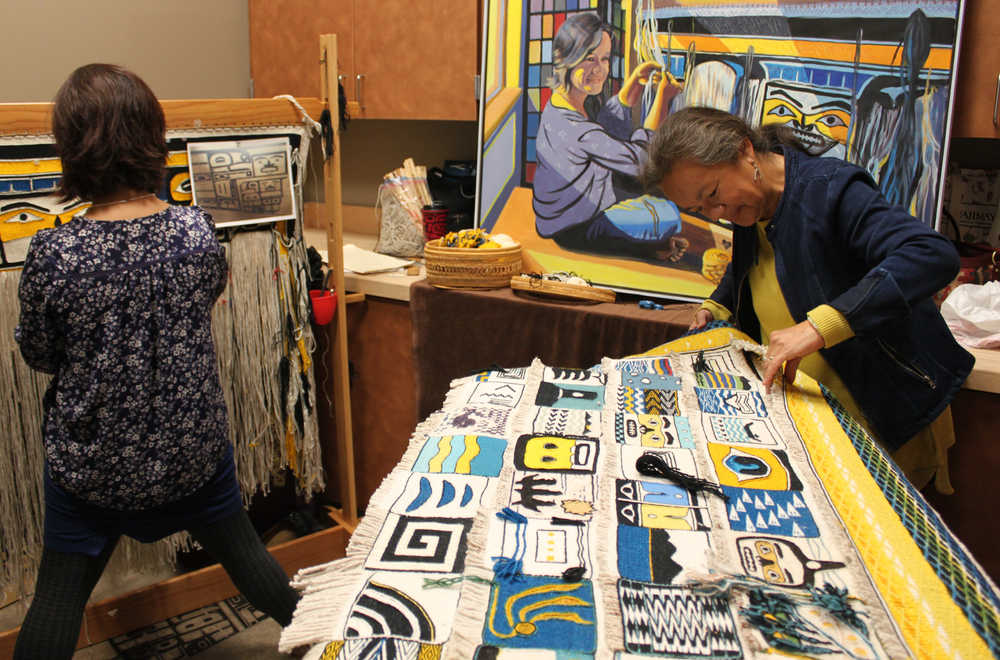
Mother and daughter – weaver Lily Hope, left, works on a robe (backdropped by an Arnie Weimer painting of her working on the same project) as her mother, Clarissa Rizal, works on the “Weavers Across the Waters” robe 40 weavers from around the Pacific Northwest contributed to. It will be used for canoe gatherings and the maiden launch of new dugout canoes.
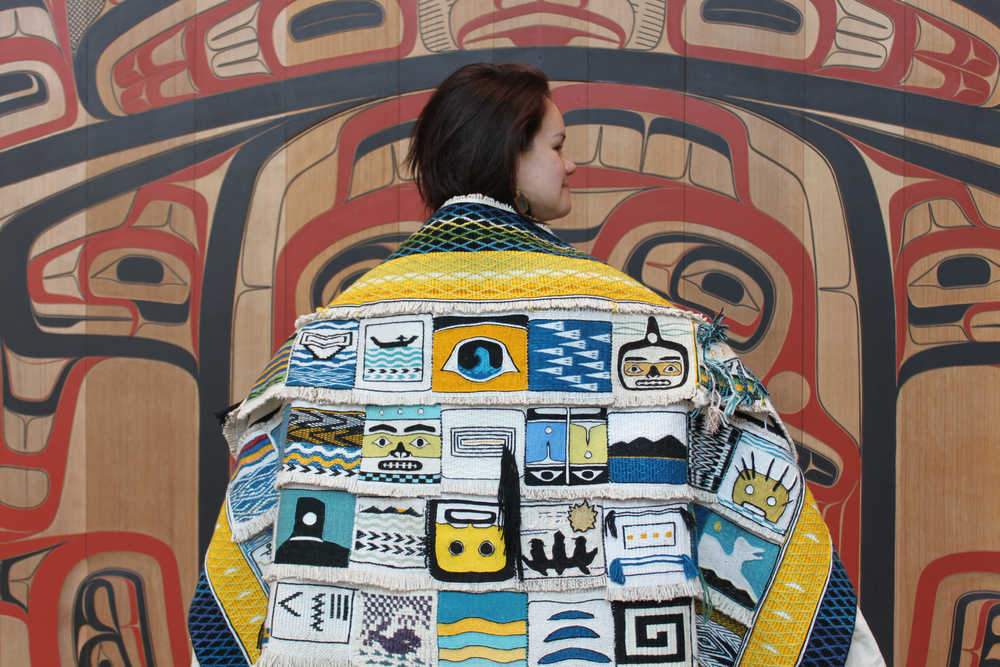
Lily Hope wears the “Weavers Across the Water” robe during its progress (the bottom was yet to be completed.) She is one of the weavers who contributed a square to the robe, which is an idea of her mother, master weaver Clarissa Rizal, who’s been spending the last month putting the pieces together and weaving the border.
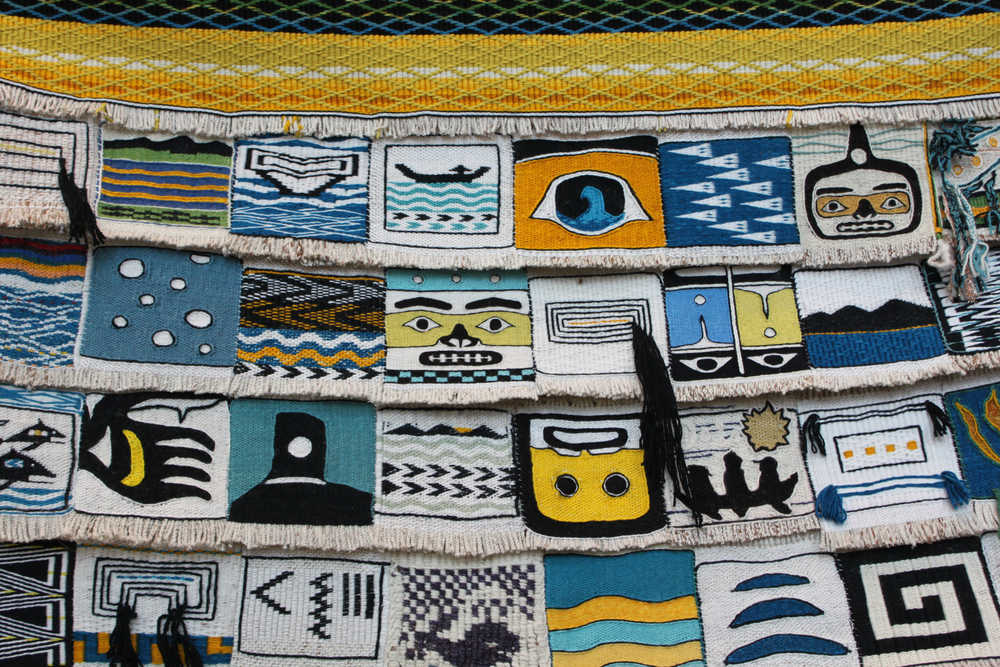
This is part of the “Weavers Across the Water” robe that will be debuted at the dedication of Xunaa Shuká Hít in Glacier Bay. Forty Ravenstail and Chilkat weavers from around the Pacific Northwest contributed a square measuring around five inches by five inches. Master weaver Clarissa Rizal wove the border around the robe, a pattern called “Mating Loons.” The robe will get its first use during the dedication ceremony for Xunaa Shuká Hít, the Glacier Bay tribal house.
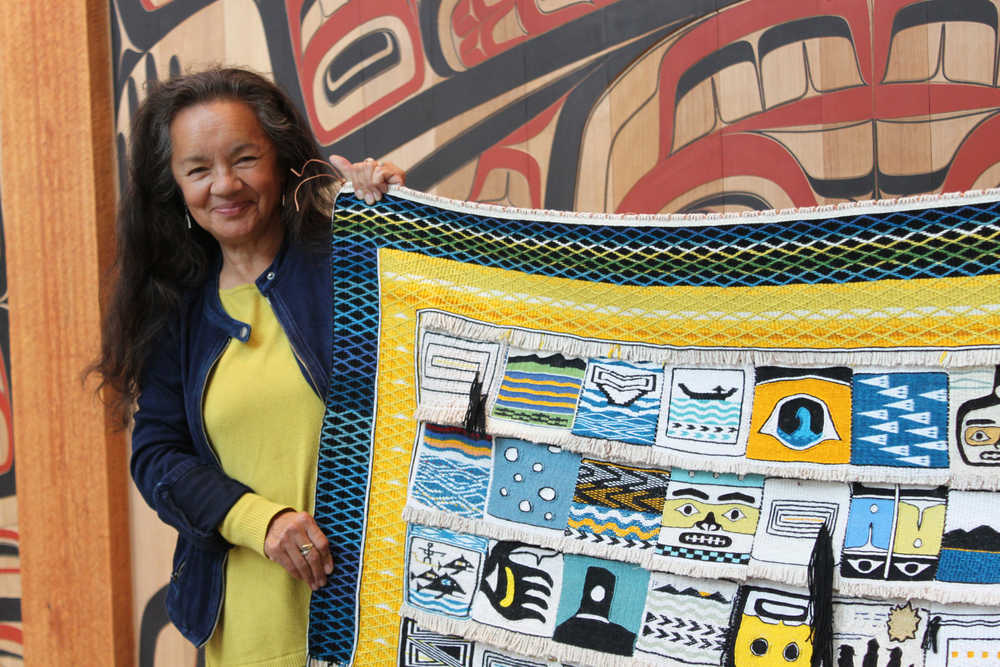
Master weaver Clarissa Rizal holds up one end of the “Weavers Across the Water” Chilkat and Ravenstail blanket. Forty Ravenstail and Chilkat weavers contributed a square measuring around five inches by five inches. Rizal wove the border around the robe, a pattern called “Mating Loons,” and is working them all into a robe that will get its first use during the dedication ceremony for Xunaa Shuka Hit, the Glacier Bay tribal house.
