
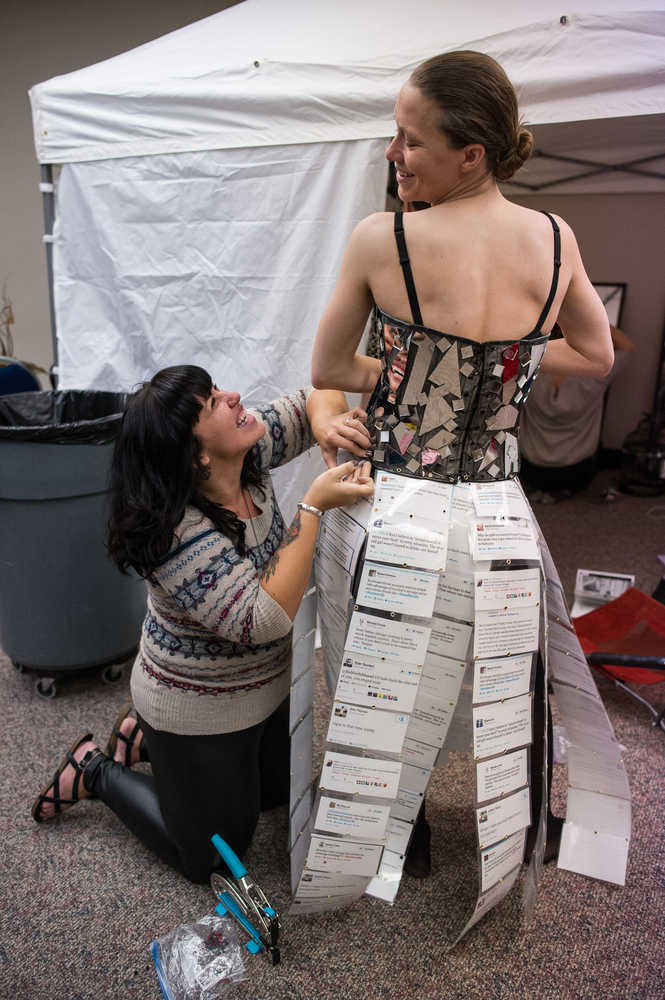
Artist Rosie Ainza fits model Marianna Carpeneti into her costume made of glass, synthetic leather, wire, ribbon and hateful public comments from social media users in her entry titled "Tweet" at the Wearable Art Extravaganza 2016 at Centennial Hall on Sunday.

Artist Rosie Ainza fits model Marianna Carpeneti into her costume made of glass, synthetic leather, wire, ribbon and hateful public comments from social media users in her entry titled "Tweet" at the Wearable Art Extravaganza 2016 at Centennial Hall on Sunday.

Wearable Art Q&A: Artist Rosalinda Ainza

Wearable Art Q&A: Artist Rosalinda Ainza

Capital City Weekly


CCW: How many wearable art shows have you participated in? 

RA: This is only my second show but I was infatuated immediately. 


CCW: What motivates you to participate in this event?

RA: After reading about the theme of last year’s “Juxtaposition” in the Empire I decided to give it a try. I elected to use the stage as a platform to share a message. Everyone, from the producers to the participants to the attendees, were all incredibly supportive. The creative process all the way through the main event was so inspiring that I just had to participate again this year.  


CCW: In last year’s show, your piece “Conflict,” modeled by Marianna Carpeneti, was one of the most intriguing designs to cross the stage. Can you briefly describe how you came up with the idea for that piece? 

RA: After spending the previous winter working in East Africa, I returned to Juneau with resolve to share messages from the region. With the stage as a tool for my voice, I chose to create a protest piece on conflict minerals. It could be viewed as shocking or bellicose with the use of a photograph I’d taken of a young boy in Rwanda, however I felt that was needed to underline the message and theme.


CCW: Does this year’s piece reflect any political/social issues? 

RA: After last year I pledged to myself that as long as I participated in Wearable Art I’d utilize it to speak up for critical issues. This year’s piece speaks to the grotesque use of social media to convey hateful messages. More specifically, it underlines the prevalence of victim blaming and shaming of women who have been sexually assaulted.


CCW: What materials did you use to create your piece this year?

RA: The piece is made from synthetic leather, metal, glass, wire, feathers, and original Twitter posts that depict asymmetrical scrutiny towards rape victims.


CCW: How much trial and error was involved in getting it to work out the way you wanted?

RA: It was trial and error all the way! I went through various bottles of glue, staples, oddly shaped sewing needles, you name it. Neither laminated paper nor glass mosaic tiles are very kind.


CCW: How much do you think about the performance aspect of your piece while you’re creating it? 

RA: I feel that the model makes the piece. Marianna Carpeneti did a wonderful job creating movement for my design last year. She is my muse and confidant, and she truly invoked the message I was hoping to share. I asked that she take free reign of her performance again this year and I suspect she’ll outdo herself.


CCW: How does wearable art fit into your artistic life as a whole — is it a small part of your creative life or a major part?

RA: I am a Jack of all trades, but master of none. I just try to exemplify what I find beautiful or moving, whether it’s in the form of photographs, poetry, or this newer project of costume design.


CCW: What aspects of wearable art do you appreciate the most?

RA: Having a chance to convey what I feel passionate about, in an artistic manner, is truly electrifying. However, what I appreciate most is how Wearable Art shines a spotlight on the breathtaking creativity of my fellow artists. I also love the community’s enthusiasm and support for this fantastic event!
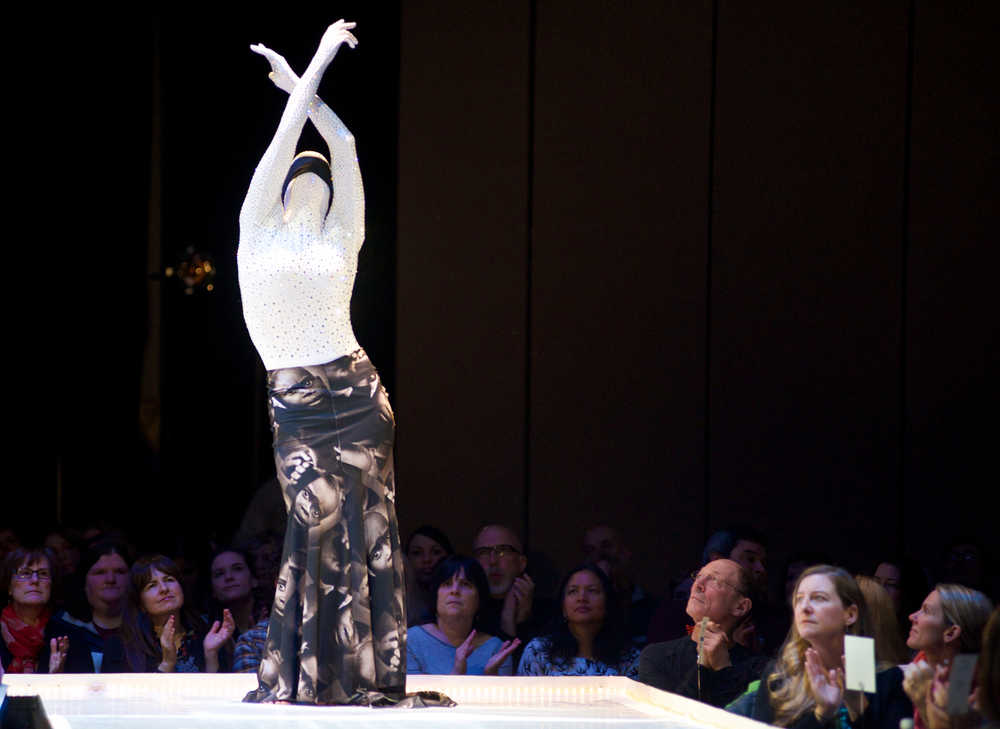
Marianna Carpeneti models artist Rosie Ainza's "Conflict" during the 2015 Wearable Art Show sponsored by the Juneau Arts & Humanities Council at Cenntenial Hall.

Marianna Carpeneti models artist Rosie Ainza’s “Conflict” during the 2015 Wearable Art Show sponsored by the Juneau Arts & Humanities Council at Cenntenial Hall.

More in Neighbors

Peggy McKee Barnhill (Courtesy photo)
Gimme a Smile: How much snow can one backyard hold?

Snow, snow, everywhere, and no place to put it!

The Spruce Root team gathers for a retreat in Sitka. Spruce Root, is an Indigenous institution that provides all Southeast Alaskans with access to business development resources. (Photo by Lione Clare)
Woven Peoples and Places: Wealth lives in our communities

Sustainable Southeast Partnership reflects on a values-aligned approach to financial wellness.

Actors in These Birds, a play inspired by death, flowers and Farkle, hold ‘flowers’ during a performance at the UAS Egan Library on Saturday, Jan. 31. (photo courtesy Claire Richardson)
Living and Growing: Why stories of living and dying in Juneau matter

What if we gave our town a safe space to talk about living and dying with family and friends?

calendar
Weekly events guide: Juneau community calendar for Feb. 2 – Feb. 8

Visit Juneau Arts and Humanities Council at JAHC.org for more details on this week’s happenings.

calendar
Weekly events guide: Juneau community calendar for Jan. 26 – Feb. 1

Visit Juneau Arts and Humanities Council at JAHC.org for more details on this week’s happenings.

Courtesy photo
Adam Bauer of the Local Spiritual Assembly of Bahá’ís of Juneau.
Living and Growing: Surfing into the future

Many religious traditions draw strength from the past.

calendar (web only)
Weekly events guide: Juneau community calendar for Jan. 19-25

Visit Juneau Arts and Humanities Council at JAHC.org for more details on this week’s happenings.

(web only)
Weekly events guide: Juneau community calendar for Jan. 12-18

Visit Juneau Arts and Humanities Council at JAHC.org for more details on this week’s happenings.

Four members of the Riley Creek wolf pack, including the matriarch, “Riley,” dig a moose carcass frozen from creek ice in May 2016. National Park Service trail camera photo
Alaska Science Forum: The Riley Creek pack’s sole survivor

Born in May, 2009, Riley first saw sunlight after crawling from a hole dug in the roots of an old spruce above the Teklanika River.

Sun shines through the canopy in the Tongass National Forest. (Photo by Brian Logan/U.S. Forest Service)
Opinion: Let’s start the New Year with an Alaskan-style wellness movement

Instead of simplified happiness and self-esteem, our Alaskan movement will seize the joy of duty.

January community calendar
Weekly events guide: Juneau community calendar for Jan. 5-11

Visit Juneau Arts and Humanities Council at JAHC.org for more details on this week’s happenings.

Kaa Yahaayí Shkalneegi Muriel Reid photo
In 2024, SSP’s Regional Catalysts attended and helped with the Kake Culture Camp hosted by the Organized Village of Kake. The goal was to be in community, grow our relationships, and identify opportunities to support community priorities determined by the community itself.
In 2024, SSP’s Regional Catalysts attended and helped with the Kake Culture Camp hosted by the Organized Village of Kake. The goal was to be in community, grow our relationships, and identify opportunities to support community priorities determined by the community itself. (Ḵaa Yahaayí Shkalneegi Muriel Reid photo)
Woven Peoples and Place: Don’t be an island, be amongst the people

Láaganaay Tsiits Git’anee and Shaelene Grace Moler reflect on celebrating values in action.