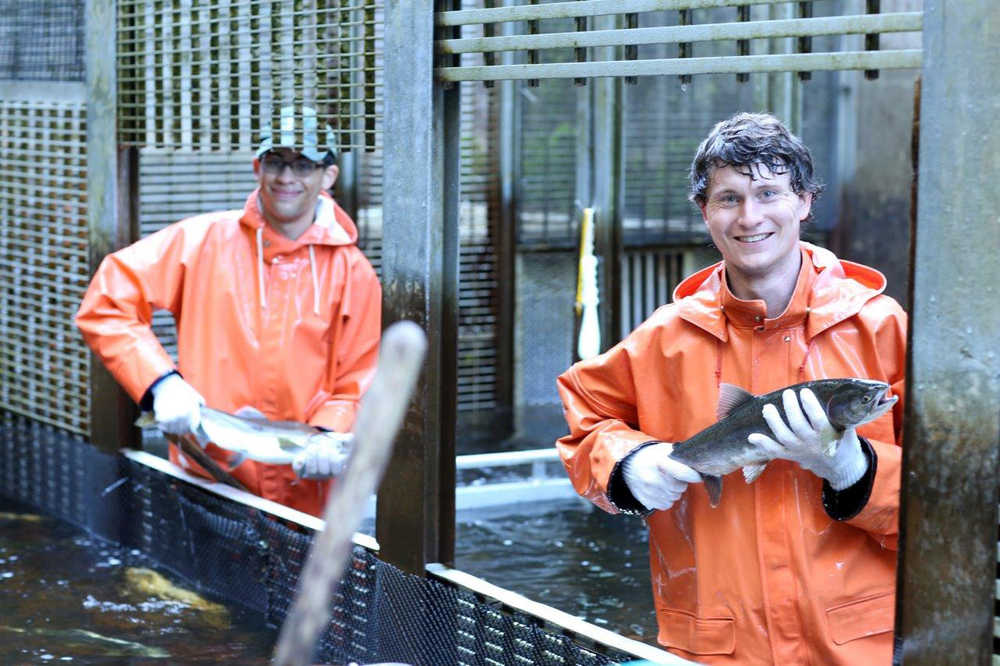
For years growing up in Juneau, Donovan Bell walked, drove and rode his bike past one of the most dynamic resources in his collegiate career, and he never knew it existed.
It’s the Auke Creek weir, where University of Alaska Southeast Juneau students can study migration patterns of salmonids — trout, char and salmon — whose journeys can take them into the Gulf of Alaska and even into the Bering Sea hundreds of miles away.
Interns like Bell contribute to existing research used by state and federal agencies, build their own portfolio, or both.
The 27-year-old Bell now spends as much time as he can at the weir, wondering how this treasure tucked in a wooded area in Auke Lake’s watershed eluded him for so long.
“The coolest part,” he says, “is that I come and collect data every morning and am analyzing that exact same data when I leave for the day to work on my project. That’s what keeps it interesting. So while I’m actually doing field work, I can think about my project on the spot. It always applies.”
Bell graduated in May 2015 with his bachelor of science in biology, underpinned by regular trips to the weir for his own research examining variables linked to dolly varden migration. He had previously earned a degree in business management at another university. By the time he knew the sciences were his calling, he was too close to completing the degree and opted to finish what he started.
New pursuits at home
So he returned to school, this time UAS, and enrolled at the Juneau campus. Soon he looked forward to near daily treks through the woods from the university’s science building to the weir.
“It’s definitely been one of the more valuable parts of my education,” he says. “I work on reading published research papers and analyzing real data, data that I collected in the first place. The data I’m helping collect is super important for research reasons. There are all sorts of projects for the government and for graduate students at the University of Fairbanks, and also for management decisions, so it goes a long way.”
His received additional class credit for his work at the weir, operated by the National Oceanic and Atmospheric Administration. Now, to bridge time between graduate and post-graduate pursuits, he’s spending an additional year at the weir collecting data for his own project while assisting John Joyce, a NOAA fisheries biologist.
Each student conducts their own supervised research while helping to provide essential man-power for positions no longer funded in NOAA’s budget. The internship provides each student with a $5,000 summer stipend to work at the Auke Creek salmon weir alongside UAS and NOAA scientists. Students collect and provide daily hands-on exposure to fisheries operations and data collection. This year, the internships were funded by the Bald Eagle Research Foundation and Alaska Glacier Seafoods, Inc.
“I am using long-term data that I collected from here to look at what kind of environmental variables are associated with the timing of dolly varden migration,” says Bell. “What we’ve learned is that freshwater to saltwater migration is mainly explained by the water temperature. But the salt to freshwater migration is best explained by both salmon migration and the amount of water moving through the creek. This study will allow for understanding of when we can expect dolly varden to migrate in a given year, and also, how their migration timing might change in response to changing climactic conditions.”
The Alaska Fisheries Science Center’s Auke Bay Laboratories (ABL) conducts scientific research throughout the state on commercially marketable species such as rockfish, sablefish, and salmon, and on all aspects of marine ecosystems such as ocean physics and chemistry essential to fish habitats, and the structure and functioning of marine food webs. Information from NOAA’s research is provided to the North Pacific Fishery Management Council, the NMFS Alaska Regional Office, fishing industries, state and federal regulators, and international treaty bodies. The information from this research makes possible the development of policies for fishery management designed to ensure sustainable commercial fisheries, subsistence harvests and recreational fishing guidelines in Alaska.
A statewide asset
NOAA’s Joyce says the weir under its current design has been collecting data for nearly 36 years. He calls it a “living laboratory,” with statewide benefits starting at UAS, extending to UAF, NOAA and the United States Fish & Wildlife Service.
It’s a place where ecology unfolds right before you and continues with each new species passing through the weir.
“We have unique capabilities because of the structure of the weir and because of the location,” Joyce says. “There are very few places, perhaps none, that can do exactly what we do because of the capabilities of the weir and the ability to look at five or six resident wild salmonidae species — trout, char and salmon — and their daily patterns of behavior.”
Joyce says scientists and students have counted nearly 40,000 fish in 2015. The more data collected each year, the greater the value of the weir to UAS students and those agencies and other researchers relying on the data.
“For students, this data has been included in dozens of masters theses and used in Ph.D. dissertations,” Joyce says. “Here, you have the ability to interact with NOAA scientists. So we are looking at how does this stuff we are doing — at least in in terms of fresh water productivity and timing — how does it interact with ocean conditions. There is lots of climate change stuff going on near shore.”
Those dynamic variables are what brings Bell down that same wooded path almost daily. Bell says when he pursues graduate work in 2017, he’ll be able to use his work from the weir to drive new projects.
“One thing that UAS focuses on is getting biology students into doing their own research and also cool internships,” he says. “The research is an emphasis at UAS and the fact that nature surrounds the school. It’s so easy to study it and get into it.
There are lots of exciting days like when it’s pouring here in Juneau and you’ve got to manage the water levels while tons of fish come up. A lot of the excitement for me is seeing the other wildlife — bears, eagles and sea lions — coming through because we have this massive food source here.”
