
“It sounds a little bit crackly,” Courtney Pegus said, putting his ear to what looked like an oversized walkie talkie.
“Turn the volume up,” Fish and Game biologist Karen Blejwas told Pegus, who was riding in the passenger seat of Blejwas’ SUV.
Pegus obligingly turned a dial on the Anabat CF2, a bat detector connected to a microphone on the SUV’s roof. The pair drove at a steady 20 mph near Echo Cove, a “Slow, research vehicle” sign stuck to the rear window.
Moments later, Blejwas and Pegus heard the same noise, more distinct this time — a staccato cross between a robin’s chirp and squeaking sneakers.
“That was a bat. Awesome,” Pegus said.
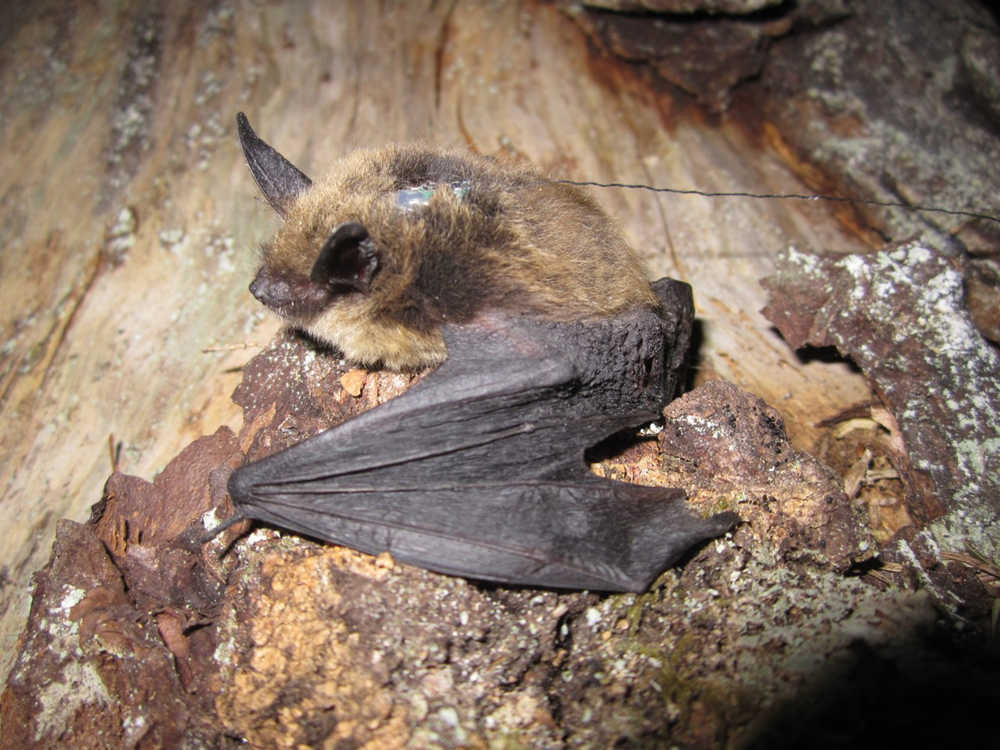
“That was absolutely a silver-haired,” Blejwas added, identifying the rare species of bat by the noise is makes.
As part of her work for Fish and Game, Blejwas conducts driving surveys several times a month to help her track the little-understood bats of Southeast Alaska. The nocturnal animals use echolocation to hunt and navigate, which Blejwas records with special microphones; she has been trapping, counting and studying bats since 2011.
“We know for sure we have little browns, California myotis, Keen’s myotis and silver-haired bats in the Juneau area,” Blejwas said. “We’ve never caught a long-legged myotis in Juneau but they’ve been found in Haines and Wrangell, and it would kind of make sense that they are here.”
Citizen scientists in Sitka, Juneau, Wrangell, Petersburg and Haines have conducted the acoustic driving surveys alongside Fish and Game researchers since 2012. In Juneau, Blejwas keeps the survey kit at the Mendenhall Valley Public Library for public use. Pegus tagged along on one of Blejwas’ driving surveys in August to learn the ropes of bat tracking.
Blejwas’ equipment picked up nine echolocation signals during the survey, what Blejwas thinks are four silver-haired and five little brown bats, mostly located near Echo Cove. It took two and a half hours, starting a half hour after sundown when bat activity generally picks up for the night.
“I’ve never heard this many silver-haired,” Blejwas said.
The bats don’t constantly make noise; Blejwas says if they are on a route they know well, they can navigate using eyesight but still depend on echolocation to find prey, almost exclusively insects.
“It’s usually pretty easy to tell if it’s a bat or not, but we can’t always get the species,” Blejwas said. “Three of the four species that we know we have in Juneau are myotis bats, and unfortunately their calls tend to look pretty similar. Silver-haired is very distinctive, so that’s easy.”
The calls can sound different depending on what the bat is doing.
“If they’re foraging, their calls get very steep and close together. All the myotis do that, so it tends to look really similar. If you get a nice search-phase call, they do have distinguishing characteristics (between the species), so it depends on how close the bat is and what kind of call it’s making at the time to be able to tell the species.”
The driving surveys are Blejwas’ attempt to get a handle on Juneau’s bat population for Fish and Game’s Threatened, Endangered and Diversity Program. The research project was prompted by the westward spread of a deadly, emerging disease affecting hibernating bat populations. White-nose syndrome has crept westward from the Northeast U.S. by bat-to-bat transmission since 2007 and was recently found on a dead bat in Washington state, a jump of 1,600 kilometers from the disease’s epicenter and the furthest point west white-nose has been found.
Blejwas hopes the driving surveys will help establish a baseline for Juneau’s bat population, which her research indicates numbers in the thousands, though it’s hard to pin down an exact number. If white-nose does make its way to Juneau, she’ll hopefully be able to recognize a concurrent drop in bat numbers.
“The spread of white-nose back east motivated us to begin the study,” Blejwas said. “Driving surveys first piloted back east have been useful in showing effects on bat populations of white-nose in areas where surveys had been conducted pre-white-nose and post-white-nose.”
According to whitenosesyndrome.org, white-nose syndrome has killed millions of hibernating bats in 29 states. Affected bats can show visible white fungal growth on their muzzle and/or wing tissue, though Blejwas says symptoms aren’t always visible.
Locating the disease first-hand will be hard in Southeast Alaska, Blejwas said, in part because bats don’t generally hibernate in large groups in the Western U.S., which makes checking for visible symptoms a difficult task.
“Up until recently, people assumed bats were doing the same thing in the West as in the East, but we just hadn’t found the caves they were hibernating in. Once white-nose hit, people started doing more cave surveys, compiling the information they do have and people realized no, they are not,” Blejwas explained. “A large hibernacula (a group of hibernating bats) east of the Rockies can number in the tens of thousands or a 100,000 bats. Once you get west of the Rockies there are very few. The largest one I’ve heard of was maybe 800 little browns.”
Being loners, Juneau’s bats don’t lend themselves easily to scientific study.
“Back east they’ve been able to monitor the spread of the disease: They go into a cave or mine, they swab bats and they send those swabs to the lab to see if the virus was there. … Since our bats don’t hibernate in caves, we can’t do that here, unless we get lucky like they did in Washington where some hikers stumbled upon a dead bat.”
Blejwas said she is lucky to find “one or two” hibernating bats; they often winter in small numbers in root systems or in the spaces between loose or “scree” rock.
“Another part of the project was a radio telemetry study to try and figure out what they were doing in the winter time,” Blejwas said. “We found them at two ridge systems, one above Fish Creek and the second over on Admiralty (Island) kind of behind Horse and Colt (islands).”
She also uses stationary bat detectors at about a dozen different locations in Juneau, and has tracked bats using adhesive radio tags. The stationary detectors provide useful information, but they aren’t much help for sizing-up populations.
“Stationary detectors tell us when they appear in the spring, when they disappear in the fall, when are the peaks of activity and when are the relative activity levels at different sites, but you can’t tell if you have one bat circling the station 100 times or 100 bats each circling once,” she said. “These driving surveys have the advantage that they are driven at 20 mph because that’s about as fast as a bat will fly. You can pretty safely make the assumption that each call represents a different bat. If you have enough activity along the route you can get a good trend.”
Blejwas wraps her research up this fall but will continue the driving surveys as long as Juneau’s citizen scientists can keep them going. There are two routes, one covering Echo Cove, Auke Bay and Fritz Cove, the other downtown, Lemon Creek and Douglas. Driving surveys will end sometime in September and pick up again in the spring.
• Contact Sports and Outdoors reporter Kevin Gullufsen at 523-2228 or kevin.gullufsen@juneauempire.com.
Correction: An earlier version of this story said the bat disease white-nose syndrome has been reported in 25 states, based on out-of-date information on the U.S. Geological Survey’s website, which is now being fixed. The correct number is 29 states, according to whitenosesyndrome.org.
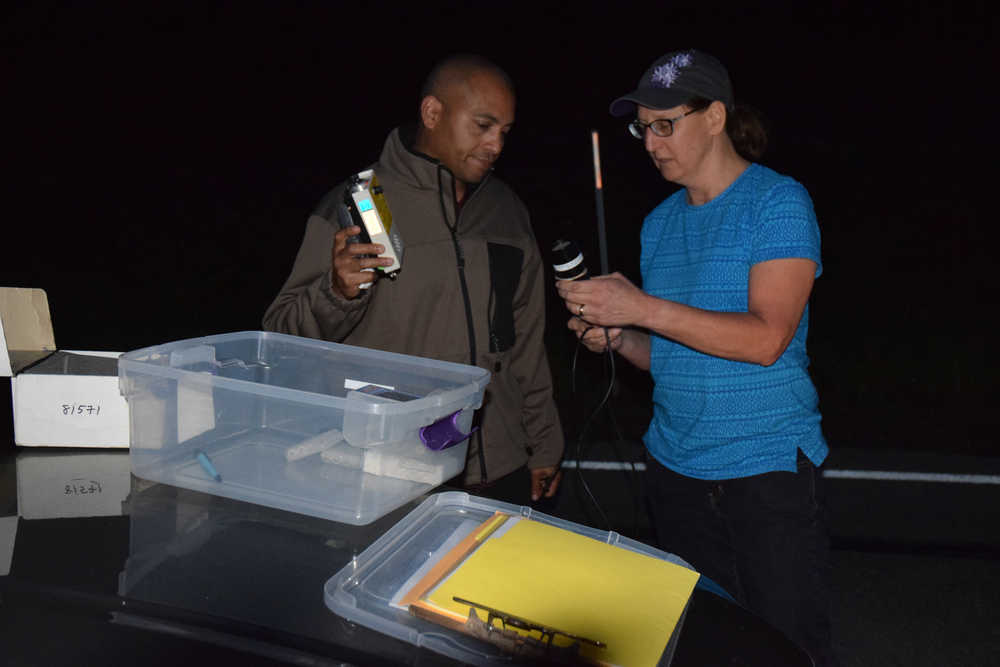
Karen Blejwas, right, introduces Courtney Pegus, left, to equipment used to track bats for Fish and Game’s Endangered, Threatened and Diversity Program.
