
As I wandered around a beaver pond one day in mid-September, I noticed something small and dark moving slowly through the grass and weeds. It was a toadlet, just recently transformed from a tadpole.
That tadpole had lived in the pond all summer, eating mostly plant material. Toward summer’s end, it resorbed its tadpole tail and grew legs. Now, only half an inch long, those legs were letting it leave its natal pond to find a place in which to hibernate for the winter—maybe under a log or some tree roots.
Sometimes, when lots of new toadlets emerge from a pond, they pile up in little heaps and mounds, several hundred of them. They may stay in such a mound for some time. The reason for this behavior is not clear; it may help prevent desiccation or protect from temperature extremes, or perhaps it somehow protects them from predation. We’ve seen that behavior in previous years here.
Once emerged from a pond, a western toad (Anaxyrus boreas, formerly Bufo boreas) is a terrestrial creature, only venturing back to the water to breed. Now its diet consists largely of insects. If it’s not squashed on the roads or eaten by a predator, it may grow for four or five years and then reach sexual maturity. In spring, mature males and females head back to the ponds to mate. Females lay long strings of eggs in shallow water, generally in April or May; each female may lay thousands of eggs.
Large numbers of eggs are necessary, because the probability of a toad egg eventually growing up into an adult toad is very small. Lots of dangers beset the tadpoles and only a few may survive. The pond may dry up or become too polluted, and their predators are many, including ducks, diving beetles, dragonfly larvae, and fish. When they transform into tiny toadlets, the dangers continue. Many species of birds would relish a young toad, and as the toads grow, weasels, mink, and other mammals may join in.
Southeast Alaska also harbors two species of frog. Neither one is very common, apparently, but both are known to breed in a few sites in the Juneau area.
Wood frogs (Rana sylvatica or Lithobates sylvatica) live all across northern North America, even above the Arctic Circle. The adults are quite terrestrial, feeding on land and hibernating under the leaf litter. They are justifiably famous for their remarkable ability to freeze solid in the winter. The heart stops beating, even the eyes are frozen, and the frog lives in a state of suspended animation. Come spring, it thaws out and goes on feeding, finding a pond for breeding, and getting on with its life. Eggs are laid in clusters; the tadpoles develop rapidly and transform into froglets in late summer. They mature in two or three years.
Freezing solid and thawing out successfully is no mean feat; very few animals can do it. When water freezes, it expands. So if a living cell freezes, its expanding water contents would normally burst the cell wall, destroying the cell and stopping metabolic functions. Wood frogs avoid that lethal problem by pumping most of the water out their cells and into the spaces between them; they also pump sugars into the cells, where the sugars act as antifreeze. Water that accumulates in the abdominal cavity freezes, surrounding the internal organs with ice.
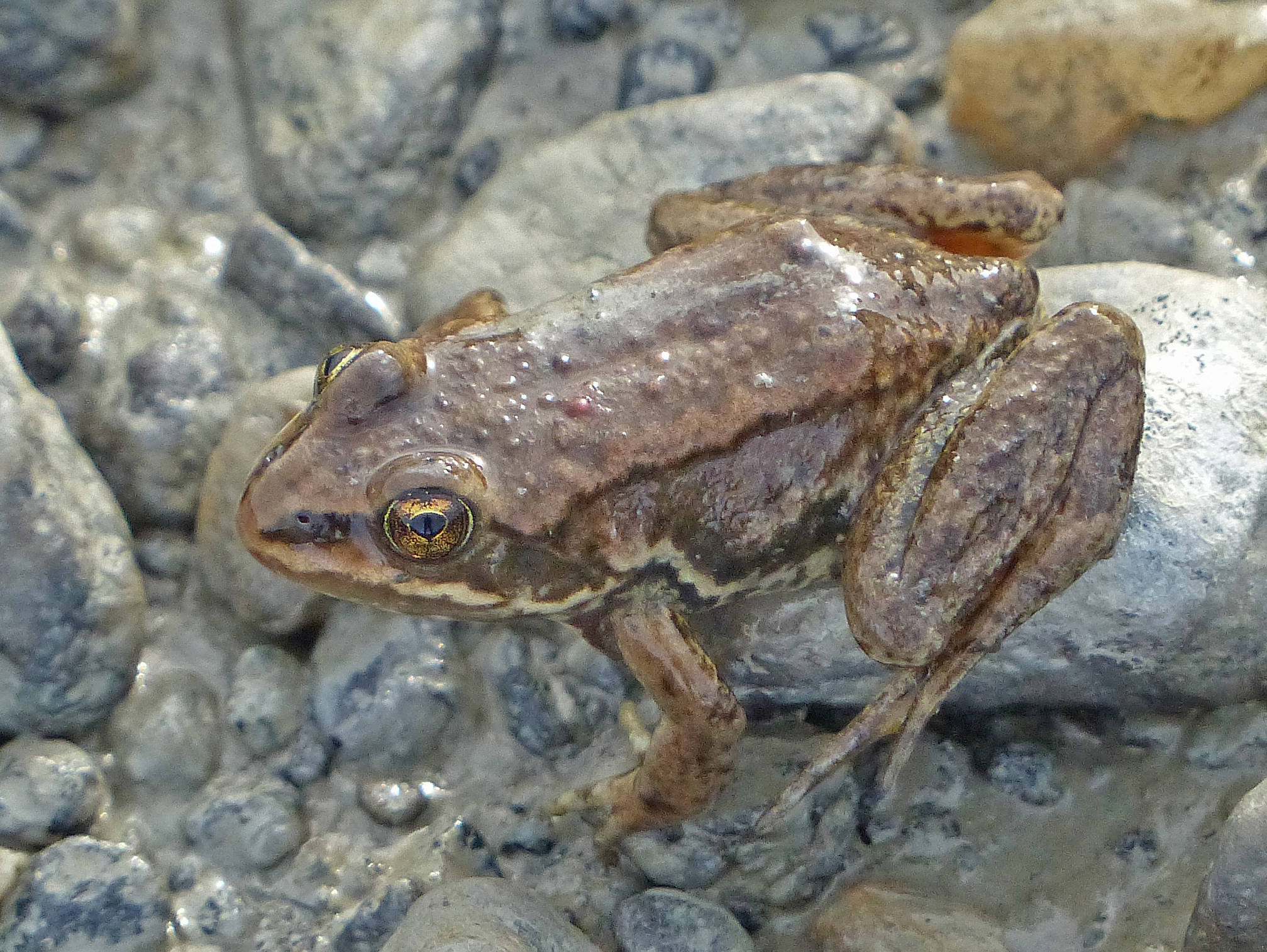
The Columbia spotted frog (Rana luteiventris) occurs in British Columbia and the western United States; Southeastern Alaska is at the northern edge of its range. This frog is highly aquatic; unlike toads and wood frogs, it even hibernates underwater in the mud. Females lay clumps of eggs and tadpoles usually transform into froglets by the end of summer; a few may overwinter and emerge the following spring. They take several years to reach maturity.
How does one distinguish these three amphibian species that live in our area? Western toad adults are usually brownish or grayish, with lots of lumps on the back and a pale belly mottled with black. There is usually a light-colored stripe down the middle of the back. They do not cause warts, but a large gland behind the eye exudes neurotoxins that may deter predators. Spotted frogs are often brownish; the belly and undersides of the thighs are reddish or pink. The back is slightly lumpy and may have irregular black spots. The upper lip has a pale stripe. Wood frogs have smooth, brownish or greenish skin and a pale belly. There’s a distinctive dark eye mask and a light-colored upper lip.
Many serious dangers afflict toad and frog populations, here and around the world. Habitat loss, for both tadpoles and adults, together with a widespread deadly fungal infection, has decimated their populations. In some areas, toads and frogs suffer develop abnormalities such as missing legs, extra legs, or malformed eyes; the precise causes of these crippling features are not well established but probably include pollution. Furthermore, enthusiastic humans sometimes collect tadpoles and toadlets or froglets for the fun of watching them transform and grow. All these hazards, and perhaps other still undocumented, have reduced toad and frog populations everywhere, endangering many of them.
When I came to Juneau, over twenty-five years ago, I found toad tadpoles, toadlets, and toads in many places, sometimes in large numbers. That does not happen anymore; now I feel lucky to find them. Many other residents of Southeast, from Haines to Ketchikan, have noted a similar trend. But perhaps because the species is still widespread, it has not attracted great conservation concern. Columbian spotted frog populations in some of the more southern states have declined seriously and have probably declined in Southeast. Although actual population estimates appear to be lacking, this species has become a conservation priority. The wood frog occurs widely in North America and in Alaska. Even though it has disappeared from some places where it was formerly found in Alaska, it is not considered to be a major conservation concern.
Regardless of the official conservation status, the warning signs are clearly there. All of our toads and frogs are at risk of becoming vanishingly rare in our area. It behooves us to avoid disturbing them when we see them. In Alaska it is illegal (statute 16.05.030) to collect toads and frogs without an Alaska Department of Fish &Game permit.
• Mary F. Willson is a retired professor of ecology.
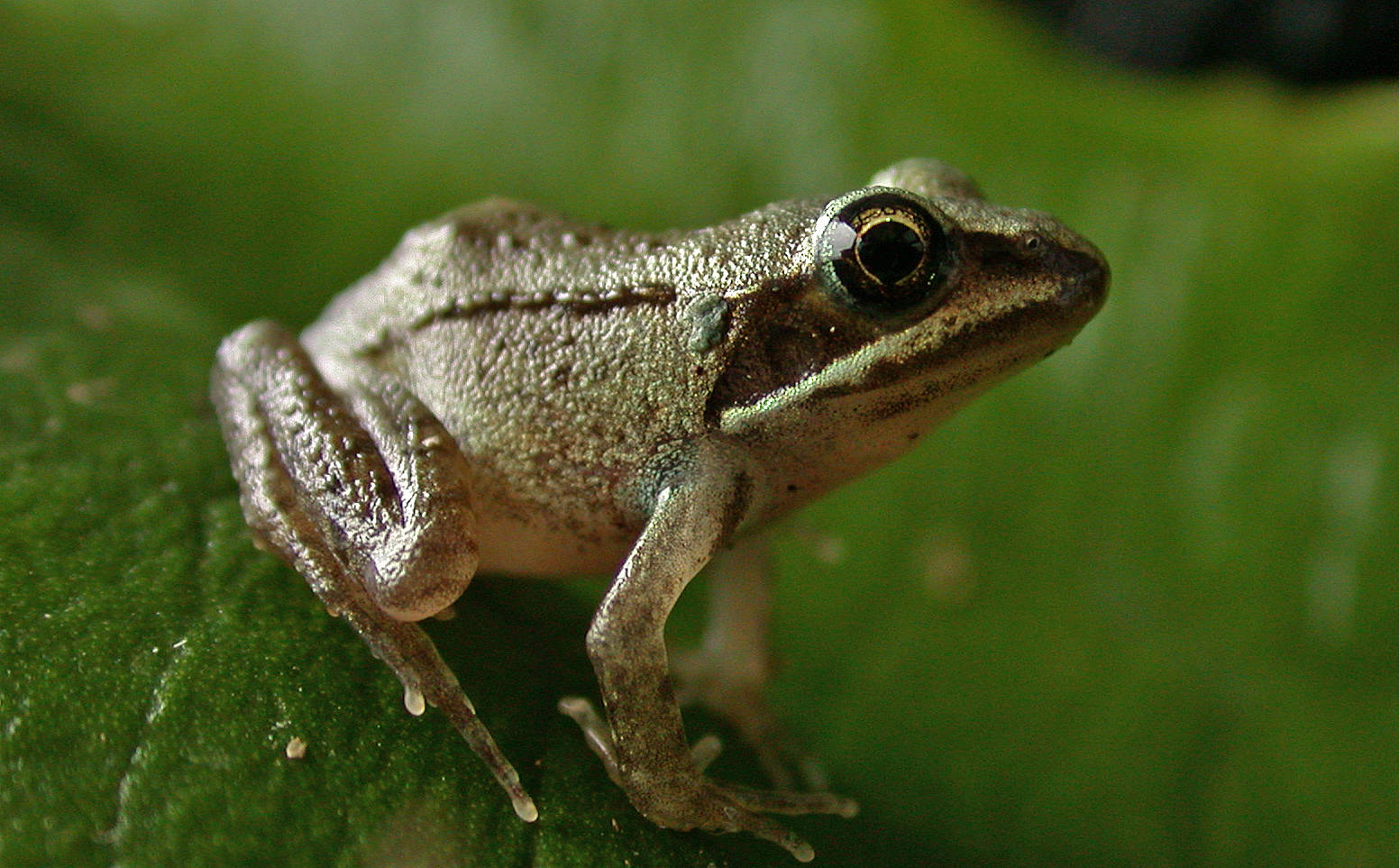
A young wood frog, with the typical black eye mask. (Photo by Bob Armstrong)
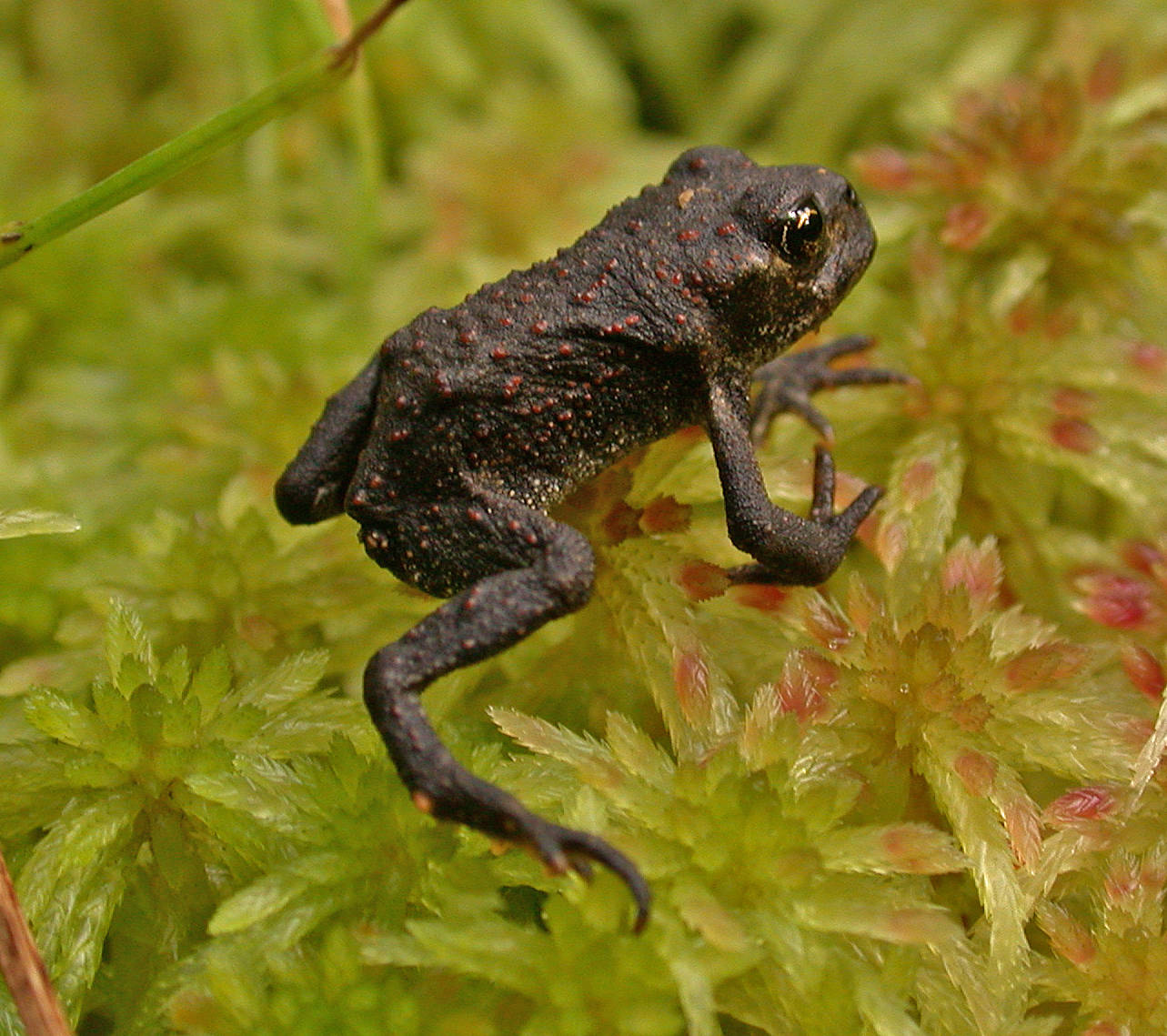
A very young western toad, showing the characteristic many bumps on its back. (Photo by Bob Armstrong)
