
Mid-May brought some fairly low tides during the daylight hours, so naturally I had to go prowling in the intertidal zone to see what I could see. I like to go with a companion, because the extra eyes greatly help the search. We found lots of things, as expected, but here are a few highlights.
• A gumboot chiton, about 5 inches long. I seldom see this species, which is often heavily harvested by humans. It’s an unusual chiton in that its dorsal surface is completely covered by the granular mantle, so none of the eight plates or shells is visible. An herbivore, it eats mostly red algae. It’s the largest chiton in the world, sometimes over a foot long, although in our area half that size is more usual. Beginning its life as a larva, after just a few days it settles on a rock and begins to look like a chiton. It can live for 40 years or so, growing a few millimeters a year.
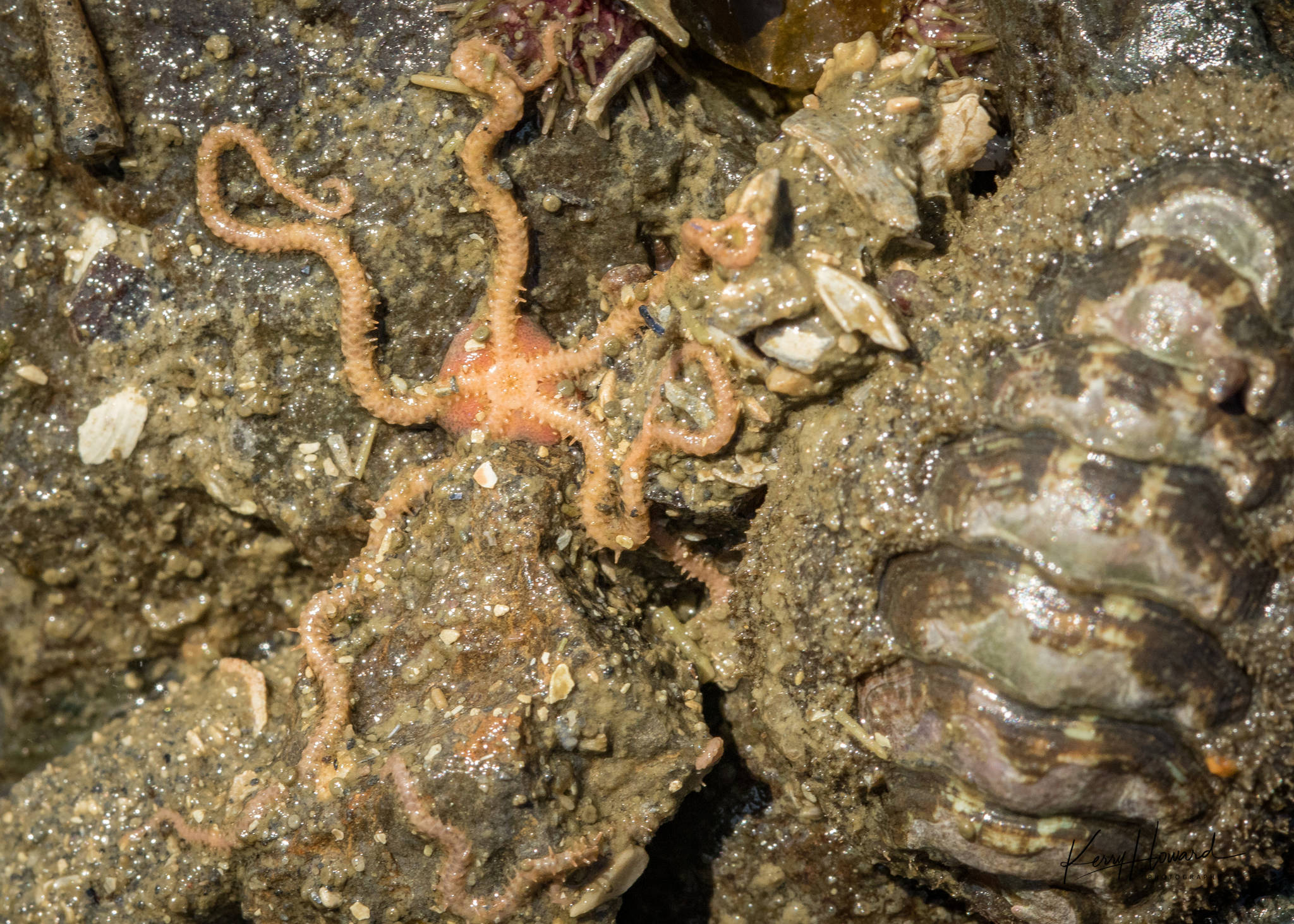
• Clinging to the underside of a rock, we found (I think) two long-armed brittlestars (called serpent stars in one field guide). These are said to be quite uncommon around here. The arms are very long relative to the size of the disc or body; they break easily but regenerate. This species eats detritus and can burrow into sediments.
• The small sea cucumber known here as the white cucumber is actually the so-called false white cucumber, to distinguish it from the “true” white sea cucumber of the outer coast. This species is extremely numerous in some places, so finding it was no surprise. But it was an occasion for remembering something weird about these critters. Many sea cucumbers breathe by taking in water through the anus into respiratory trees comprised of narrow tubules. Some cucumbers can eviscerate themselves if they are molested, spewing out both the gut and the respiratory trees through the anus, and regenerating them later. We found ejected guts of several false white cucumbers. The thought of regenerating body parts is exciting (and not very common in the animal kingdom); sea stars can regenerate their broken arms, and we often see evidence of this, but regenerating internal organs??!! How long does it take to re-grow these parts and what do the animals do before the missing pieces are replaced? We also found two giant black cucumbers, which were apparently near the upper limit of their tidal range.
• Cucumber suckers are tiny snails, just a few millimeters long, that feed on sea cucumbers. Strangely, they do not have the rasping, file-like radula by which many snails scrape their living. Instead, they somehow stick to a host cucumber, penetrate the skin, and suck its body juices. Although that’s how they feed, and there were many potential hosts close by, I found a cluster of this species just perched under a rock.
• We love to find baby king crabs tucked under the edge of a rock or a sea star but this time we found only three of them. Starting life as larvae in the plankton, they transform into little crabs and move to the intertidal zone. They molt their exoskeleton as they grow and move to deeper waters, eventually maturing at age five or six years.
• Hermit crabs may be everyone’s favorite intertidal beasties, and there are several kinds here. We found a few very tiny hermits wedged nicely into really small periwinkle shells — the “big” claws of these individuals were less than two millimeters long. A small hermit was startled when we picked up a 3-inch whelk shell, and it scuttled directly up into the top spirals of that shell and out of sight — clearly, this shell was not to be carried about on the crab’s abdomen! One old, barnacle-covered whelk shell housed a beautifully colorful widehand hermit, whose extra-wide big claw can close the “door” when the hermit retreats into its protective shell.
• Some small rock crabs were inconspicuous in the sediments under loose rocks. I pried one out of its niche to look more closely. It protested vigorously, nipping me several times — which I ignored. But then it got serious and its pincers opened up the end of my finger, staining red the rocks at my feet. That worked — it was soon back among the cobbles where it belonged.
There were other enjoyable observations, too: a gorgeous, 6-inch crescent gunnel, crows harvesting and toting food to their nests, a flotilla of bright harlequin ducks, a whale blowing in the channel. A partially visible sparrow in the bushes above the beach sang an unfamiliar song repeatedly, making it hard to identify, but then it sang the normal song of a song sparrow. Was it just practicing, or do such song variants have another purpose?
• Mary F. Willson is a retired professor of ecology. Her essays can be found online at www.onthetrailsjuneau.wordpress.com
