The most remote place in the U.S.
Published 7:27 am Friday, December 29, 2017
Richard Forman, a Harvard professor of landscape ecology, once visited a mangrove swamp in the Florida Everglades that he described as the most remote place in the eastern U.S. The swamp was 17 miles from any road.
What’s the most remote spot in Alaska? Dorte Dissing once tackled that question. Dissing is a geographer with Alaska Biological Research, Inc. She’s proficient with the use of digital mapping systems.
According to the U.S. Bureau of Transportation Statistics, more than 4 million miles of road crisscross the continental U.S. Alaska has 12,823 miles of public roads. That’s less than Vermont, which is 62 times smaller.
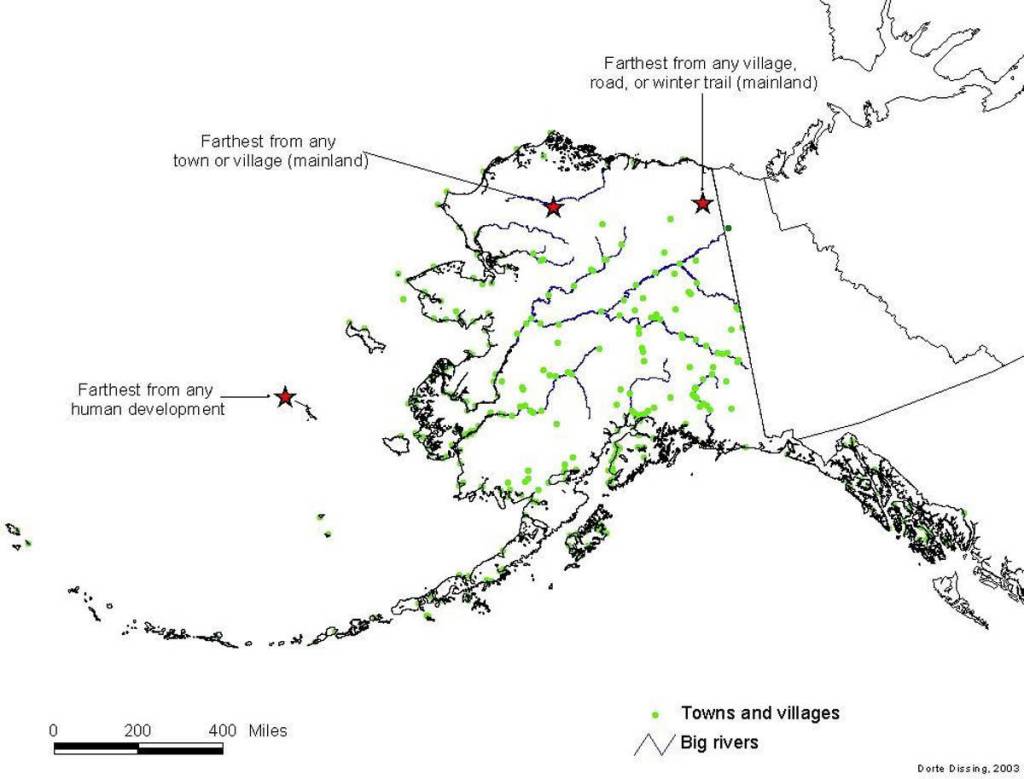
Dissing used a program with a blank map of Alaska to which she added features, such as rivers, towns, roads, and trails. To begin the search for the Alaska’s middle-of-nowhere, she created a buffer zone of increasing mileage around Alaska roads, trails, and villages. The most remote spots appeared as tiny wedges in northwest and northeast Alaska. Other lonely spots were a few Aleutian islands and St. Matthew Island in the Bering Sea.
When she lengthened the buffer zones to 85 miles from villages and trails listed on her GIS program, the most remote spot on mainland Alaska was an upper branch of the Coleen River in the Arctic National Wildlife Refuge close to the Canada border. The hill is about 85 miles from both the villages of Old Crow in the Yukon Territory and Arctic Village in Alaska’s Brooks Range.
Because some of the trails included on her program are historic winter trails over tundra, Dissing dropped Alaska roads and trails for another run of her GIS system. She found that the farthest place from an Alaska village or town in mainland Alaska was a bend of the Etivluk River about 15 miles from its confluence with the Colville River on Alaska’s north slope. The closest villages — each about 120 miles from the river bend — are Ambler to the southwest and Atqasuk to the north.
Though 85 miles and 120 miles allow plenty of elbow room, Alaska’s champion recluse seems to be St. Matthew, which sits alone in the Bering Sea without road, airstrip, or town. The closest village is Mekoryuk, on Nunivak Island off the Yukon River delta. St. Matthew’s nearest neighbor is 209 miles away.
Biologist Brian Lawhead spent a few months studying seabirds on St. Matthew Island in the mid-1980s. He remembered a few long rides to reach the island, one in a Grumman Goose from Bethel and another by chartered boat from Dutch Harbor, 400 miles away.
“I remember sitting there and realizing how far the nearest land was,” he said from his Fairbanks office, where he works as a senior biologist for Alaska Biological Research. “The island is all tundra, not as lush as the Aleutians, with lots of seabird cliffs. It’s a beautiful place.”
• Since the late 1970s, the University of Alaska Fairbanks’ Geophysical Institute has provided this column free in cooperation with the UAF research community. Ned Rozell is a science writer for the Geophysical Institute. A version of column first ran in 2003. UAF is on winter break.