
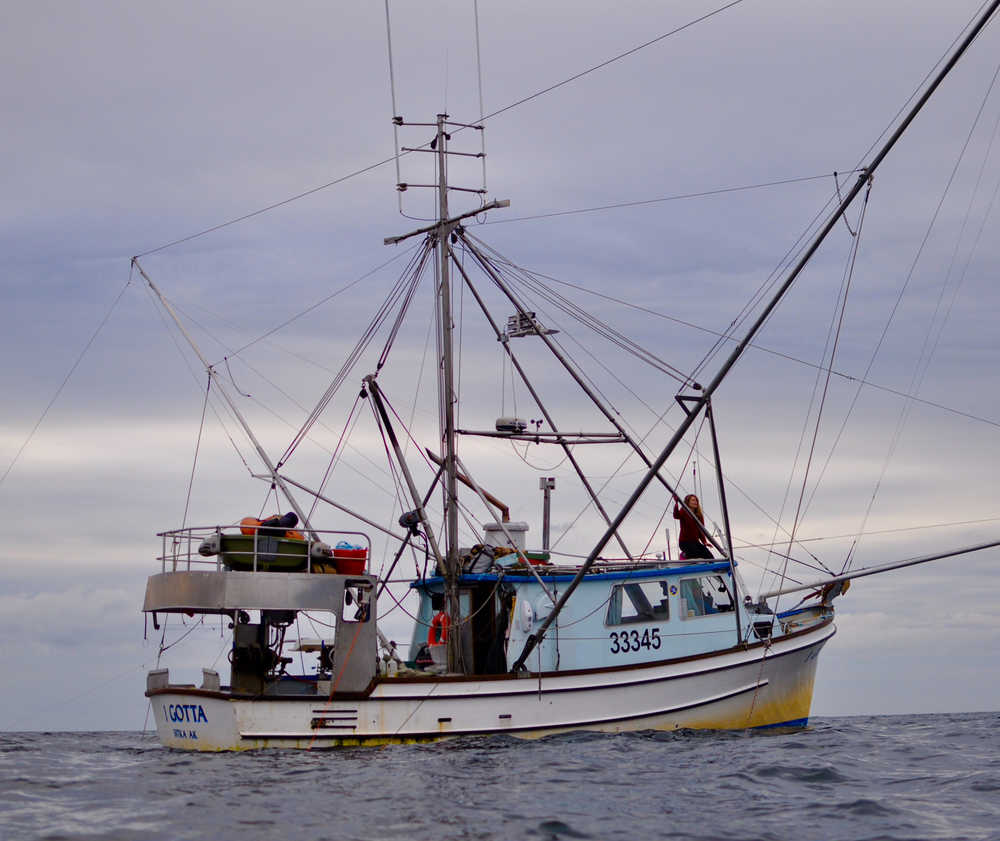
Most Americans don’t know where their food comes from. Alaskans have it better, thanks to subsistence lifestyles and programs like Alaskans Own, a Sitka-based community supported fishery (CSF).
“We always eat the first fish we catch,” explained troller Eric Jordan. “We show respect for our fish and our business. It reminds us of how special it is. We’re not just catching fish; we’re producing food and it’s so good.”
Jordan trolls out of Sitka. He has a big voice and the comfortably grand presence of a lifelong Southeast Alaskan who has spent much of his life out on the water and who is deeply connected to the land, his community, and the future of fishing.
Like many other fishermen in Sitka, Jordan is gearing up for another fishing season. Part of his catch will be sold to Alaskans Own (AO), which sends a monthly basket of fish to seafood lovers in Sitka, Juneau, Seattle and Anchorage. This season, fish fans in Fairbanks will also have the opportunity to sign up for CSF membership. Similar to community-supported agriculture (CSA) programs that send produce boxes directly from farmers to their customers, AO provides an opportunity for customers to know where their fish comes from.
“AO supports fishermen who are working to sustain the resource,” said Anya Grenier, AO project manager.
The community-supported fishery started in 2010 with a handful of boats from the Alaska Longline Fishermen’s Association (ALFA). ALFA is a member-based nonprofit in Sitka that represents the interests of small-boat fishermen in Southeast Alaska. It promotes sustainable fisheries and sustainable fishing communities through research, advocacy and collaboration.
“It provides a collective voice for the fishermen,” Grenier said.
ALFA programs include the Fishery Conservation Network (FCN), which involves fishermen in also protecting the ecosystems that sustain the fishery.
Kent Barkhau was one of many fishermen in the network who participated in a bathymetric project that mapped the structure of the ocean floor. Scientists worked with FCN’s fishermen, who collected data while they fished.
“We had a sounder and a computer with special software to record the depth,” recalled Barkhau. “The maps they created were distributed to members to help us be more efficient at catching the targeted species and better at avoiding non-target fish.”
The FCN also created a guide with tips for fishermen to use fuel more efficiently, in an effort to reduce the fleet’s carbon emissions — and, in their own way, to help with the increasing temperature and acidity of the ocean.
“Fuel efficiency is a start, but it’s really important to go further and shift away from fossil fuels to something more sustainable,” said Barkhau, who has been part of the fishery for more than 35 years. “I’m hoping that we can be leaders in piloting new technologies for this effort.”
Subscriptions for the 2016 season are now open. CSF subscribers can choose to be part of a four-month program from May through August, or a six-month program from May through October. “A half share for either program will receive about five pounds of fish per month and a full share will receive 10 pounds of fish per month,” Grenier said.
The selection of seafood in each month’s pickup depends on what the fishermen are catching, including seasonal Southeast Alaska favorites such as halibut, king salmon, coho salmon, rockfish, black cod, and ling cod. Subscribers are also eligible for bonuses, such as spot prawns and halibut cheeks, depending on availability. Bulk and wholesale orders are also an option for subscribers and non-subscribers.
Vicki Keele, who’s been a subscriber at least four years, said she stays a subscriber because of the quality of the fish.
Tad Fujioka, a Sitka salmon troller and ALFA member, agrees. “I’ve eaten king salmon all my life, but the king salmon I catch out here taste better than any I remember eating,” he said.
Fujioka, like many other fishermen in Sitka, enjoys his work because it gives him the freedom to manage his own business, to be out fishing, and also dedicate time to his family.
Jordan loves the region. “I love all the bays and inlets, places to explore and fish and anchor out,” he said. “When you’re out harvesting, you’re really immersed in it all!”
Jordan’s father, who was also a fisherman, influenced his awareness of his connection to the natural environment and sense of responsibility as a fishermen. “The highest ethic in being a fisherman is not just catching the most, or producing the highest quality fish,” he explained. “These are all really important. You do want to be competent at fishing. But you also want to be vested in the conservation, enhancement and sustainability of not only your target species, but the whole ecosystem that sustains them and you.”
Barkhau added, “Our whole family loves the ocean. We love the wild healthy fish that live in a healthy ecosystem. The fishermen who sell their fish to AO are people who care about these underlying ecosystems, so that we can leave something as beautiful for the next generation. And the one after.”
More details and subscription information can be found at www.alaskansown.com and 907-738-2275.
• Jennifer Nu is a freelance writer in Alaska. She writes on topics at the intersection of wellness, sustainability, and community. Contact her at jennu.jnu@gmail.com.
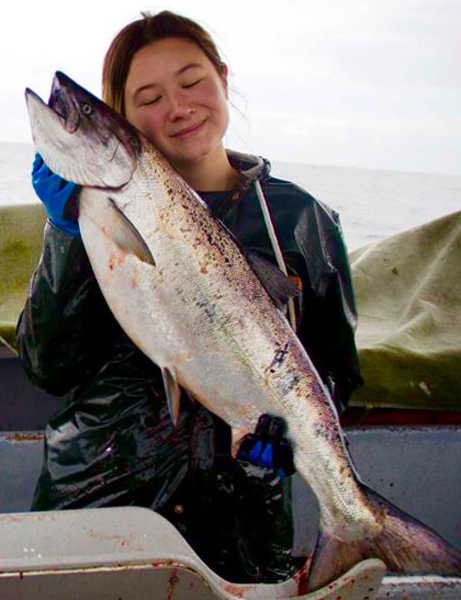
Ellie Schmidt, on the crew of FV I Gotta, appreciates a good salmon. Courtesy of Sophie Nethercut.
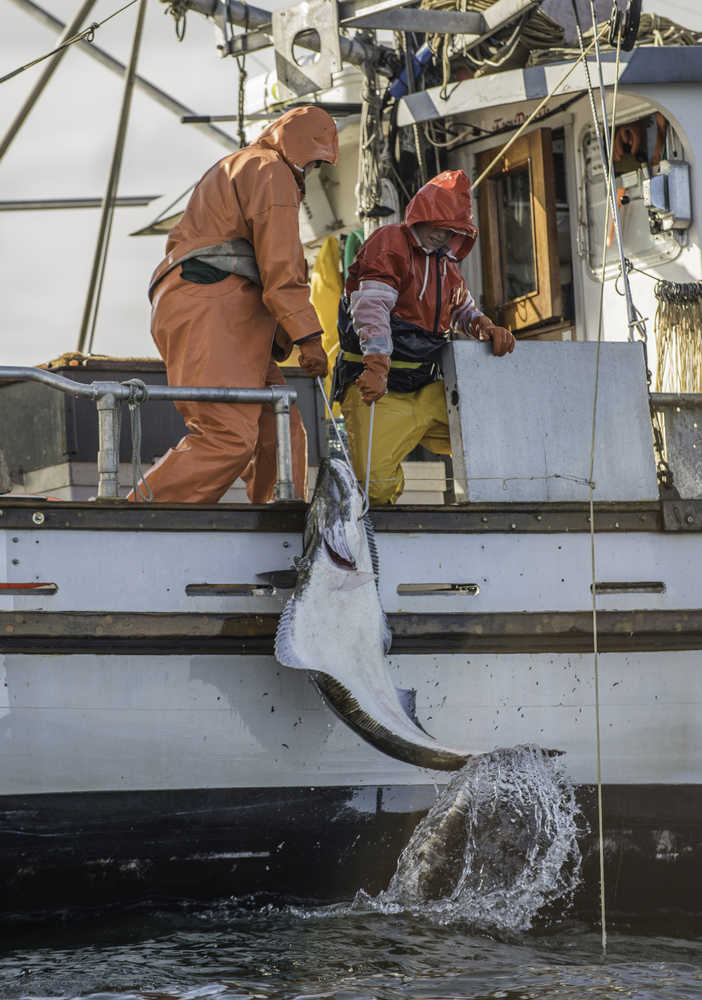
Kent Barkhau and Linda Behnken of Alaskans Own fish for halibut. Photo by ASMI/Joshua Roper
