
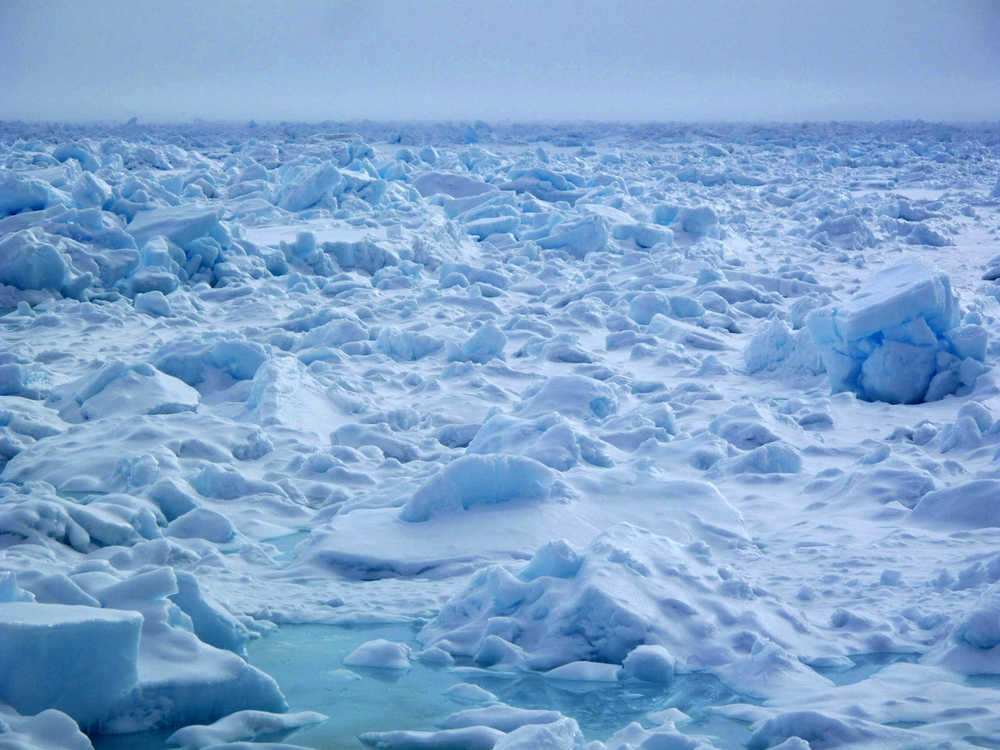
The ice floating on top of the world covers pretty much the entire Arctic Ocean in midwinter. By late summer it shrinks to half that much. If trends continue, by mid-century the summer ice may take up less space than Japan.
As the Arctic Ocean becomes more blue, it absorbs much of the sun’s heat that it once reflected with great efficiency. This warmer ocean would quicken the melt of the Greenland ice cap, which would lead to sea level rise. It might encourage wacky weather patterns all over the globe.
Since satellites first allowed us to watch sea ice in the late 1970s, the jigsaw puzzle has shrunk as the years have passed, with a low point reached in late summer 2012. Some scientists thought that year might have been a tipping point from which the ice would not recover.
But the ice is perhaps more resilient than that. Some researchers suggest northern sea ice can bounce back and continue its role as refrigerator of the world.
Stephanie Pfirman of Columbia University shared a vision for restoring sea ice at the fall meeting of the American Geophysical Union in San Francisco last month. More than 20,000 scientists attend the weeklong meeting.
“Some models say the Arctic Ocean will be almost ice free (during summer) as soon as 2030 to 2040,” she said in San Francisco. “But it could return. When the Arctic cools, the ice will return.”
But with record levels of heat-trapping carbon dioxide in our atmosphere and a steady climb in world temperatures, how could the Arctic get colder?
“If you take the CO2 out of the atmosphere, the ice will come back,” said Pfirman’s colleague Robert Newton, a geochemist at Columbia.
What will it take to lower carbon dioxide levels?
“To get the ice back before it’s gone completely, we definitely need decarbonization and CO2 removal,” Pfirman said, referring to political and mechanical solutions for reducing emissions or pulling carbon out of the air.
Newton said he thinks the world will come around to the preservation of a white Arctic when climate change makes it clear there is no other option.
“I grew up in the Cold War — a time when people worried about mutually assured (nuclear) destruction,” he said. “And we didn’t go there. I think this is going to be something like that. I really believe in my heart we will do this. But not before a lot of human and ecological damage takes place.”
“I think there will be a time when consequences will be large enough that (carbon reductions) will happen,” said Bruno Tremblay, a sea ice expert who works at McGill University and was also at the meeting. “It’s going to need to be a quick and forceful commitment” to get atmospheric carbon dioxide levels back to 350 parts per million from the current 401 parts per million as measured at Mauna Loa observatory in Hawaii.
Tremblay mentioned the recent United Nations Paris meeting on climate change as an encouraging sign, though he thinks the action will happen at more nimble state, community and personal levels.
The trio of scientists echoed others at the giant meeting who expressed hope that people are paying attention to the unprecedented level of carbon dioxide in the atmosphere. Those are people who might be convinced that keeping ice on top of the world is important for humans as well as polar bears and walrus.
“I think we can turn the corner,” Pfirman said. “I think people will notice the value of the Arctic . . . We can innovate our way out of this.”
• Since the late 1970s, the University of Alaska Fairbanks’ Geophysical Institute has provided this column free in cooperation with the UAF research community. Ned Rozell is a science writer for the Geophysical Institute.
