
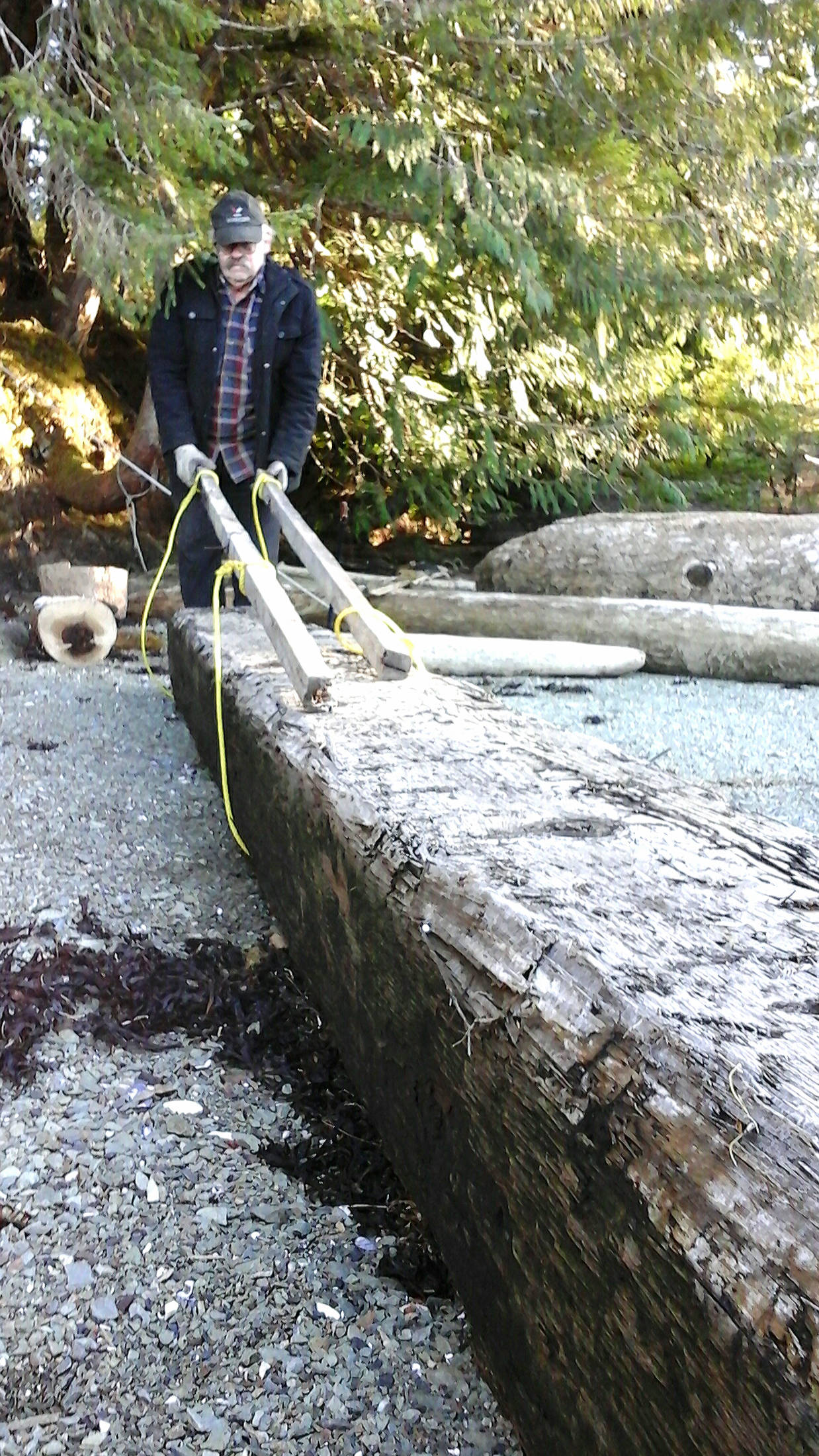
Yesterday, my dad agreed to put on all his outside gear and set out into the chilly weather to help me take “re-enactment” photos of how we constructed a latter-day Stonehenge in my mom’s kitchen.
It all began when my family lived at the burned down cannery. We built a huge six-bedroom house in the wilderness entirely by our own labor, using lumber my dad milled himself.
Besides the six bedrooms, there was a vast, high-ceilinged living room about two times the size of my current house that overlooked the creek, a game room, a large pantry, and an even larger kitchen. For the kitchen my dad had already built two large tables: one long one of pine with benches on either side for us five kids to sit on and a chair on either end for my parents; and a square, sturdy work table made of beachcombed redwood.
These already impressive pieces of furniture weren’t enough for my mom, though. One day she sighted the remains of an old fish trap half-buried in the beach grass and drift logs above the high tide line a short distance down the beach.
She took one look at the massive 12-inch by 12-inch weathered beams and decided they were just what we needed to construct a built-in niche for her propane cook stove and kitchen cabinets.
My dad probably thought she was insane, but his engineering mind could never resist a challenge.
It was a chilly, late fall day when we took the skiff down to the old fish trap. My mom and us kids cleared a path through the drift for my dad to get at the trap with his chainsaw. While he and my mom figured out lengths and the best sections of beams to saw out, I looked at the weathered remains and wondered about its story.
I knew that fish traps were banned at Alaska’s statehood, so this trap was probably only a few decades old, depending on how long it had been in use. On the other hand, it was located very close to a salmon spawning creek and fish traps were banned from being positioned directly on a creek or river in 1889. If this trap had been one of those it was around a century old. Always assuming, of course, it wasn’t illegally used on the creek by the remotely located cannery after that cut-off date.
Independent, local fishermen hated fish traps, I’d heard. For one thing they were often owned by canneries that kept their money out of state and brought their labor and supplies to the canneries in with them so that they invested almost nothing in the local economy. They also scooped up way more than their fair share of fish and could kill off an entire cycle of spawning salmon, impacting fishing for years, if not decades to come.
That’s why some fishermen decided that the salmon in the traps should be up for grabs and they embarked on a life of piracy. In return, canneries hired armed military veterans to guard the traps. The fishermen were undaunted and the piracy became so bad that at one point a group of packers requested government support and the U.S. Navy sent patrol vessels to guard the traps.
Looking at the old trap my dad was sawing into, his chainsaw roaring in this quiet, lonely area of forest and bay, I wondered who the long ago guards had been for it, what their stories were. Had it been pirated? If so, who had been the pirates? Had gunfire ever broken out and had anyone been hurt? There was a lot of history in those silent logs and beams.
My dad soon had sawed out three sections, the longest one about six feet long. He used the power of the fifty horsepower outboard engine to drag them down the beach and into the water. We all piled into the skiff and towed our treasure home.
Then came the tough slog of getting them to the house. My dad made a cradle of ropes with 2 by 2 handles the length of each beam and assigned each of us to a side. With many pauses for breathers, our arms feeling like they were going to be pulled out of their sockets and our knees about to give, we finally got all three beams into the kitchen.
We managed to get the two end pieces vertically into position and secured without too much trouble. But then came the question of how we were going to get the longest and heaviest piece on top of them to form the lintel. The ceiling wasn’t high enough for us to rig a rope and tackle the way we’d done for the rafters in the living room. Maybe it couldn’t be done?
Of course it could be done. Hadn’t the builders of Stonehenge, with nothing more than the same tools we had — our muscles and brains — done the same thing with much, much heavier stones?
According to professor of astronomy Gerald S. Hawkins in his book “Stonehenge Decoded,” the most likely way the ancient builders placed the massive lintels across the top of the uprights, “may well have been to rock the lintels up on a rising latticework tower of logs.”
So that, more or less, is what we did. But, rather than rocking it, my dad lifted each end of the beam in turn onto one of the table benches. Then onto the table. We kids and my mom then put the bench onto the table and my dad lifted the lintel, one end at a time, onto it, up next to the two uprights. As we got near the tops of them we had to use blocks of wood, sliding them under first one end and then the other until finally my dad could slide the massive beam onto the two uprights.
We had our very own Stonehenge, Southeast Alaska style, in our kitchen.
• Tara Neilson lives in a floathouse between Wrangell and Ketchikan and blogs at www.alaskaforreal.com.
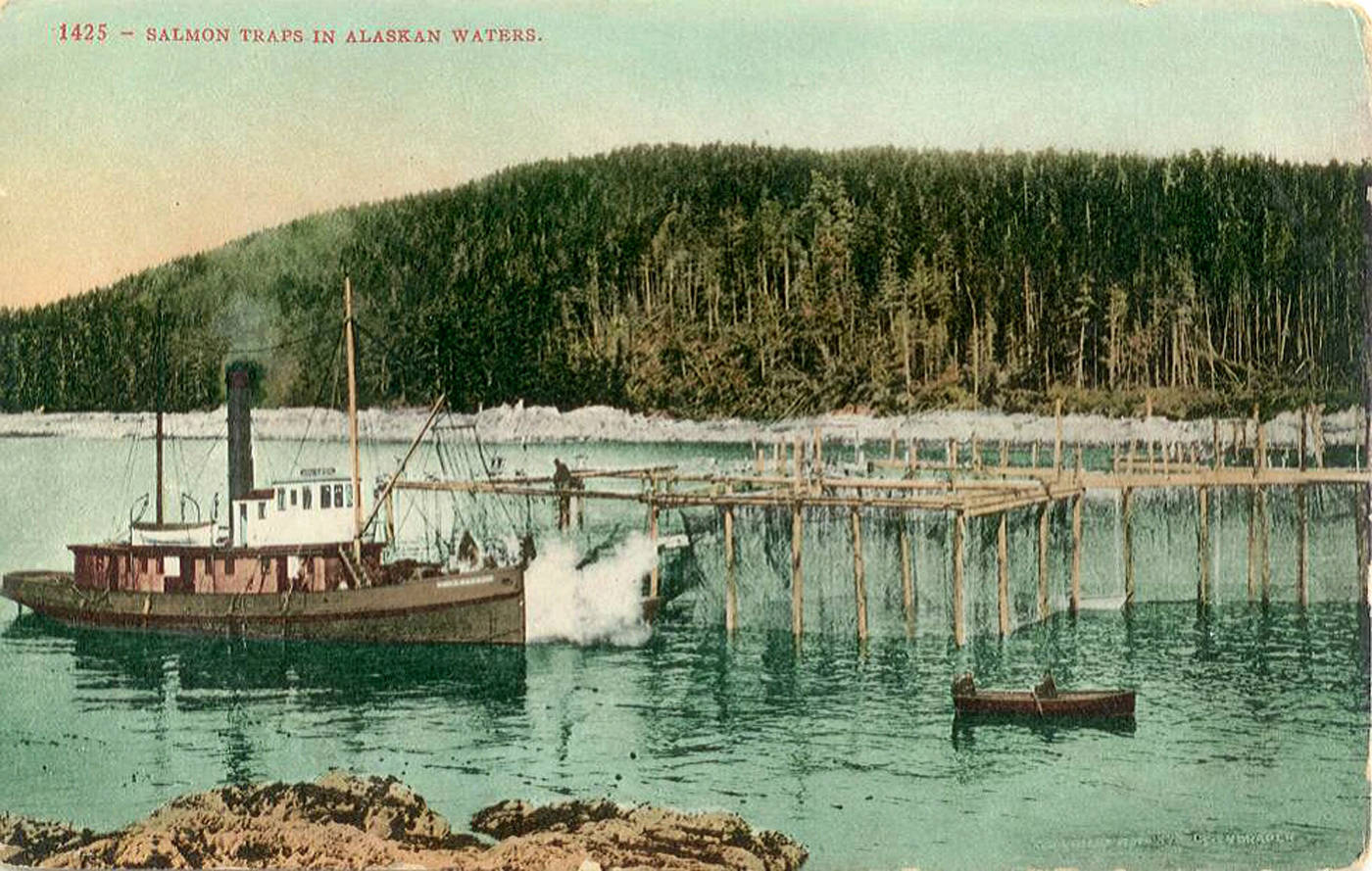
“Steam tug Anna Barron tending a pile trap at the Kitten Islands Outside Funter Bay, from a 1907 Case & Draper postcard.” Alaska Historical Society photo.
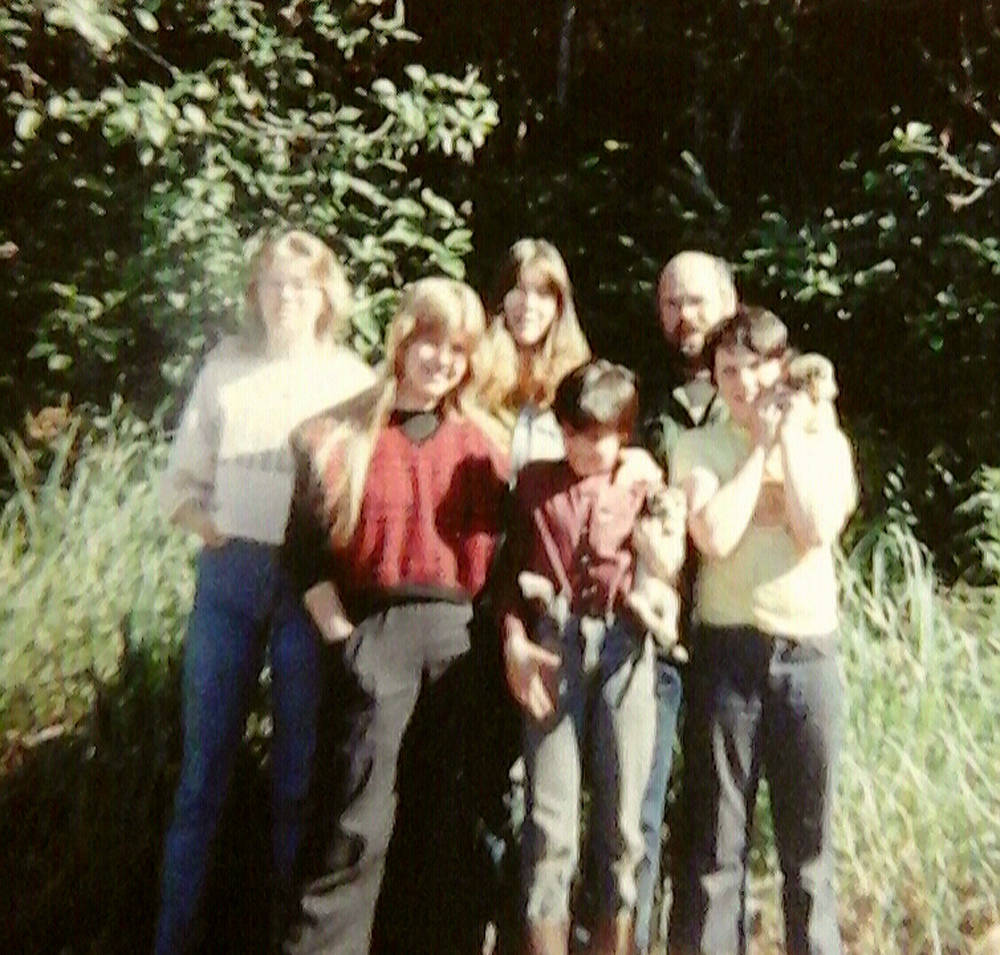
The labor and brains used to construct the Neilson’s kitchen Stonehenge, from left to right, are: Megan, Tara, Romi, Chris, Gary, and Robin. (The author’s oldest brother, Jamie, was away commercial fishing at this time.) Photo courtesy of Tara Neilson
