
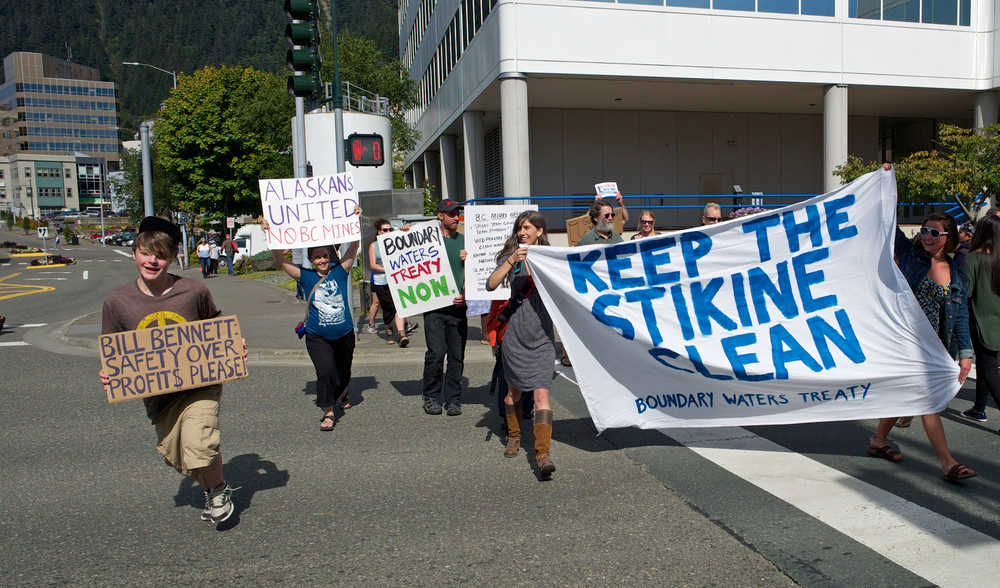
Southeast tribal groups met with officials from the Department of State and the Environmental Protection Agency last week in Juneau and Ketchikan to discuss ongoing issues with Canadian mining projects on Southeast Alaska watersheds.
The Central Council of Tlingit and Haida Indian Tribes of Alaska called for the meetings to address concerns over Canadian mines diverting potentially-toxic water to Southeast Alaska rivers. So-called “transboundary” mines are proposed on the Stikine, Taku, Alsek and Unuk River watersheds.
“What we’re trying to do is elevate our concerns and make sure they’re heard at the appropriate levels,” Central Council president Richard Peterson said in a Tuesday phone interview with the Empire. “We’re not against mining, what we’re concerned about are the mining practices that are proposed. … We’re concerned that all measures are taken and we want to ensure that our voices are heard.”
The meetings focused on preventing harm to Southeast Alaska water quality and salmon habitat. The Central Council asked the EPA to help locate funds for baseline studies on water quality in Southeast Alaska; the studies would be necessary to establish whether Canada’s mines are affecting Alaska’s water quality.
Peterson said they did not ask for “new money” but a “shift in funding to prioritize baseline water quality studies.”
“They are not going to walk away making promises, but I felt they were very responsive in regards to our needs, especially the EPA,” Peterson said. “This is an ongoing process but I hope they come back with some funding identified.”
In addition to asking for research funding, the tribal groups brought up a May 3 report by the BC Auditor General concluding that BC’s mining regulation was insufficient.
“We put forward that we didn’t think BC regulations appropriately represent our concerns,” Peterson said.
Alaska’s congressional delegation asked the State Department in a May 12 letter to consider action through the International Joint Commission, an intergovernmental agency tasked with water disputes between the U.S. and other nations. The State Department declined to pursue IJC action in a June 14 response.
Several tribal groups and Southeast environmental groups also petitioned the Department of the Interior to pursue mediating transboundary mines in a June 27 petition. That request hasn’t yet been answered. The Central Council did not sign that petition.
[Rhetoric ratchets up in transboundary mining battle]
In considering legally-binding mediation through the Department of Interior, Peterson said: “I wouldn’t say that we’re there yet, we’re really at the beginning.”
Organized Village of Kasaan Tribal Vice President Frederick Olsen Jr. said in lieu of legal action from the IJC or the Department of Interior, these meetings do too little to address the problem in a timely manner.
“It’s good to have these meetings, but we need something to happen,” Olsen said. “We need federal engagement, this is an international issue so of course we need international solutions. As good as British Columbia and Alaska are at working together, the things we have aren’t really enforceable. It’s nice to work with your neighbors, it’s nice to agree, it’s nice to say all the right words but the reality is the same, business as usual is continuing. That’s something I felt very strongly to say to them as politely as I could.”
Plans were discussed at the meetings for participation with the Dominion of Canada and the First Nations of British Columbia and the Yukon Territory through a Statement of Cooperation with BC led by Lt. Gov. Byron Mallott. Mallott is currently in the process of drafting the SOC which would provide a non-binding structure to address concerns over transboundary mines.
Peterson said the next step in addressing tribal concerns over transboundary mines is an inter-agency meeting in Washington, D.C. with the Department of Interior, Department of State, EPA and tribal groups.
“We’ve talked about having an inter-agency meeting in D.C. and possibly one in B.C. We’re all actively engaged in this issue, so the next step is a follow-up meeting,” he said.
Olsen Jr. believes last week’s meetings gave federal officials useful firsthand perspective, but that non-binding, good faith agreements with Canadian officials will take too long to protect the Unuk from mining pollution.
“These things take time but we don’t have time in some of these cases,” he said.
• Contact Sports and Outdoors reporter Kevin Gullufsen at 523-2228 or kevin.gullufsen@juneauempire.com.
Correction: An earlier version of this article misidentified the president of the Central Council of the Tlingit and Haida Indian Tribes of Alaska. He is Richard Peterson, not Robert Peterson. The Empire regrets the error.
Related stories:
My turn: Two years later, all is not well following Mount Polley disaster
BC mining minister won’t seek reelection
Tulsequah Chief Mine owner defaults on debt payment, critics wonder about cleanup responsibility
Empire Editorial: On the topic of transboundary mines, a response to Mr. Bill Bennett
