
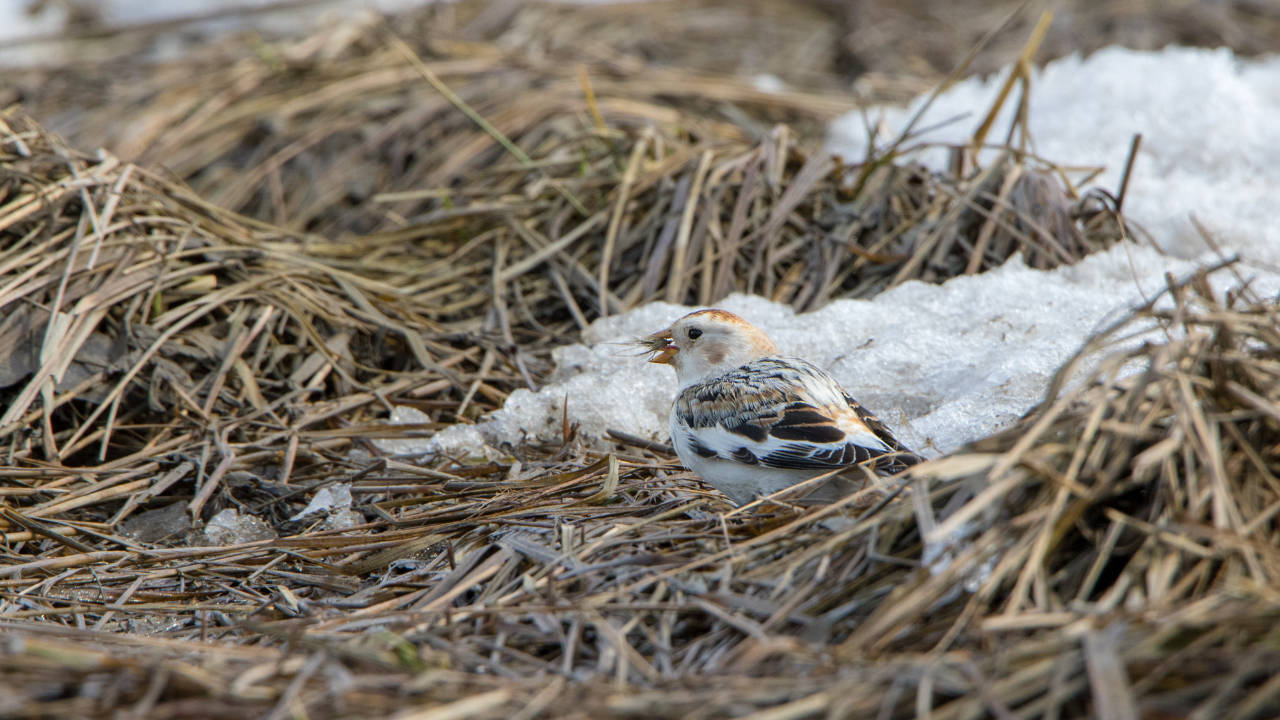
As a few green shoots popped up in intertidal meadows and along the beach fringes in the middle of March, a welcome avian harbinger of spring arrived: a small flock of snow buntings foraged among the dead grasses in the Lemon Creek wetlands. They were probably finding fallen seeds as well as some marine arthropods, such as amphipods.
Snow buntings nest in Arctic regions all around the world, as well as in alpine areas somewhat farther south. In western North America, for example, they have been recorded to nest in the high mountains of extreme northwestern British Columbia and parts of the Yukon. In Alaska, there are alpine nesting records from (for example) Katmai, Kenai, the Alaska Range, and even near the Muir Glacier in Glacier Bay.
Most snow buntings migrate south for the winter, spending several months in southern Canada and the northern tier of the contiguous U. S. However, in our part of the world, they sometimes winter at various places in the Interior of Alaska and the Seward Peninsula. And in the Aleutians and Pribilofs, most of the buntings are reported to be resident all year round, foraging in snow-free alpine areas and in the beach rye near the coasts.
The timing of arrival for northward migrants no doubt varies from year to year, depending on weather and snow cover and who knows what other factors. Sometimes these birds arrive quite early in the season: On the Seward Peninsula, the first migrants might be seen in early March; at Anatuvuk, it might be early April.
Male buntings migrate northward earlier than females, sometimes arriving on their nesting grounds perilously early and becoming victims of late snowstorms that cover the ground where food might be found. However, there are advantages to arriving early and staking out the best nest sites and territories. So if all goes well, the males set up their territories in open country and defend their borders against other males. Females generally arrive a few weeks later. Well before then, the males have lost the brownish edges of their feathers and now sport a resplendent white and black plumage.
Snow buntings like to nest in rock crevices; sometimes the nest is a foot or more deep in a crack, well-concealed and protected from wind (but not from cold). Sometimes a niche under a boulder suffices. If cracks in a cliff or a pile of boulders are not available, buntings may resort to heaps of driftwood or human debris (such as junked cars) or even niches in buildings. Suitable nest sites are thought to be quite limited, which would make it advantageous for males to claim them early in the season. At least in some regions, the territories function chiefly to claim nest sites, and the adults may forage much more widely.
When the females arrive, they no doubt look around at several males and possible nest sites. Eventually, they pair up with their chosen males; buntings are typically socially monogamous—one male with one female, although a rare male might get two mates. Females are said to be very aggressive toward other females, which may reflect the limited availability of nest sites and which may tend to enforce the social monogamy. However, if buntings are like most other birds that have been studied closely, they too sometimes make extra-curricular excursions, so some of the chicks in a nest may have different fathers.
A mated pair checks out possible nest sites together. Then females do the nest-building, generally accompanied by their mates as they gather material. That may reinforce the pair bond and reduce the chances of copulations outside of the pair bond. The number of eggs in a nest varies a lot but apparently is often four to six eggs, the average clutch size increasing slightly with latitude. Females do all the incubating, although at least in some part of the species’ geographic range, males feed their mates while they are sitting on their eggs. Incubation commonly begins before all the eggs have been laid, so some chicks hatch later than others in the same nest. Both male and female feed chicks in the nest, but fledglings are divided into two groups, each one tended by one parent. Males typically take charge of the early fledglings while females stay with the chicks still in the nest.
The role of males in determining the number of chicks produced from a nest can be important, depending on circumstances. For instance, one set of studies showed that when a male fed his mate during incubation, hatching success was improved, compared to nests at which males that did not feed their mates. And in years of poor food supply, widowed females raised fewer chicks, and those chicks were thinner, than the chicks in nests tended by both parents. Some studies have shown that even if chick-feeding rates increase at very low temperatures, that is not enough for the chicks to survive. But still other studies have not found some of these results, indicating that the reproductive success of buntings depends on a variety of factors that vary with place and time.
The nesting biology of snow buntings has been studied is some detail in a variety of places such as Svalbard, Spitzbergen, Greenland, and Nunavut (Canada), but apparently not in Alaska. Given that researchers in the various places at differing times have not always observed the same patterns, it seems that some detailed studies of Alaska populations would be very useful in determining what is happening here.
That is particularly so because the numbers of snow buntings may be declining, at least in North America, although more research is needed to confirm this. On-going climate change and decreasing snow cover in the Arctic may change this apparent trend, provided there are no major ecological problems (such as pesticides) in the wintering range.
• Mary F. Willson is a retired professor of ecology. “On The Trails” appears every Friday. Her essays can be found online at onthetrailsjuneau.wordpress.com.
