
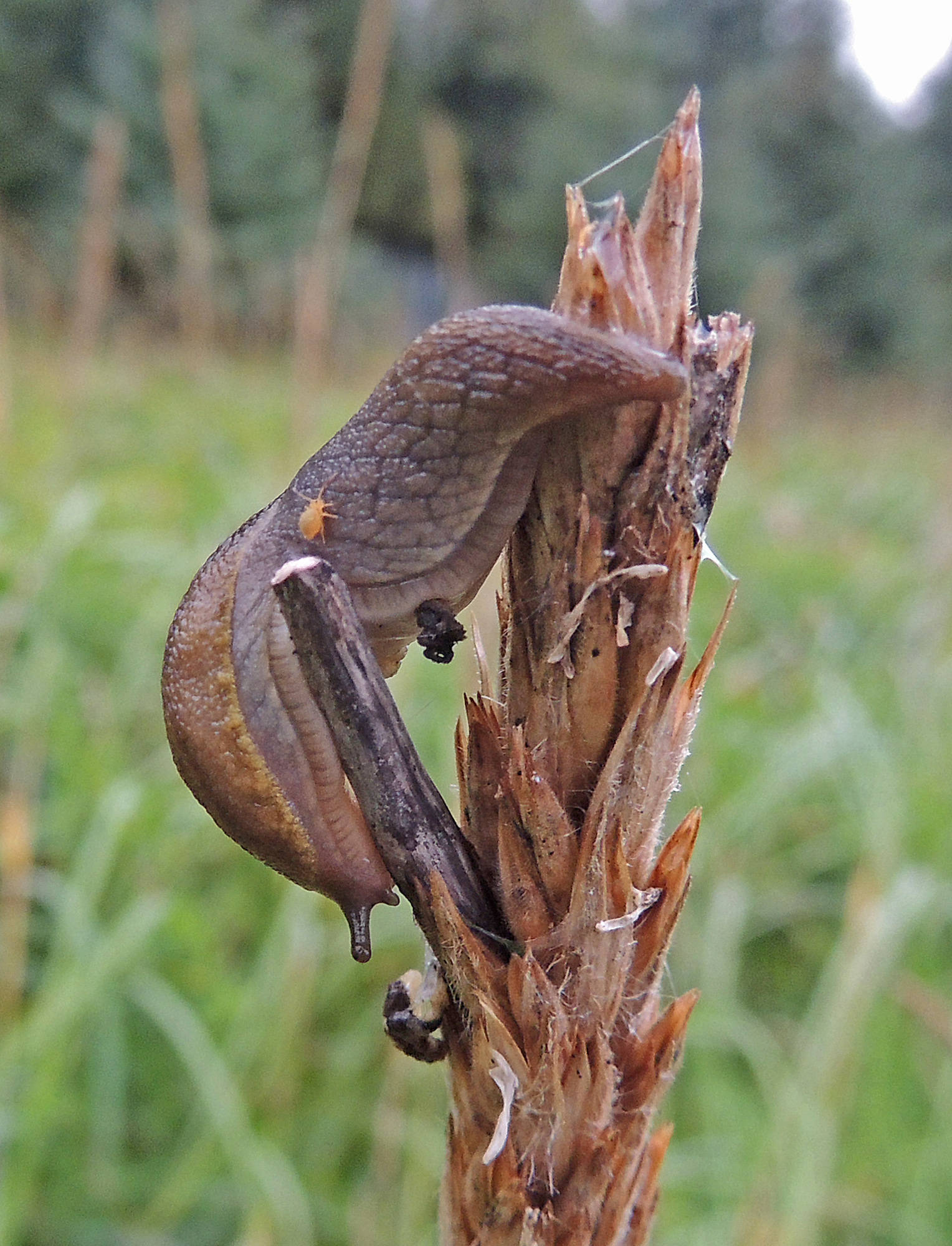
The slug season is upon us, it seems. I recently pulled the first little brown slug off one of my garden plants. There will be more! The proper common name of the small brown slug is reticulate taildropper. It’s one of several species of taildroppers in North America, but this one is native along the West Coast.
They are called taildroppers because they can self-amputate their own tails when attacked by a predator (as can some lizards), leaving a predator with just a twitching tail while the slug gets away. Even if a predator aims for the head end of the slug, a disengaged tail might distract it. These slugs (and lizards) can regenerate the lost tails, a convenience not available to mammals. The slug does not lose any important digestive or reproductive organs in the amputation process; those are at the front end of the slug.
Besides eating our gardens, the little slugs eat almost anything they can reach. We’ve seen them on mushrooms and lichens, on bear scat full of vegetation fibers such as angelica, on various kinds of decaying organic material, on the dead bodies of their comrades … you name it. Sometimes a dozen slugs gather at some luscious pile of bear scat, where there is plenty for everybody. However, conifers and ferns are said to be avoided.
When I find these slugs on my so-called garden (pretty much a care-free establishment, I fear), I fling them into my pond. They are air-breathers, so presumably some of them drown. The ducks may nab a few. Slugs can swim, I’m told, so maybe some of them make it back to shore to try again in the garden.
Our other native slug is the much larger banana slug (possibly the only slug to be chosen as the mascot of a college team). Banana slugs got their name because, down California-way, they are usually bright yellow, but up here they are more usually a sort of olive green, often with dark gray blotches. This is another West Coast species, with relatives elsewhere in North America.
The diet of banana slugs is much like that of the small brown one … almost anything goes. They both have “tongues” like small files, studded with many tiny teeth, and they rasp any tasty item into fragments that can be swallowed. In addition to the usual fare, banana slugs are known to eat salmonberries, swallow the seeds, and disperse them to some (usually rather short) distance before defecating them along with their digested dinners; the seeds that pass through a slug’s gut are capable of germination.
Like their smaller relative, banana slugs are hermaphroditic (both male and female) and mating, after a long courtship, is often reciprocal, each one of a pair fertilizing the eggs of the other. Fertilization is internal, and sometimes the pair has difficulty disengaging from each other. When that happens, the inserted, stuck penis is chewed off and sometimes eaten, a behavior that has generated quantities of internet interest but relatively little rigorous scientific study. The process of regeneration is not reported to be available in this case, so apparently the thus-deprived partner can thereafter mate only as a female.
Eggs are typically laid in clusters, in damp places such as under logs or a pile of rotting vegetation. They take several weeks to hatch. During that time, they are very vulnerable to desiccation, more than juveniles or adults, simply because they cannot move to more salubrious locations.
One of the distinguishing features of slugs is their slime or mucus. Most humans find slimy slugs “yucky” to touch. Other predators probably find the slime repellent too. Slugs actually produce several kinds of slime. There’s a thick, gummy one for protection and ones of different texture and composition for traveling. The slime allows a slug to travel up vertical surfaces and even slide along upside down on a ceiling. Banana slugs can make a slime cord on which to descend from high places less laboriously than crawling. Slime also protects the soft, shell-less slug body from dehydration and may carry reproductive signals as well. Versatile stuff!
In addition to those two native species, I have seen another kind of slug in several parts of Southeast. This is the furrowed slug or the black slug, a hitchhiker from Europe that presumably arrived on shipments of garden plants or in vehicles or cargo. It’s a chunky little beast, and the rear part is grooved or furrowed. The color can be a beautiful glossy black or a sort of reddish brown. They might compete with banana slugs, perhaps driving the banana slugs into less preferred habitats, but more research is needed. Some people believe that this slug causes more damage to gardens than the native species.
• Mary F. Willson is a retired professor of ecology.
