
By Geoff Kirsch
For the Juneau Empire
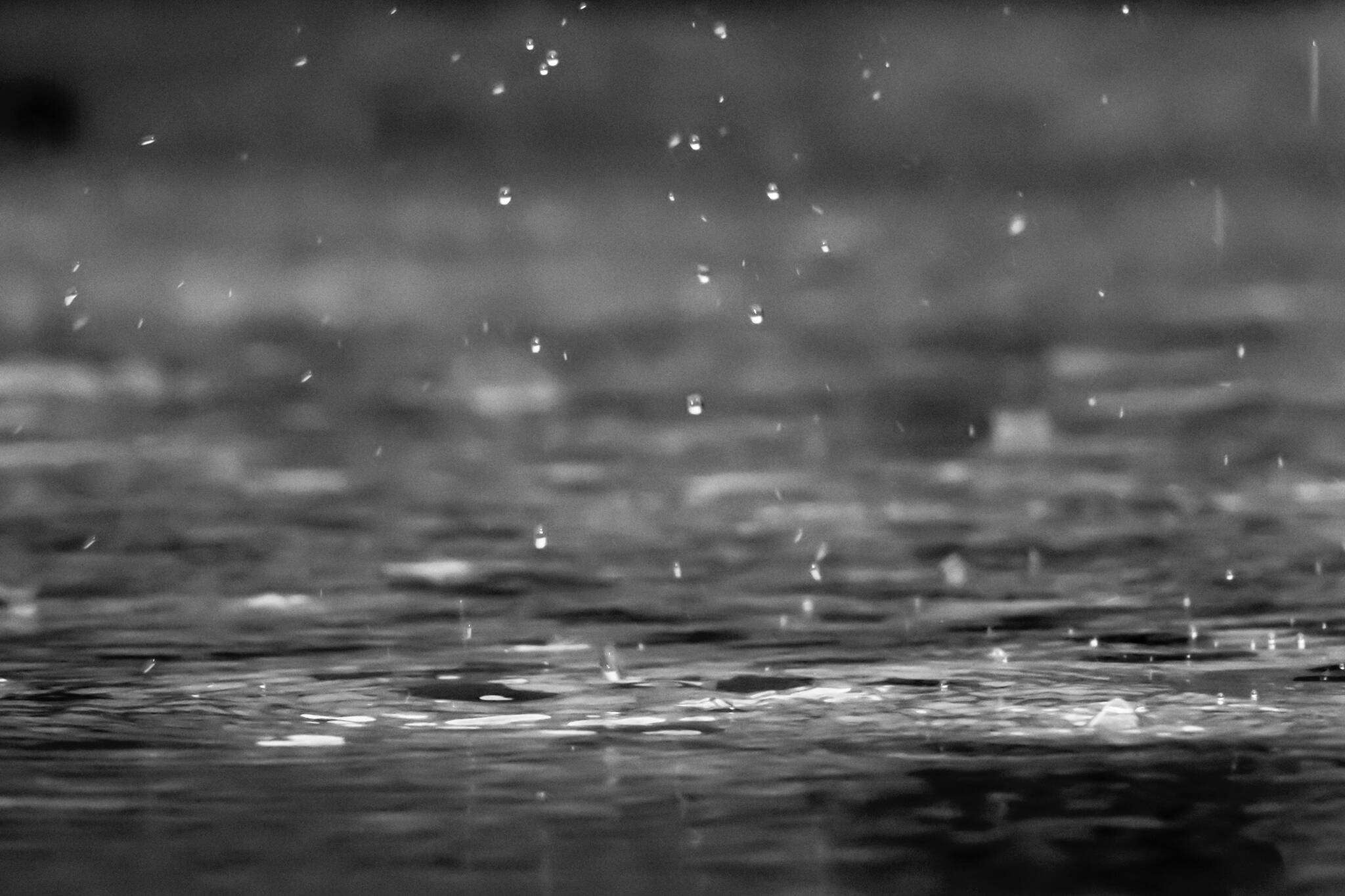
Rain is a state of precipitation in the form of liquid water, or, as some Alaskans like to call it “liquid sunshine.” I low-key hate that kind of cheery optimism.
A prime component of the water cycle, rain is responsible for depositing most of the fresh water on our planet. In Alaska, it’s also responsible for washing most of the cars.
Every year, the earth receives 121,000 cubic miles of rain, 95,000 cubic miles of which falls over oceans. Kind of makes you feel better about peeing off the side of the boat, right?
Cherrapunji, in the Indian Himalayas, is the rainiest place on earth, with an average rainfall of 450 inches—anyone else feeling a little rain envy? The rainiest place in Alaska is Little Port Walter on Baranof Island… or wherever you happen to be holding your outdoor event on any given day.
Rain is caused by moisture traveling along zones of differing temperatures and pressures. It’s also caused by deciding—what the hell?—not to put up the rainfly on your tent.
[Everything you wanted to know about snow…and less]
Raindrops, themselves, form when water vapor in the air condenses until it becomes heavy enough to fall to earth. Or, whenever it’s a weekend, all weekend long, until the exact stroke of 9 a.m. Monday.
Contrary to popular belief, raindrops are not shaped like teardrops. They actually look more like tiny hamburger buns, which makes sense, considering how strongly you crave French fries every time it rains.
Rain falls at “terminal velocity,” the maximum speed a falling object’s medium will allow. “Terminal Velocity” can also refer to a 1994 film starring Charlie Sheen, Nastassja Kinski and a rather trim James Gandolfini (with hair!). What does this have to do with rain? Nothing. But it’s got a killer final action sequence involving a shootout in the front seat of a Cadillac as it free-falls out the back of a cargo plane.
Anyway…
A rainfall’s intensity and duration tend to be inversely related — intense storms are usually short-lived, while low-intensity storms can last days, even weeks. This phenomenon is known as “tantric rain.”
Meteorologists classify rainfall intensity using the following scale: Light; Moderate; Heavy; Violent and August 2021.
Globally, rain tends to fall in seasonal patterns. Of course, in some places, every season is rainy season. Some people like it that way. Radiohead fans, for instance.
Rainfall also varies from region to region, and even location to location within a region. For instance, in Alaska, Juneau averages 50 inches a year, while other parts of the Panhandle can receive more than 275 inches. Anyone else feeling rain envy?
Also, all across the Alaska, La Nina events lead to drier than normal conditions, while El Nino events actually show no correlation either way. Go ahead and tell that to the know-nothing know-it-all at the next soggy bonfire who keeps going on and on about El Nino like he was its “padre.”
However, Alaska’s precipitation can increase by as much as 40% when a measurement known as the “Pacific Decadal Oscillation” is positive; this is determined by having the Pacific Ocean pee on a stick.
Rain is believed to exist on other planets, where it may be composed of methane, neon or sulfuric acid or iron falling at temperatures approaching 3000 degrees Farenheit. No matter how cruddy the weather, at least it’s not raining sulfuric acid and molten iron. Not even those fancy $350-a-square-foot roofing panels would stand up to something like that.
Although, on the other hand, for those who spent August 2021 in Southeast Alaska, a few scattered sulfuric acid and molten iron showers might prove a welcome change. And at least it’d be a warm rain.
• Geoff Kirsch is an award-winning Juneau-based writer and humorist. “Slack Tide” appears twice monthly in Neighbors.
